







What do the Manner incidents reveal about barista work?
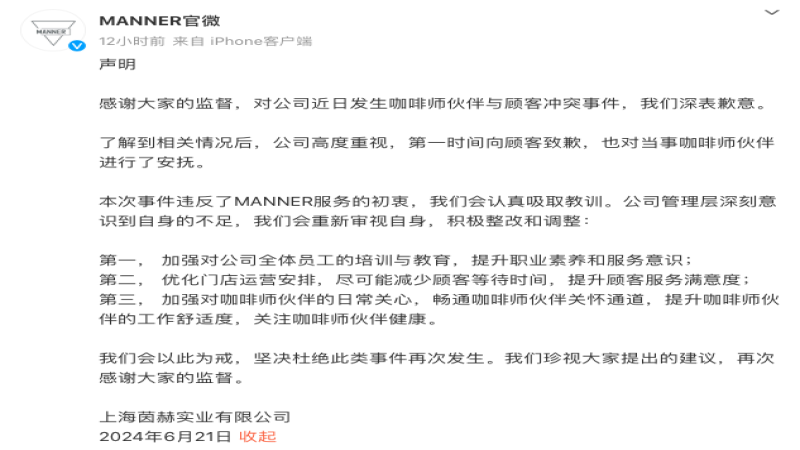
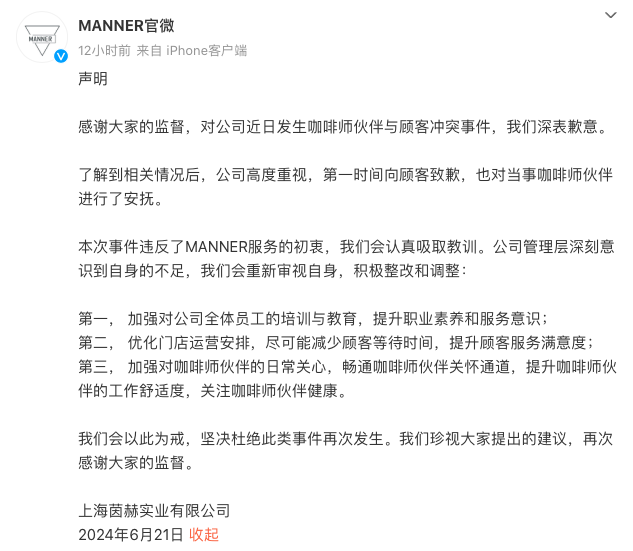
Manner Coffee apologized on Weibo after three staff-customer conflicts erupted over two consecutive days in June. The statement promised reforms and listed improvement measures, but drew criticism for not clearly addressing a case in which a customer entered the bar area and assaulted a staff member. Manner's two Douyin accounts were also cleared of content.
Media investigations and former employees described high-intensity work, heavy psychological pressure, and what they called an unreasonable compensation system under rapid expansion. Manner is among the few chains with over a thousand stores that still uses semi-automatic machines, and balancing efficiency, drink quality, espresso machine operation, and staff rights is now the pressing issue.
Manner Coffee was thrust into the spotlight after three incidents of conflict between staff and customers occurred over two consecutive days. The brand issued an apology statement via its official Weibo account that evening, promising reforms, but netizens did not accept the content of the statement, especially expressing dissatisfaction over the lack of a clear response to the incident in which "a customer entered the bar area and assaulted a staff member." Meanwhile, the content of Manner's two official Douyin accounts has been completely cleared, sparking further speculation. Behind the incidents, media investigations and revelations from former employees exposed that under Manner's rapid expansion, frontline baristas face high-intensity work, heavy psychological burdens, and an unreasonable compensation system. As one of the few brands in the industry with over a thousand stores that still insists on using semi-automatic espresso machines, how Manner can strike a balance between efficiency, quality, and employee rights has become an urgent issue to address.
▲
Click to follow | Daily specialty coffee culture magazine Coffee Workshop
The Manner staff-customer conflict saga that lasted two days finally saw new developments at around nine o'clock last night. The brand's official Weibo posted a formal statement, publicly apologizing for the three incidents that have been continuously exposed recently. In the statement, Manner acknowledged that these situations deviated from the brand's original service philosophy, and stated that it would re-examine its own problems, actively push forward with rectification and adjustments, and listed specific improvement measures.
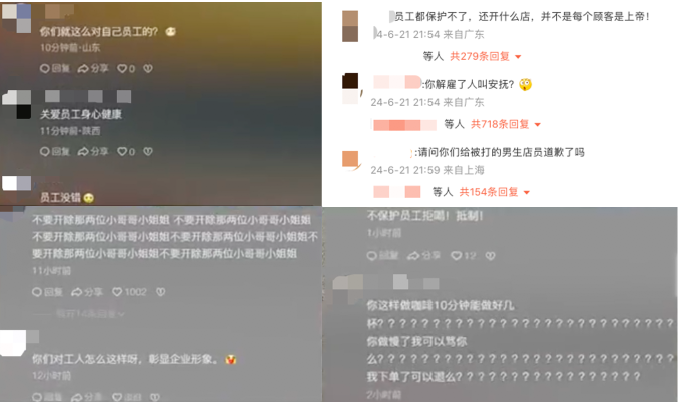
However, this apology did not quell netizens' anger. Although Manner had previously responded to the two conflicts that occurred on June 17, regarding the incident that sparked widespread discussion yesterday—"a customer entering the bar area and assaulting a staff member"—the statement neither gave a clear explanation nor published any investigation conclusions. This evasive attitude deeply disappointed netizens who were concerned about the subsequent situation of the two staff members.
The comment section was quickly flooded with voices speaking up for the staff: "Firing them is what you call comforting?" "Have you apologized to the male staff member who was beaten?" Such questions could be seen everywhere. Some netizens also moved to Manner's two official Douyin accounts and continued to post a large number of critical comments.
However, a Blue Whale News reporter noticed that the content of Manner's two official accounts on the Douyin platform has been completely cleared, and the comments previously posted by netizens supporting the staff and accusing the brand of failing to protect its employees have also disappeared.
Manner, at the center of public opinion, became the target of widespread criticism. Follow-up reports by multiple media outlets and successive revelations from former employees have allowed more people to see the chronic problems hidden in its corporate culture—a high-intensity work pace, tremendous psychological pressure, less-than-generous pay levels, and unreasonable institutional design.
According to a report by Phoenix News' "Storm Eye," in order to keep the 1,000-yuan full attendance bonus, Manner employees often come to work on an empty stomach and work eight hours straight. Coupled with having to handle a workload far beyond what an individual can bear each day, over time employees become physically and mentally exhausted and find it hard to keep going.
As for the 8,000-yuan high salary for Manner baristas listed on recruitment platforms, multiple former employees revealed in media interviews that it can only be reached after passing internal promotion assessments.
But employees said, "Only five percent of those who work more than half a year can pass the assessment."
Therefore, before passing the assessment, most employees actually take home around 5,000 yuan. The brand also deducts work hours and overtime pay in various ways, causing employees to put in more labor without receiving the pay they deserve.
Industry insiders pointed out in an interview with Southern Weekly that the biggest difference between Manner and other chain brands is that its baristas use semi-automatic espresso machines: "Among those in the industry with more than a thousand stores that still use semi-automatic espresso machines, it may be the only one left."
Although semi-automatic espresso machines can extract higher-quality coffee, they pose a certain threshold for baristas' operation, involve more steps in making drinks, and are clearly less efficient in output than fully automatic machines. Therefore, if a store using semi-automatic espresso machines is required to produce three to five hundred cups a day, the barista is like a worker on a factory assembly line—both monotonous and extremely prone to fatigue.
But it is precisely this differentiated positioning that made Manner stand out among many brands, attract investors' attention, and secure multiple rounds of financing. Because of this, Manner, which had opened only three stores in Shanghai in its first three years of entrepreneurship, obtained expansion capital and embarked on a path of rapid store expansion.
However, as store scale continued to expand, the problem of understaffing gradually surfaced. The brand once tried to ease baristas' work pressure by adding part-time workers, but untrained part-time staff could only handle auxiliary tasks such as taking orders and packaging, and were not allowed to participate in drink preparation. So although hiring part-timers could reduce some of the baristas' burden during peak hours, it could never solve the problem at its root, and the heavy burden on baristas remained.
In a coffee market pursuing high efficiency and low prices, Manner wants to satisfy market demand and improve operational efficiency, while also maintaining its "specialty coffee" brand style, and at the same time hopes to cut costs and expand profits. This "want it all" approach ultimately translated into unbearable work pressure for frontline employees, forcing them to vent their accumulated dissatisfaction in such intense ways.
These three conflicts undoubtedly sounded a warning bell for Manner: while pursuing multiple goals, it must also find a balance between expansion speed, staffing efficiency, and service quality, so as not to cause deeper negative impacts on its brand image.
Image source: Internet
Disclaimer: Some images in this article are from the Internet. For some content on the website, such as images, we will respect the original author's copyright and indicate the source. However, due to the large quantity, some images and texts may not have been credited in time. Please forgive us. If the original author has any disputes, they may contact the website for handling. Once verified, we will correct it immediately. Compiled and edited by "Coffee Workshop." Please indicate the source when reprinting. If there is any infringement, please inform us for deletion. Thank you~!
The above content is compiled by CoffeeHunters, a coffee news website.


