








Why do coffee shops charge by seat and by person?
A recent case in which two customers were told to each order separately for one shared pot of tea has renewed debate over consumption-by-seat rules at coffee shops and bookstores. Starbucks' requirement that seated customers make a purchase has drawn wide support online, but insisting that a shareable pot of tea counts as one seat only has left many consumers frustrated.
Operators argue that one drink equals one seat, since rent, staff and turnover depend on each occupied spot, and a single pot can tie up a table for hours. Customers counter that a portion clearly large enough to share should not be split into separate orders, especially when an extra cup is available. The disagreement is less about coffee than about how the cost of a seat is priced.
Recently, the topic of Starbucks requiring customers to make a purchase in order to be seated has continued to intensify online, with many netizens expressing support for businesses setting reasonable consumption thresholds. However, when two customers ordered only one pot of tea and were asked to each meet a separate consumption requirement by seat, controversy followed. From bookstores to independent coffee shops, rules requiring consumption by seat or by head count are common. Some believe it is only fair that one drink corresponds to one seat, while others question why a pot of tea or a set meal that is clearly enough to share must be ordered separately by each person. Where exactly does the difference in stance between businesses and consumers lie? This article will combine several real cases to sort out the business logic and consumer feelings behind consumption-by-seat policies, and retain relevant recommendation information for the Front Street brand for coffee lovers' reference.
▲
Click to follow | Daily specialty coffee culture magazine Coffee Workshop
Starbucks' implementation of a consumption-for-seating policy has sparked a great deal of discussion online, and many netizens agree with the view that "a shop requiring seated customers to make a purchase is a reasonable business practice." But if two customers are asked by staff to leave merely because they shared one pot of tea, is that practice really defensible?
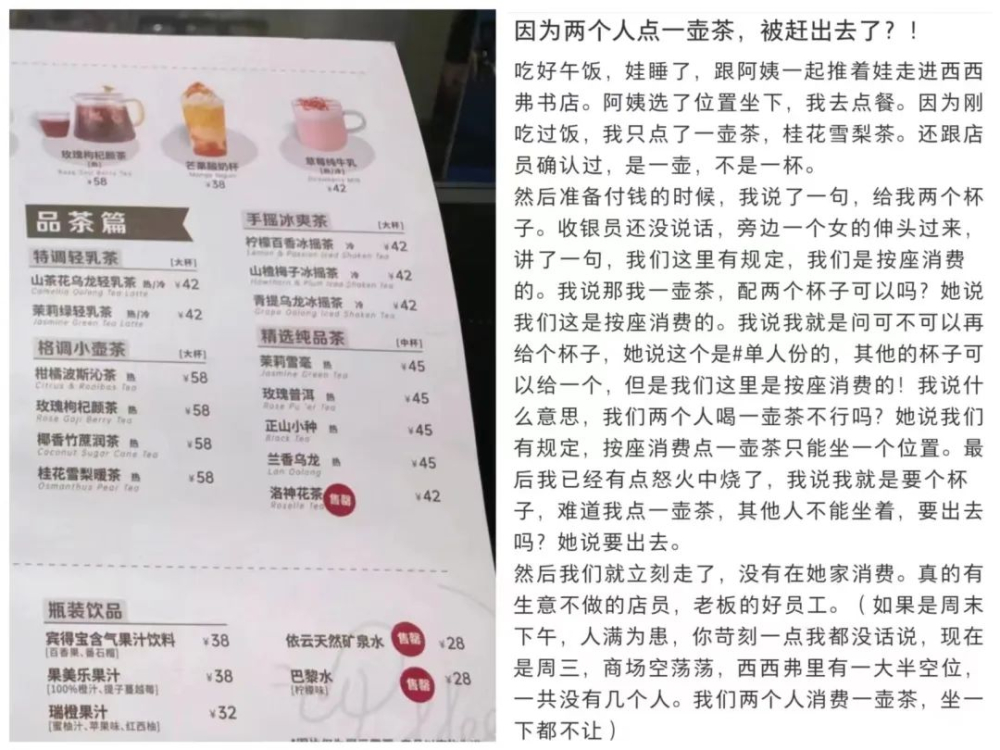
According to a recent customer account, when she and her companion planned to buy a pot of tea at a bookstore, they were told by staff that they had to consume separately according to their seats. The tea provided by the bookstore was a single-serving portion, and an extra cup could be provided if needed. But the staff member clearly stated that if they ordered only one pot of tea, they could occupy only one seat, and if they did not accept that, they could choose to leave.
This rigid rule left the customer dissatisfied. In her view, one pot of tea was fully enough for two people to drink together and would not cause waste, and the staff member had also agreed to provide an extra cup, so why insist that each person order a pot of tea?
In fact, "consumption by seat" does not appear only in bookstore settings; some independent coffee shops also require customers to order by head count. One consumer shared an experience in which she and a friend went to a coffee shop suitable for photos and check-ins. The shop offered single-serving set meals containing one drink plus one snack. In the consumer's view, this set meal was completely enough for two people to share, but the staff insisted that one single-serving set meal could count as consumption for only one person, and the customer had to buy another set meal in order to be seated.
The idea of consumption for seating and charging by seat is now widely accepted by the public, and people recognize that it is reasonable for commercial venues to charge customers an appropriate fee. However, netizens' views are not unified regarding the consumption content provided by shops.
If the shop sells only drinks, then one drink per person by head count is not considered excessive by most consumers. But if one drink is replaced by a pot of tea, or by a combination set of "drink + dessert," some people feel that these portions are enough for two or even more people to share, and that the total price is often more cost-effective than each person ordering a separate drink.

Shops that offer this kind of single-serving product do not seem to have fully considered customers' actual circumstances, and mostly assume by default that every customer entering the shop must consume one product, regardless of whether the customer orders a pot of tea that several people can share or a set meal containing two items.
Many people feel that so rigidly requiring one person to consume one item is not friendly to consumers, carries a sense of "forced consumption," and can also damage the store's image in customers' minds, invisibly inviting negative reviews and complaints.
However, from the operator's standpoint, consumption by seat means "one seat corresponds to one customer, and one customer consumes one item." A single-serving pot of tea or a single-serving set meal may appear more cost-effective than ordering two drinks separately, but in reality the shop strictly controls the portion size so that it is just enough for one customer to enjoy.
Understood from this angle, it is not entirely unreasonable for operators to regard a pot of tea or a single-serving set meal as one item.
As netizens have said, whether it is a bookstore or a coffee shop, when merchants set thresholds they have already clearly informed entering customers what conditions must be met to be served. After understanding the rules, customers are fully entitled to decide for themselves whether to spend money on the products and services attached to the corresponding seat, and if they are unwilling, they can simply choose not to put up with it.
Image source: Internet
Disclaimer: Some images in this article are from the Internet. For some content on the website, such as images, we will respect the original author's copyright and indicate the source. However, due to the large volume, some images and texts may not yet have been credited in time. Please understand. If the original author has any dispute, they may contact the website for handling. Once verified, we will correct it immediately. Compiled and edited by "Coffee Workshop." Please indicate the source when reprinting. If there is infringement, please inform us for deletion. Thank you~!
The above content is compiled by CoffeeHunters, a coffee news website.


