







What Does the Latest USDA Report Say About Global Coffee Exports?
The USDA's Coffee: World Markets and Trade report projects global coffee production at 176.2 million bags in 2024/25, up 7.1 million bags from the previous year, driven by Brazil's recovery and Indonesia's rebound. Rising supply is expected to push global coffee exports up by 3.6 million bags to 123.1 million bags, even as Vietnam's export forecast was revised down on drought and higher domestic use.
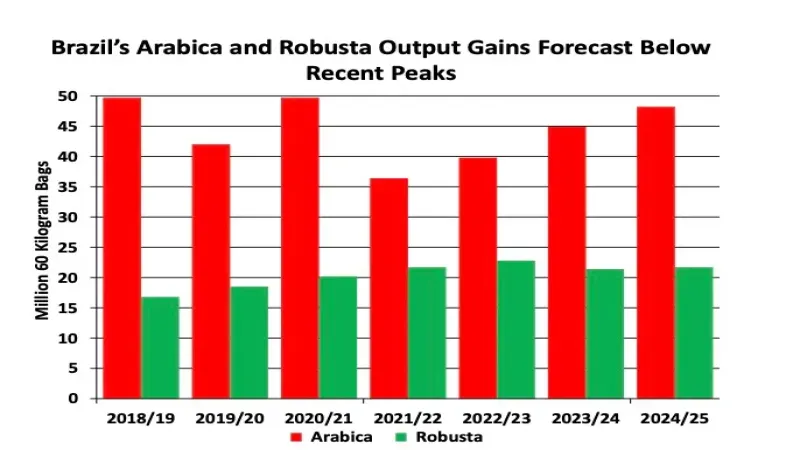
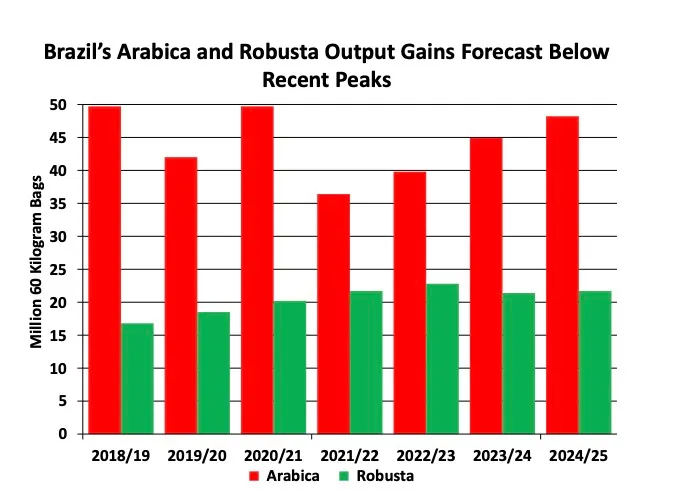
Brazil's coffee production is forecast at 69.9 million bags, including 48.2 million bags of arabica and 21.7 million of robusta, with exports reaching 42.5 million bags despite variable weather in early 2024. Colombia is recovering slightly but faces pest concerns, Central America is broadly flat, and Indonesia's robusta gains do not offset Vietnam's shortfall, leaving overall coffee production growth concentrated in a few origins.
The U.S. Department of Agriculture recently released its Coffee: World Markets and Trade report, providing forecasts for global coffee production, consumption, and trade in the 2024/25 marketing year. According to the report, thanks to Brazil's ongoing production recovery and Indonesia's rebound, global coffee production is projected to increase by 7.1 million bags from the previous year to 176.2 million bags. Rising supply will also drive global coffee exports up by 3.6 million bags to 123.1 million bags. By region, Brazil is seeing notable gains, Colombia is recovering slightly but faces pest concerns, Central America is broadly flat, and Indonesia's robusta increase is not enough to offset Vietnam's shortfall. Although Vietnam's production is unchanged, rising domestic consumption and drought impacts have led to a downward revision in its export forecast. The detailed report follows.
Recently, the U.S. Department of Agriculture released its Coffee: World Markets and Trade report. The report forecasts that global coffee production in 2024/25 will increase by 7.1 million bags from the previous year to a total of 176.2 million bags.
This growth is mainly attributed to the continued recovery of Brazil's coffee production and a rebound in Indonesia's output. Along with rising supply, global coffee exports are expected to increase by 3.6 million bags to 123.1 million bags.
Focusing on Brazil, the country's total coffee production in 2024/25 is forecast to rise by 3.6 million bags to 69.9 million bags. Among this, arabica coffee production will climb to 48.2 million bags, while robusta coffee production will grow to 21.7 million bags. Driven by increased supply, Brazil's coffee exports will also rise to 42.5 million bags.
Although Brazil experienced variable weather in the first half of 2024, with some regions hit by high temperatures and little rain while others saw frequent heavy rainfall, the overall impact was limited. This is thanks to the high technical standards in some Brazilian states, where irrigation can alleviate drought pressure. In addition, Brazil's continued expansion of coffee planting area in recent years has also supported production growth.
In Colombia, the El Niño phenomenon has affected local coffee-growing areas since 2023 and continued into the first half of 2024.
However, the impact of El Niño gradually weakened earlier this year, and Colombia's coffee production has rebounded slightly in recent months. The report therefore forecasts the country's coffee production at 12.4 million bags. But sources indicate that the local coffee berry borer infestation rate is on the rise, and 12.4 million bags may be the recent production peak. Under current conditions, Colombia's coffee production is unlikely to return to the highs seen during 2011-2013. Exports, driven by increased supply, will reach 10.8 million bags.
Among other Central American countries, only Mexico's coffee production increases by 30,000 bags to 3.9 million bags, while Nicaragua's coffee production is expected to rise by 300,000 bags to 2.7 million bags. Production in Costa Rica, El Salvador, Guatemala, Honduras, and Panama remains basically flat compared with before. As a result, the region's exports will rise to 13.4 million bags.
Good news comes from Indonesia, where coffee production is expected to increase by 2.8 million bags to 10.9 million bags. Although coffee crops suffered heavy rainfall during the growing period last year and pollination conditions were unfavorable, the lowland areas of southern Sumatra and Java were not affected. Favorable weather conditions pushed robusta coffee production up by 2.7 million bags to 9.5 million bags, and exports also rose to 6.5 million bags.
However, even with Indonesia's robusta increase, it cannot fully make up for the shortfall caused by Vietnam's reduced robusta production. The report points out that Vietnam's coffee production will reach 29 million bags, unchanged from last year's figure. But with rising domestic coffee consumption in Vietnam, exports will decrease by 500,000 bags to 24.4 million bags.
In addition, Vietnam was still plagued by drought in the first half of the year, with temperatures in many production areas above average, the rainy season arriving late, and rainfall during the rainy season also below average. Vietnam also faces long-term issues such as insufficient groundwater, reduced forest cover, and competition from other crops. However, the government is rolling out a sustainable coffee production strategy, which is expected to improve future production.
The above content is compiled by CoffeeHunters, a coffee news website.


