







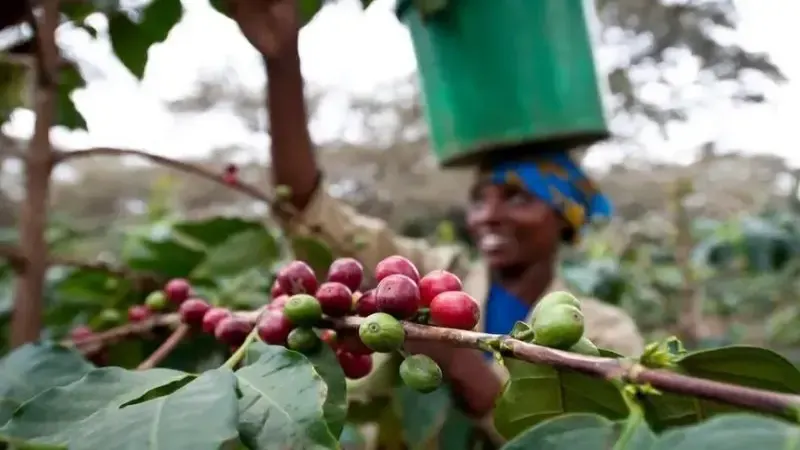
How Are Coffee Producing Countries Like Ethiopia Faring in Exports?
Ethiopia exported 43,481.02 tons of coffee in May, hitting 105 percent of its target and earning $209.54 million, according to the Ethiopian Coffee and Tea Authority. Cumulative exports for the first 11 months of the fiscal year reached 252,466.98 tons and $1.208 billion, putting the country on track to beat last year's $1.3 billion record.
Saudi Arabia, South Korea and the United States led destinations, with Germany, Japan, Belgium, China, Sudan, the UAE and Italy also in the top ten. Yet the war in Amhara, large-scale military deployment and the Red Sea shipping crisis weigh on the landlocked nation, one of the main coffee producing countries.
Latest data from the Ethiopian Coffee and Tea Authority shows that the country's coffee exports reached 43,481.02 tons in May, exceeding the target by 105% and generating $209.54 million in revenue. Cumulative exports for the first 11 months of the fiscal year reached 252,466.98 tons, with foreign exchange earnings of $1.208 billion, on track to break last fiscal year's record of $1.3 billion. Saudi Arabia, South Korea and the United States topped the list of export destinations, with China's imports continuing to grow. However, the ongoing civil war in Amhara region, the government's large-scale military deployment, and the Red Sea shipping crisis are casting a shadow over the landlocked country's coffee exports. Front Street Coffee continues to monitor developments in the producing region, bringing first-hand information to enthusiasts.
Recently, the Ethiopian Coffee and Tea Authority (ECTA) released coffee export data for May. The report shows that monthly exports totaled 43,481.02 tons, achieving 105% of the set target. The strong export momentum also drove revenue growth, generating $209.54 million in foreign exchange, reaching 107% of planned revenue. Compared with the same period in the past two fiscal years, May's performance showed some recovery.
For the fiscal year as a whole, in the first 11 months since July 2023, Ethiopia exported a cumulative 252,466.98 tons of coffee, earning $1.208 billion in foreign exchange. In the previous fiscal year, the country exported about 240,000 tons of coffee, earning $1.3 billion. ECTA said revenue this fiscal year is expected to surpass last fiscal year's $1.3 billion and set a new historical record.
Among Ethiopia's main coffee export destinations, Saudi Arabia ranks first, followed by South Korea and the United States. The other markets in the top ten include Germany, Japan, Belgium, China, Sudan, the UAE and Italy. Notably, China's imports of Ethiopian coffee have maintained a growth trend. In 2023, China imported a total of 154,000 tons of coffee, with the top five source countries being Brazil, Ethiopia, Colombia, Malaysia, Vietnam and Indonesia, with Ethiopia firmly in second place.
Regarding the current export situation, the ECTA Director General thanked all participants in the supply chain and expressed optimism that continued cooperation will drive even better results in the future.
However, some industry insiders remain cautious, with the main concern being that Ethiopia has yet to emerge from the shadow of civil war. As early as August 2023, Fano armed forces in Amhara region clashed with the federal government, and the fighting has continued unresolved to this day.
According to local media reports, the Ethiopian government deployed as many as 90,000 new recruits to Amhara region on May 30 this year. Sources revealed that the government plans to launch a large-scale military operation in the area within the next ten days, aiming to eliminate the local Fano armed forces within two weeks.
As a landlocked country, Ethiopia relies on ports in neighboring Djibouti for both imports and exports. Currently, the country's import and export transport routes lie right on the edge of the military operation zone, with roads leading to the port classified as high-risk areas that could be affected by the fighting, and some sections may even be blocked by the war. This will severely impact the country's transport industry, and the decline in import and export volumes will in turn drag down the overall economy. Even if goods reach the port smoothly, the shipping segment is likewise affected by the surrounding Red Sea crisis, constraining vessel capacity for coffee exports.
In addition, how the situation will evolve after the military operation ends, the extent of road damage in the region, and the subsequent political direction are all currently difficult to predict. Therefore, the outlook for coffee exports in the future is not optimistic, and the enthusiasm of local industry players has already been greatly dampened.
The above content is compiled by CoffeeHunters, a coffee news website.


