







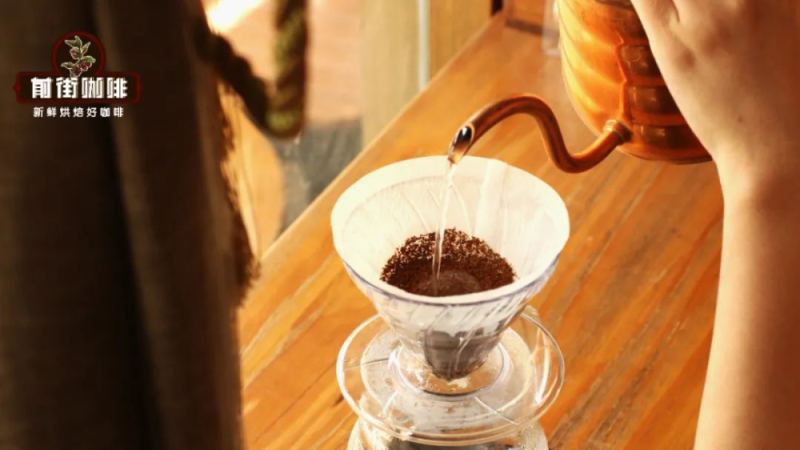
How do you make iced pour-over coffee at home?
A workable iced pour-over uses one part coffee powder, ten parts hot water, and five parts ice. That single ratio covers most beans and setups. Grind slightly finer than for hot pour-over to offset the ice, which dilutes and slows extraction, and keep the coffee bed even while pouring.
For a simpler route, Tetsu Kasuya's one-pour iced method skips multiple pulses and finishes in a single pour. Home brewers who also use a stovetop pot should note how long does moka pot take to brew, because heat and timing differ from a pour-over kettle. Both routes end with a chilled cup that keeps flavor while staying light.
A glass of iced pour-over in summer always brings a uniquely refreshing experience, but many coffee lovers encounter all kinds of questions when trying to replicate it at home: How should the ratio of coffee powder, water, and ice be balanced? What water temperature should be used? What are the particular requirements for pouring technique? Front Street Coffee, drawing on practical experience from its stores, has summarized a simple and easy universal formula for iced pour-over—coffee powder paired with 10 times hot water and 5 times ice, while also providing a grind-size adjustment solution for the problem of under-extraction. In addition, it has also compiled Mr. Tetsu Kasuya's "one-pour iced pour-over" method, which is more direct to operate and suitable for friends seeking convenience. The full text covers specific parameters, operating steps, and flavor descriptions to help you easily make a café-quality iced pour-over.
Many friends, when walking into a café to order, always carry a learning mindset, paying attention to every movement and step of the barista while quietly inquiring about various parameter details, hoping to recreate the same taste at home.
Take Front Street's stores as an example. Whenever iced coffee is being made at the bar, customers who gather around not only stare intently at the pouring kettle and the changes in the coffee bed, but also often throw out all kinds of questions: How many grams of powder were used for this cup? How much ice and water are added? Does putting the ice in first or later give a better taste? What temperature is the water controlled at? Are there any special technique requirements when pouring?
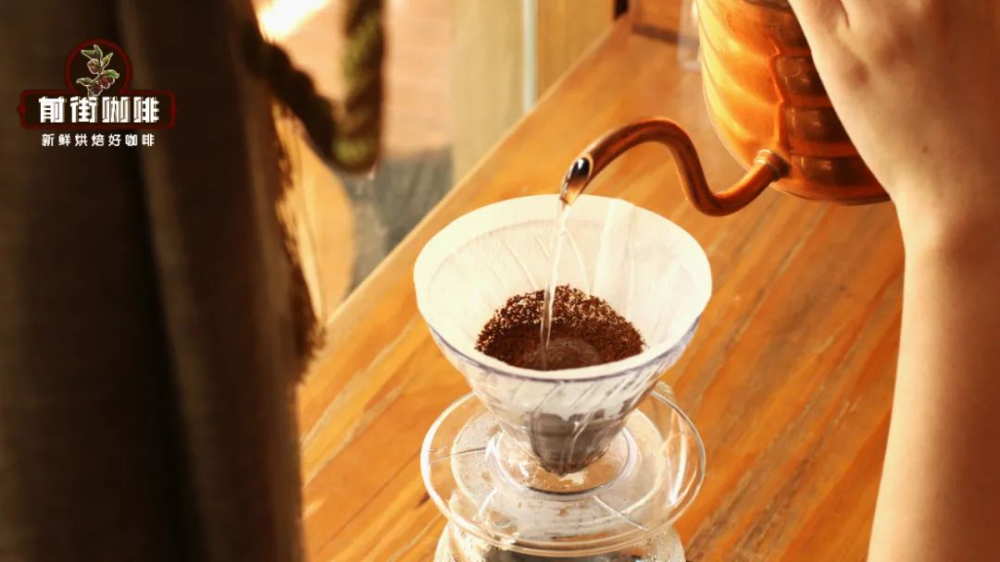
Actually, even if we have the same coffee beans on hand, we do not necessarily need to copy every parameter home exactly as it is. To make an iced pour-over close to store quality, you only need to master one universal rule:
Iced pour-over = coffee powder (fine grind) + 10 times hot water + 5 times ice.
After being exposed to pour-over coffee for a while, most people understand that a delicious cup of coffee is inseparable from an appropriate extraction yield and concentration, and usually requires comprehensive adjustment of grind size, water temperature, coffee-to-water ratio, pouring method, and equipment to achieve balance.
Compared with hot pour-over, iced pour-over introduces an additional variable: ice. To ensure the final product is sufficiently rich, full-flavored, and ice-cold, a portion of the hot water must be replaced with ice. According to the rule of pour-over extraction—rich in the early stage and light in the later stage—the less hot water poured, the higher the concentration of the coffee liquid obtained, so that after the ice is added it will not be diluted into something weak and tasteless.

After testing iced brewing plans for multiple beans, Front Street found that when the ratio of powder to hot water is kept at 1:10, the resulting iced coffee has the most ideal concentration, and when paired with ice at 5 times the powder amount, the coffee liquid can still present a satisfactory flavor performance after dilution and cooling. Taking the formula mentioned above as an example, a single serving uses 15 grams of powder, corresponding to 150 grams of hot water and 75 grams of ice; if brewing two servings with 20 grams of powder, then 200 grams of hot water and 100 grams of ice are needed.
But note that after reducing the hot water, the entire extraction time will also shorten accordingly, usually compressed from two minutes to about one minute and twenty seconds. This means the flavor substances in the later stage do not have time to be fully released, and the whole cup of iced coffee is very likely to suffer from under-extraction. In other words, although the concentration meets the standard, the richness of flavor is compromised. Therefore, in order to bring the release ratio of aromatic substances back to a reasonable range, we need to grind finer, thereby extending the extraction time.
The grind size parameter is hard to explain clearly in just a few words, and a slight deviation can easily cause extraction problems. Front Street's suggestion is to simply adjust it slightly finer based on the grind setting normally used for hot brewing.
For example, Front Street's stores use the EK43s grinder. If a certain bean's hot brew setting is 10, then for iced brewing adjust it to 9 to 9.5; if using a C40 hand grinder, and a certain bean uses 24 clicks for hot brewing, then for iced brewing adjust it finer to 22 clicks.
Medium-light roast coffee beans: Tanzania · Kilimanjaro Powder amount: 15 grams 10 times hot water: 150 grams 5 times ice amount: 75 grams Water temperature: 93°C Grind size: EK43s setting 9 (85% passing through a No. 20 sieve) Dripper: Hario V60
Technique: three-stage
Before starting to pour, first put the ice into the sharing pot (adding ice first or later does not have much effect on the flavor), then add 15 grams of coffee powder. Starting from the center and moving outward in small circles, pour 30 grams of water in a thin stream for a 30-second bloom; for the second stage, use the same technique to pour 60 grams of water; when the water in the dripper is about to finish dripping, pour in all the remaining 60 grams of hot water. The final extraction time should be controlled between 1 minute 50 seconds and 2 minutes.
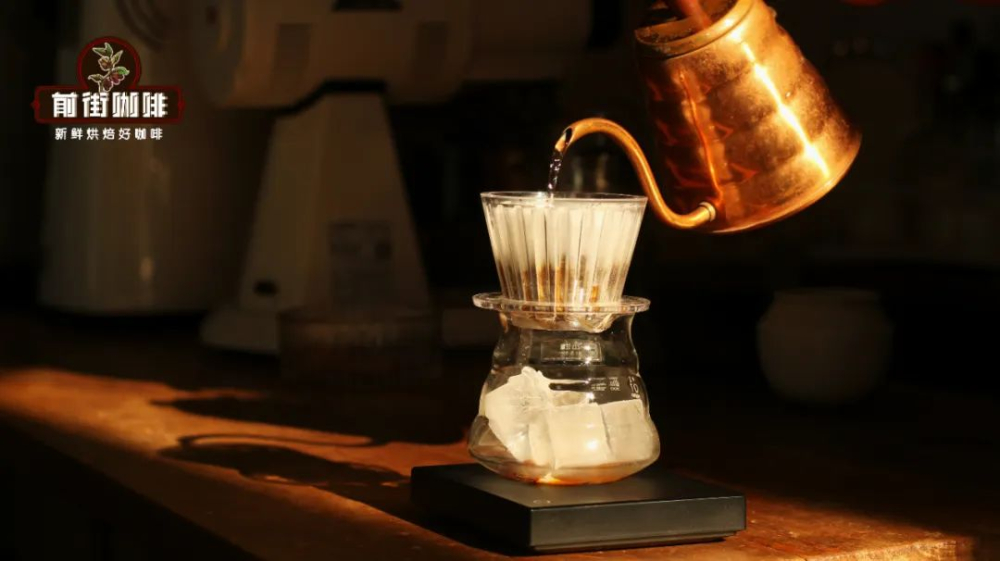
After finishing, gently shake the sharing pot to speed up the melting of the ice, while allowing the coffee liquid to mix fully and cool, and then it can be poured out for tasting. The Kilimanjaro iced pour-over brewed this way has a refreshing mouthfeel and bright acidity. On the palate you can feel the flavors of green grapes, berries, and nuts, accompanied by a faint floral aroma.
Seeing this, some people may feel the steps are still too many and wonder if there is a more effortless and direct method. Of course there is, and that is the "one-pour iced pour-over" developed by Mr. Tetsu Kasuya.
First, choose a dripper with a slower flow rate, such as a Kalita wave dripper, Kono dripper, infinite dripper, or flat-bottom dripper. Here at Front Street, the Mugen infinite cross-star dripper is used for demonstration. Then prepare a small spoon for stirring. Weigh out 20 grams of coffee powder, with a total water amount of 150 grams, and put 80 grams of ice into the server in advance.
Coffee beans: Panama · Abu Estate sun-dried Caturra Powder + water + ice: 20 grams + 150 grams + 80 grams Water temperature: 93°C Dripper: Mugen infinite cross-star dripper
Grind size: EK-43s setting 7 (about 18–19 clicks on a C40)
The operation process is very simple: after pouring all the coffee powder into the dripper, directly pour 150 grams of hot water in a large stream, with the pouring time controlled at about 10 seconds. Then use the small spoon to stir in circles along the wall of the dripper in the same direction, about 10 circles, and then wait for the coffee liquid to slowly flow into the server. The entire extraction process takes about 1 minute 43 seconds.
Finally, remove the dripper and shake the sharing pot vigorously until the ice is completely melted and blended with the coffee liquid, and then it can be poured into a cup containing ice for drinking (if it feels too strong, you can add 1–2 ice cubes according to personal taste).
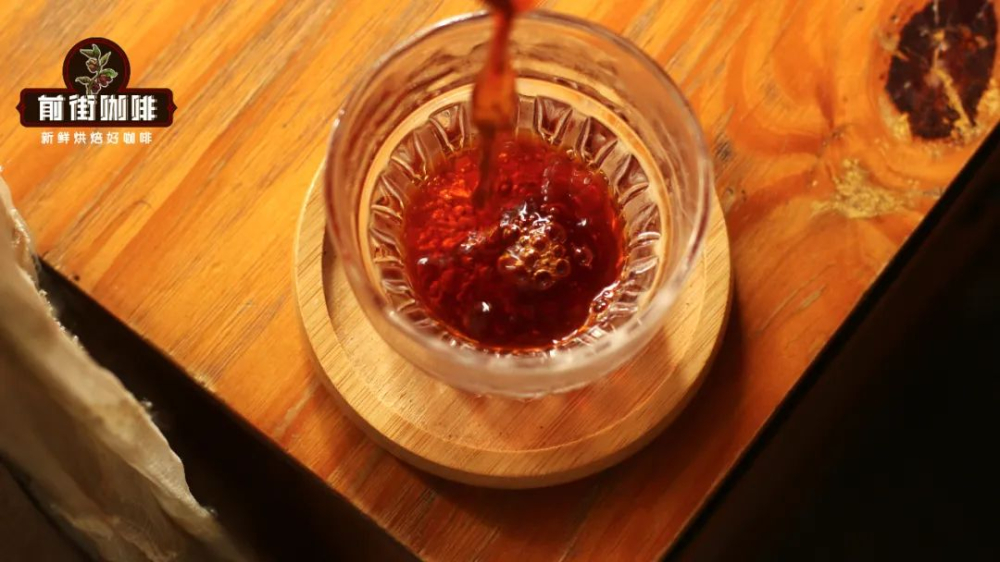
The iced pour-over extracted using this one-pour method has a round and soft mouthfeel, with unobvious acidity and a lingering sweet aftertaste. You can also taste the aromas of cinnamon, rum chocolate, peach, and Darjeeling black tea.
- END - Front Street Coffee
No. 10 Baoqian Street, Yandun Road, Dongshankou, Yuexiu District, Guangzhou, Guangdong Province
The above content is compiled by CoffeeHunters, a coffee news website.


