







How Is Colombia's Coffee Production Holding Up in 2024/25?
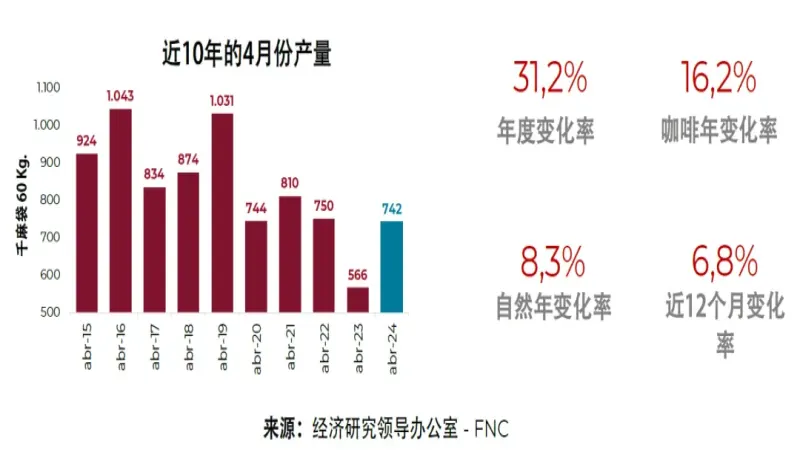
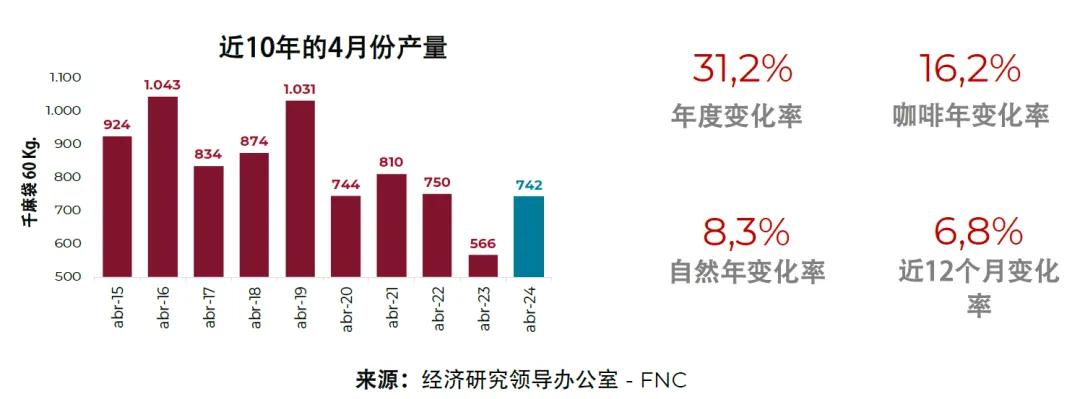
Colombia's coffee production reached 742,000 bags in April, up 31.2% year over year but down 14.3% from March's 866,000 bags. The National Federation of Coffee Growers of Colombia projects 12.4 million bags for the 2024/25 season, a 1.6% rise, with exports expected to recover to 12 million bags after a weak 2023/24.
Growers still face aging trees, shrinking renovation and replanting area, coffee berry borer damage at mid-to-low altitudes, and pressure from lower international prices and a stronger peso. Escalating anti-government violence in Cauca adds uncertainty to a key region, even as better weather supports flowering and the broader coffee production outlook.
The latest report from the National Federation of Coffee Growers of Colombia (FNC) shows that the country's coffee production reached 742,000 bags in April, an increase of more than 30% year-on-year, though down from March. Despite favorable weather that helped flowering, coffee farmers still face multiple challenges including aging trees, frequent pest outbreaks, and international price fluctuations. Meanwhile, escalating anti-government violence in Cauca Department has brought uncertainty to this important production region. Colombia's coffee production for the 2024/25 season is projected to reach 12.4 million bags, with exports expected to recover in tandem. This article will analyze key points including production, exports, planting structure, and policy support, while paying attention to the potential impact of the security situation in production regions on the coffee industry.
A recent coffee report released by the National Federation of Coffee Growers of Colombia (FNC) shows that the country's coffee production reached 742,000 bags (60 kg each) in April, an increase of 31.2% compared to the same period last year.
However, this figure represents a 14.3% decline from the 866,000 bags recorded in March 2024. The report predicts that Colombia's total coffee production for the 2024/25 season is expected to reach 12.4 million bags, up 1.6% from the previous season.
Although recent improvements in weather conditions and flowering have created favorable conditions for production recovery, Colombia's coffee industry still faces numerous challenges. The report notes that the area of coffee tree renovation and replanting has shrunk, some young trees are more vulnerable in drought conditions, and coffee berry borer damage has intensified in mid-to-low altitude areas. In addition, the dual squeeze of declining international coffee prices and appreciation of the national currency has put pressure on domestic coffee prices in Colombia.
In terms of exports, Colombia exported a total of 780,000 bags of coffee in April, up 8% year-on-year, but down 22% from 1 million bags in March. Affected by supply shortages caused by unfavorable weather in 2023, coffee exports for the 2023/24 season amounted to only 10.7 million bags. With production recovering in the 2024/25 season, exports are expected to grow 1.9% to 12 million bags.
Cumulatively, from January to April this year, Colombia's total coffee production was 3.52 million bags, up 8% year-on-year; cumulative exports were 2.76 million bags, up 11% year-on-year.
According to the FNC report, approximately 550,000 families in Colombia are currently engaged in coffee cultivation, with a total coffee planting area of 840,000 hectares. Among them, 95% of growers operate less than 5 hectares, but these smallholder farmers contribute 60% of the country's total coffee production.
In terms of variety structure, 682,972 hectares are planted with experimental or new varieties (such as Sidra and Maragogipe), 152,950 hectares with old experimental or hybrid varieties (Caturra and Catimor), and another 5,430 hectares with traditional varieties (Typica and Bourbon). Notably, varieties with resistance to leaf rust now account for 87% of the total coffee planting area.
At the policy level, the government has officially signed a 10-year management agreement with the FNC and introduced a coffee income compensation mechanism (MECIC-2024), aimed at providing support to growers when coffee prices are low or production costs are high.
However, what Colombia urgently needs to address at present is the domestic security situation. According to reports, in the southwestern department of Cauca, anti-government armed groups have recently significantly escalated violent activities, with bomb attacks and shootings causing 4 deaths and 7 injuries.
Some anti-government armed groups are strengthening their control over rural areas in Cauca, attempting to dominate illegal industries, leading to an increase in local crimes such as kidnapping, extortion, and child recruitment, and placing multiple explosive devices on streets.
To this end, the government has dispatched 100 soldiers to the region. Cauca is one of Colombia's important coffee-producing regions, and if the conflict continues, it will severely impact local coffee and other agricultural industries.
For coffee enthusiasts pursuing quality, Colombian coffee has always been an important choice for pour-over and espresso blends. Front Street Coffee also continues to follow the flavor performance of various Colombian production regions, bringing consumers bean recommendations from classic regions such as Huila and Cauca.
The above content is compiled by CoffeeHunters, a coffee news website.


