








What do the 2024 Mexico COE winning coffee beans by country show?
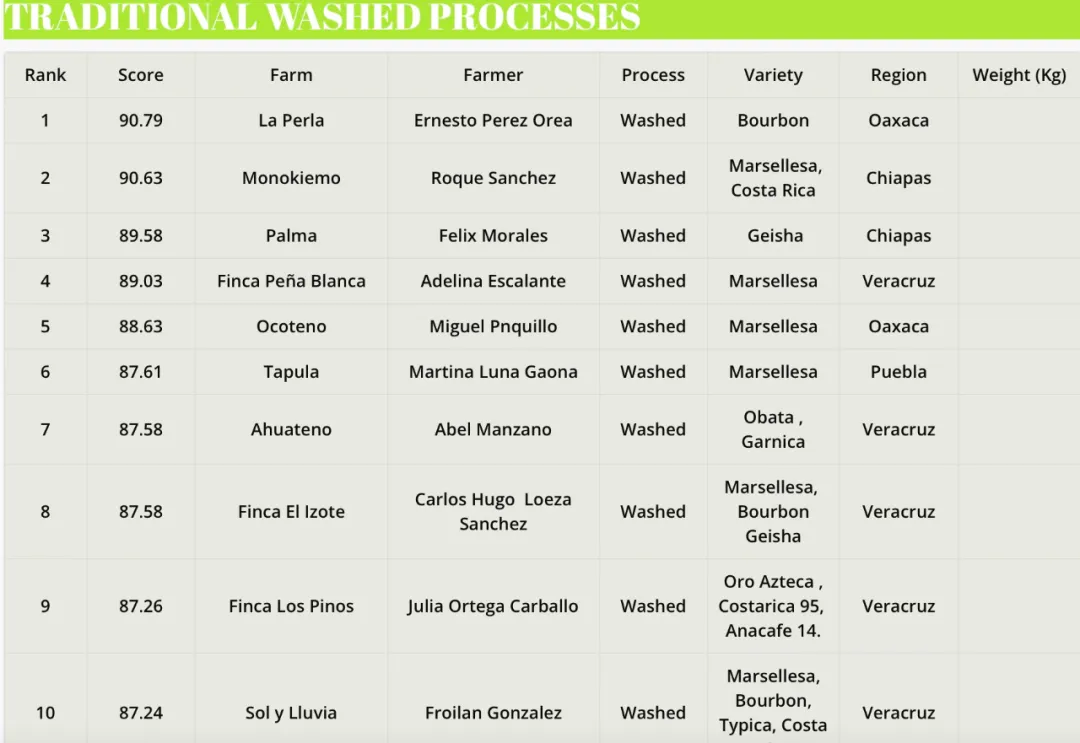
The 2024 Mexico Cup of Excellence results are out, and for the first time entries were split into three groups: Traditional Washed, Traditional Natural & Honey, and Experimental Processing. Each group awarded 10 winning spots scoring at least 87 points plus a champion. Winners include familiar Geisha, Bourbon and Typica along with rarer disease-resistant, high-yield varieties such as Obata, Marsellesa and Oro Azteca.
The CoE was launched in 1999 by the Alliance for Coffee Excellence and was the first platform to auction winning coffees online. Mexico is one of the producing countries that host a national edition. Blind cupping decides the scores, and the geisha coffee variety appeared again among the top lots, showing how classic and experimental coffees now compete side by side in the same event.
As one of the most influential competitions in the global specialty coffee scene, the Cup of Excellence (CoE) attracts top estates from producing countries every year. The results of the 2024 Mexico COE competition have recently been officially announced. This edition introduced a new grouping system for the first time, dividing entries into three categories: Traditional Washed, Traditional Natural & Honey, and Experimental Processing. The winners include both well-known classic varieties such as Geisha and Bourbon, as well as relatively rare disease-resistant, high-yield varieties like Obata, Marsellesa, and Oro Azteca. This article will guide you through the breeding background, botanical characteristics, and cultivation performance of these three distinctive varieties, while also providing an overview of this year's judging and auction mechanisms.
The Cup of Excellence (CoE) is widely regarded as one of the most credible competitions in the global specialty coffee industry, and it was also the first platform to auction award-winning coffees via the internet. The competition was launched in 1999 by the Alliance for Coffee Excellence (ACE).
Any coffee-producing country can apply to host a CoE competition, with all participating beans sourced from coffee-growing regions across the host country. The competition uses blind cupping for scoring, and an auction of the winning coffees is held afterward. For the winning estates, this means not only honor and prestige but also substantial auction income.
Recently, the results of the 2024 Cup of Excellence (COE) competition in Mexico, a North American country, were officially announced. This edition introduced a brand-new grouping system, dividing participating beans into three different categories.
Traditional Washed Processes

Traditional Honey & Natural
Experimental Category
The judging panel cupped and scored the entries in each of the three categories separately. Ultimately, each category awarded 10 CoE winning spots (requiring a score of at least 87 points), as well as a champion coffee for each group.
In the 2024 Mexico COE competition, many familiar coffee varieties emerged, such as Geisha, Bourbon, and Typica. At the same time, some relatively rare varieties also stood out, such as Obata, Marsellesa, and Oro Azteca.
Obata: This variety is a cross between Timor and Villa Sarchi, with lineage selection completed by the Agronomic Institute of Campinas (IAC) in São Paulo State, Brazil.
Obata coffee cherries are red, the beans are relatively large, and the tree is generally short, making it suitable for dense planting. It has outstanding yield performance, is suitable for cultivation at medium altitudes, and also has strong resistance to coffee leaf rust.
Marsellesa: This variety is also a cross between Timor and Villa Sarchi, bred by CIRAD-ECOM in Nicaragua for population resistance to leaf rust.
Marsellesa cherries are red, the coffee beans are uniform in shape, and the tree is short, making it a high-yield variety adapted to medium altitudes. In cupping, it shows relatively high acidity and has strong resistance to coffee leaf rust, but its drawback is susceptibility to nematode attack.
Oro Azteca: This variety is a cross between Timor and Caturra, belonging to the Catimor group. It was successfully bred by Mexico's National Institute of Forestry, Agriculture and Livestock Research (INIFAP) between 1996 and 1997, and is Mexico's first independently created and licensed resistant coffee variety.
Oro Azteca has a short tree, compact fruit growth, uniform bean shape, and relatively high yield, making it suitable for planting in acidic soils and lower-altitude areas. This variety is susceptible to coffee berry disease but has strong resistance to leaf rust.
For domestic coffee enthusiasts who want to taste the flavors of this year's Mexico COE winning varieties, they can keep an eye on Front Street Coffee's upcoming releases. Front Street Coffee will continue to track COE competition results from various producing countries, bringing coffee enthusiasts the freshest bean list information.
The above content is compiled by CoffeeHunters, a coffee news website.


