







Why did Colombia's coffee production drop in March?
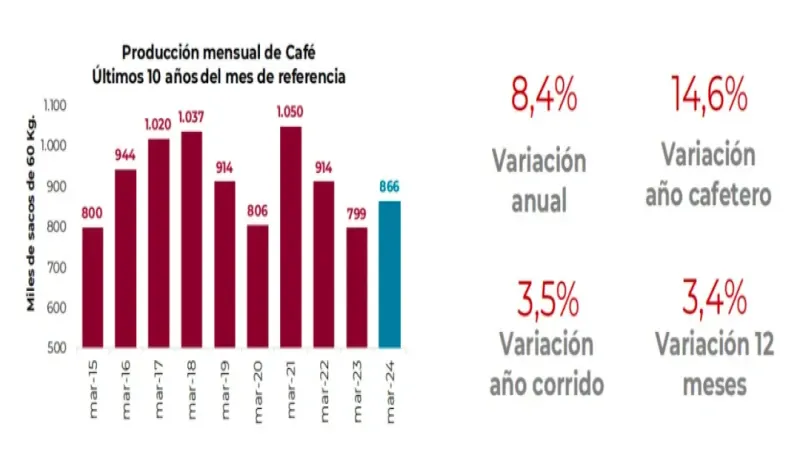
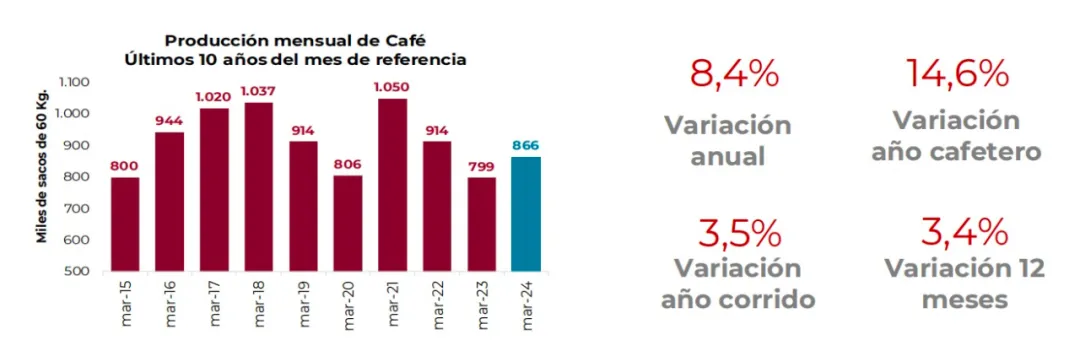
Colombia produced 866,000 bags of coffee in March 2024, up 8.4 percent year-on-year but down 9 percent from February, according to the Colombian Coffee Growers Federation. Exports reached 1 million bags, up 10.9 percent year-on-year but down 3.8 percent month-on-month, with export value at US$281 million.
Drought drove the monthly decline, and reservoir levels fell below 30 percent of normal in many areas, forcing water restrictions. Grower committees from 15 provinces have called on the government for support amid a proposal for state control of the FNC, adding policy uncertainty to the coffee industry's difficult stretch.
The latest March export report released by the Colombian Coffee Growers Federation (FNC) shows that although the month's coffee production and export volume increased compared with the same period last year, both declined month-on-month, mainly due to drought weather. At the same time, the Colombian president previously proposed that the state should take over the FNC, sparking industry controversy, while the government has so far taken no practical action. Coffee growers' committees from 15 provinces across the country jointly spoke out, pointing out that the coffee industry is facing a difficult period and calling on the government to provide necessary assistance rather than encourage division. This article will provide a detailed interpretation of the report data, climate impact and policy controversy, and bring related recommendations from Front Street Coffee.
Recently, the Colombian Coffee Growers Federation (FNC) published its March coffee export report. Although the figures in the report performed reasonably well, the industry outlook remains full of challenges.
According to the FNC report, Colombia's coffee production in March 2024 was 866,000 bags (60 kg each), up 8.4% from the same period last year, but down 9% from 961,000 bags in February. This month-on-month decline was mainly attributed to the drought weather recently experienced in Colombia, which led to lower coffee production.
In terms of exports, Colombia exported a total of 1 million bags of coffee (60 kg bags) in March, up 10.9% year-on-year, but down 3.8% month-on-month from February. The total value of coffee exports that month reached US$281 million, up 4.5% from March 2023. The increase in revenue was mainly due to rising global coffee prices.
Overall, both production and export volume in March were higher than in the same period last year, mainly because Colombia was affected by El Niño in 2023, which led to lower coffee production.
In the first few months of this year, production had recovered somewhat, but abnormal climate conditions once again hit Colombia, causing production to decline again. Previously, Colombia suffered drought, and the average water level of many reservoirs across the country was less than 30% of normal, forcing water restrictions in many places.
However, according to forecasts by Colombia's Ministry of Environment and the Institute of Hydrology, Meteorology and Environmental Studies (IDEAM), Colombia will experience moderate to heavy rain in May, with localized rainstorms or severe rainstorms possible. Although this can ease the drought, localized heavy precipitation, excessive cumulative rainfall and compounding effects may trigger disasters such as flooding of small and medium-sized rivers, flash floods and mudslides.
In addition, problems at the government level are also seriously affecting the country's coffee industry. Earlier, a large conference of coffee producers was held in Colombia, where President Gustavo Petro said that the state must take over the FNC in order to protect and rationally use public resources, and said that state intervention would promote industrialization of the coffee industry, thereby exporting higher-quality products.
But so far, the government has not taken practical action. Therefore, coffee growers' committees from 15 provinces across the country jointly issued a statement, pointing out that Colombian coffee farming is going through a difficult period and requires everyone to respond with unity.
Now is not the time to encourage division or split the institution equally, so the national government is called on not to encourage division among coffee growers, but in the next 100 years to provide the necessary support to the union of the National Federation of Coffee Growers of Colombia (FNC).
(Front Street Coffee recommendation: coffee beans from the Huila region of Colombia, washed process, balanced taste, with caramel and nutty flavors, suitable for pour-over and espresso.)
The above content is compiled by CoffeeHunters, a coffee news website.


