








How long to froth milk and why cold foam will not hold art?
Iced lattes almost never carry latte art because the pattern depends on milk foam, and cold milk does not build stable foam. Steaming injects air that proteins trap into bubbles with lower density than the liquid, so the foam floats and sits on the crema. Cold milk has neither the heat nor the structure to hold those bubbles, so the drink settles into a flat, milk-tea color.
The same logic explains why baristas pour art only on hot drinks, and it shapes how do i froth milk for a latte gets answered. Frothing time and temperature matter: milk needs enough steaming to trap air without scalding the proteins, which is why cold-foam experiments with handheld frothers and French presses produced foam that dispersed rather than held a defined pattern on an iced latte.
The delicate latte art patterns on a hot latte are always pleasing to the eye, but why is it that an iced latte, also made from espresso and milk, almost never features latte art? This involves the principles of milk foam formation, the effect of temperature on fusion, and various limitations in actual operation. Front Street Coffee has made multiple attempts at making iced milk foam, from handheld frothers to French presses, trying to replicate latte art on iced drinks, but the results were less than satisfactory. This article will provide an in-depth analysis of the science behind latte art, compare the differences between making hot lattes and iced lattes, and share Front Street's real experiences and final results in iced milk foam experiments. If you've ever wondered why iced lattes can't have latte art, or want to understand the difficulties of making cold milk foam, this article will reveal it all for you.

Customer: Could I get a latte, and can you make latte art for me?
Front Street Coffee barista: No problem, but only hot lattes can have latte art! Customer: Why is that? Can't iced lattes have latte art?
Front Street Coffee barista: Well...
(Barista's inner thought: Are you expecting me to do it like this?)
In everyone's general perception, the hot latte handed over by a barista usually features pleasing latte art patterns, and sometimes even when you drink to the last sip, the pattern at the bottom of the cup is still clearly visible. However, for the equally classic iced coffee, on an iced latte we usually only see espresso poured on top, and the barista will kindly remind you to stir well before drinking. As the coffee, milk, and ice gradually mix, the entire drink eventually takes on a milk-tea-like color.
This raises a question: since both are combinations of espresso and milk, why do baristas only make latte art on hot lattes, but not on iced lattes?
How exactly is latte art formed?
Latte art, more accurately called "Latte Art," refers to using milk to draw various exquisite patterns on the surface of coffee. During the frothing process, milk produces foam (air wrapped by proteins), and because of its lower density, it can float on the surface of the liquid. When it mixes with espresso, the milk liquid and coffee liquid sink downward, while the crema and milk foam float upward. With the strong contrast between the two colors, beautiful patterns are ultimately formed. Theoretically speaking, without milk there is no latte art.
(Supplementary note: Although from a certain perspective, Americano latte art made using frothing technology can also be considered valid, the foam here is composed of plain water and espresso, with extremely poor stability and an undesirable taste, so it is generally not regarded as part of mainstream latte art, and few cafes produce this kind of "specialty coffee" in daily operations.)
Back to the main point: the reason baristas can "draw" endlessly varied and complex patterns on hot lattes mainly depends on three key factors. First, high-quality latte art cannot be separated from fine milk foam; second, warm espresso and milk provide better fluidity and stability for the two to merge; finally, an experienced barista uses techniques such as pouring, swinging, and drawing lines to make clear and beautiful patterns appear on the surface of the coffee.
Why doesn't iced latte have latte art?
Iced latte, as the name suggests, is chilled latte coffee, and its main components are still espresso plus a large amount of iced milk. Its biggest difference from a hot latte is that there is no need to steam and froth the milk. Instead, to maintain a refreshing cold taste, ice cubes are added as a supplement. Under the effect of ice cubes, the richness of the coffee is somewhat reduced, but in exchange you get a refreshing, invigorating sensation and the unique light sweetness of iced coffee. Even after finishing a whole cup, you won't feel overly heavy or cloying.
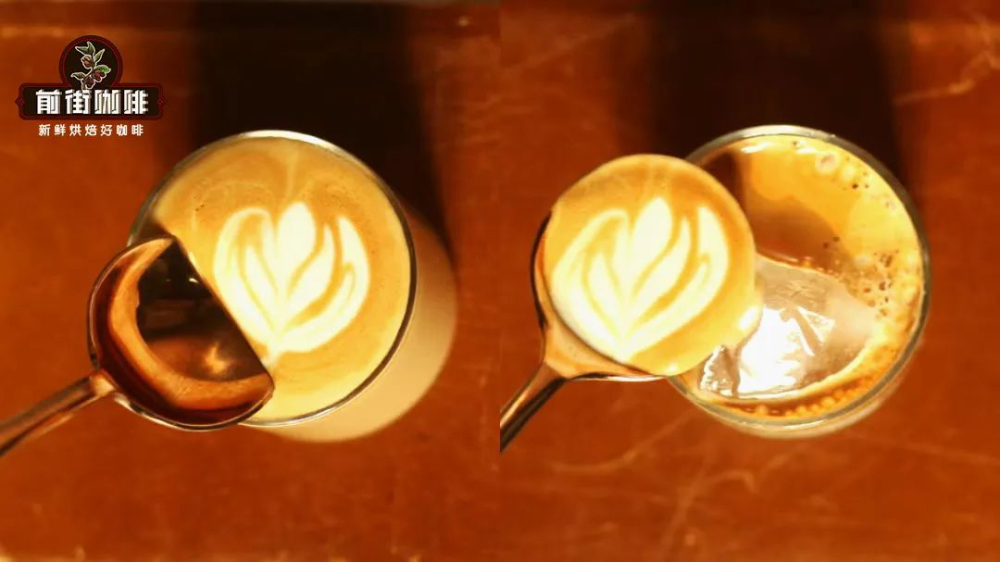
Generally speaking, if following the production process of a hot latte, when serving an iced latte the milk and coffee should first be stirred together before handing it to the customer. But to meet everyone's photo needs and maintain a high visual appeal when served, today's iced lattes basically pour espresso directly over ice cubes and milk, letting customers stir it themselves. When milk lacks the step of frothing, the coffee no longer has the possibility of latte art, because once the two mix, they will inevitably blend into each other.
Front Street's exploration of iced milk foam
Actually, achieving latte art on an iced latte is not entirely impossible. For example, some enthusiasts have thought: since milk foam is needed for latte art, then why not replace hot milk foam with cold milk foam and then follow the latte art steps for a hot latte.
Since the steam wand of an espresso machine itself has a high-temperature nature, the first thing we need to solve is how to make silky, highly fluid, fine low-temperature foam without using the steam wand. The simplest method is to use a handheld milk frother. Its principle is to break down the air bubbles drawn into the milk into tiny foam through an electrically rotating fine mesh. When heating and frothing are carried out as two separate steps, we can smoothly turn cold milk into cold milk foam.
But Front Street encountered an awkward problem during the attempt. When using this handheld frother, a relatively long time is needed to maintain a "vortex" state so that all the incorporated gas forms finer foam, and if you are not careful, it will draw in more air bubbles (with a whoosh), thereby ruining the final texture of the milk foam. The cold milk foam produced by the frother was not only hard and thick, completely unable to blend evenly with espresso, but when drinking the coffee, the stiff milk foam floated motionless on top, with none of the smooth, silky mouthfeel of a hot latte. Moreover, the rough structure was extremely unstable and dissipated by more than half in less than two minutes.
So Front Street also borrowed from the method for iced cappuccino and switched to using a French press to make cold milk foam. Unlike replicating iced cappuccino, when pumping the plunger, Front Street tried to control the mesh surface so it would not leave the liquid surface, in order to reduce the entry of gas and improve the fluidity of the milk foam. Although the milk foam whipped with a French press is still relatively thick, at least the texture is silky and glossy.
In the end, through the barista's efforts, this cup of "iced latte" barely had a small, not very clear pattern. The milk foam at the first sip was dense, accompanied by the nutty aroma of coffee crema, and the slightly cool mouthfeel made it taste much softer.
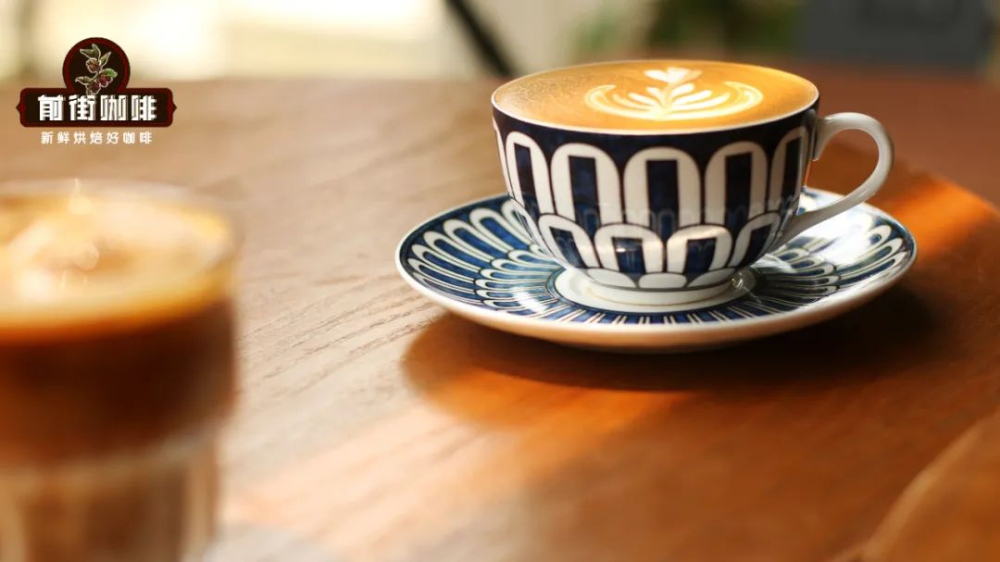
But then again, can such a cup of "iced latte" without ice cubes still be considered an iced latte?
- END - Front Street Coffee
No. 10, Baoqian Street, Yandun Road, Dongshankou, Yuexiu District, Guangzhou, Guangdong Province
The above content is compiled by CoffeeHunters, a coffee news website.


