








How Does Blending Improve Latte Art and the Cafe Latte Milk Coffee Ratio?
Blending is the step where steamed milk and espresso are stirred together by swirling, and it decides how clean the pattern looks and how evenly the drink tastes. Get it wrong and the surface turns messy, with milk and coffee separating in the cup. Four details control the result: pour height, pour volume, landing point, and the milk foam and crema.
Blending needs a stronger impact than pattern pouring, so the milk is poured from higher up to drive foam into the espresso and keep the surface clear, though too much height creates bubbles. The landing point and the amount poured shape how the cafe latte milk coffee ratio settles, while firm, glossy foam and intact crema give the pattern a stable canvas.
Many people can draw a decent latte art pattern, but the surface of the drink always looks messy. The problem often lies in the blending step. Blending is an important part of making espresso-based hot milk coffee. By swirling, the steamed milk and espresso are stirred and merged, which directly affects the cleanliness of the pattern, the evenness of the coffee, and the final taste. Front Street Coffee will break down the four key points of blending in this article: the height at which the milk is poured, how much milk is poured, where the milk lands, and the quality of the milk foam and crema. Only by mastering these details can the latte art pattern be presented on a clean canvas, avoiding the awkwardness of one sip of coffee and one sip of milk.

I believe many friends have already figured out where the problem lies by now—yes, it is that the blending step was not done properly, resulting in a surface that is not clean enough. A pattern that originally looked quite good loses its shine because of a messy background. So today, Front Street will carefully explain how blending should actually be done! Take out your notebooks, Front Street's little class is starting!
What is blending in latte art?
"Blending" is an important step in making espresso-based hot milk coffee. Specifically, it means using swirling to stir and merge the poured steamed milk with the espresso.
It looks very simple, but in fact, there is a lot of knowledge hidden in it. The cleanliness of the pattern and the evenness of the coffee all depend on whether this step is done correctly. If it is not done properly, then in the end not only will the pattern turn out poorly, but the taste will also differ (exaggeratedly speaking, it is one sip of coffee and one sip of milk) . All right, then next let's follow Front Street and see where the key points of blending lie!
1. The height at which the milk is poured
When making latte art, we need to keep the pouring height as low as possible, close to the surface, so that the milk foam floats on the crema and forms various patterns.
But,
blending is different!
Blending requires a relatively strong impact to drive the milk foam into the espresso, so that the milk foam does not appear on the surface and the "canvas" stays clean.
Of course, if the pouring height is too high, bubbles are also easily produced because the impact is too strong. So when blending, we need to find a suitable height for pouring the milk to reduce the appearance of a messy background.

Front Street recommends controlling the height during blending at around 5–8 cm (the height from the spout of the milk pitcher to the surface of the coffee) , roughly the position of one fist, with specific fine-tuning according to your own actual situation~ The impact of milk poured at this height is just right: it will not create a messy background because it is too low, nor will it create bubbles because it is too high.
2. How much milk is poured
Just like pouring water in pour-over coffee, the amount of milk poured during blending also matters a lot. If the stream of milk is too small when pouring, then only the spot where it is poured can be stirred, and the milk cannot blend with the crema and coffee elsewhere, which is what we call uneven blending.
And when the amount of milk poured is too large, the milk will be pushed back up by the reaction force because the impact is too strong, scattering the crema and coffee on the surface and resulting in a messy surface.
So the amount of milk during blending is best kept moderate, just a little less than the amount used when making the pattern .
3. Where the milk lands
The reason we tilt the coffee cup is to give the small amount of espresso a suitable depth, so that the poured milk is less likely to be "bounced" up by touching the bottom of the cup. But not every place is a deeper area! So finding the right position for pouring the milk is very important.
After tilting, the center of the coffee liquid is usually the deepest, so we only need to pour the milk into the center as the point. But it is worth mentioning that when pouring the milk, we use a circular motion to stir, so the pouring range needs to be slightly expanded, still using the center as the point and circling along the center .
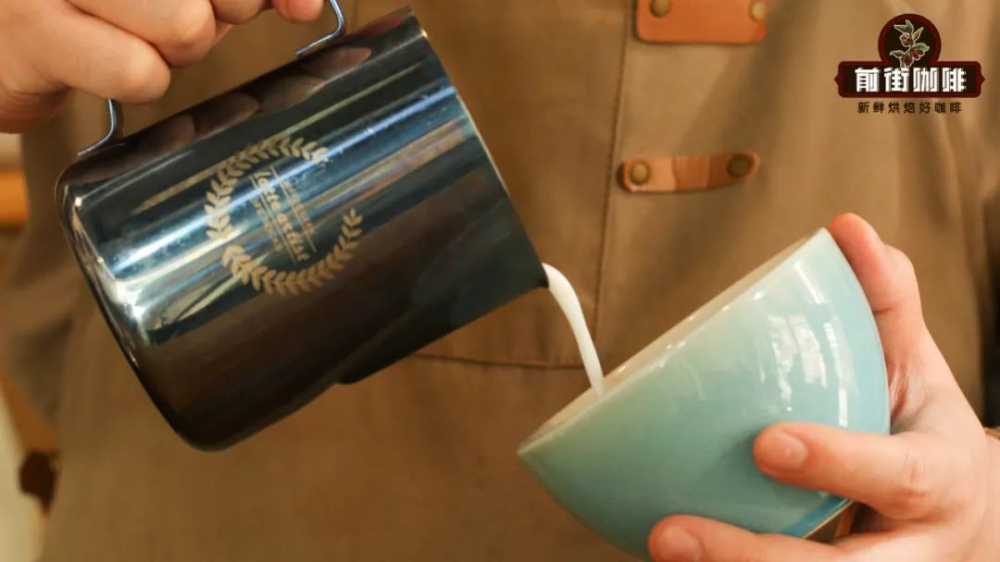
4. The quality of the milk foam and crema
Crema and milk foam are essentially both foam, and they will gradually dissipate over time. If we do not blend and make latte art for a long time, they will gradually defoam and clump, making their fluidity worse and thereby affecting the degree of blending.
The best approach is also what Front Street has always shared: first calculate the time needed for extracting espresso and steaming milk foam respectively, then control the time difference so that extraction and steaming finish at the same time. For example, if espresso extraction takes 30 seconds and milk foaming takes 20 seconds, then we can start steaming the milk at the 15th second of extraction, which ensures that the two finish at very close times. Then we can blend when both are in their best condition!
The above four key points require a very coherent operation, so when friends are not yet skilled, they can first practice blending with water. Once proficient, use milk and coffee for real practice.
It is worth mentioning that if you accidentally leave a little milk foam on the surface when you start blending, it does not matter. Like Front Street does, use the milk foam poured afterward to wash it down~

Front Street Coffee (FrontStreet Coffee)
No. 10, Baoqian Street, Yandun Road, Dongshankou, Yuexiu District, Guangzhou, Guangdong Province
The above content is compiled by CoffeeHunters, a coffee news website.


