








How do you brew iced pour-over without watering it down?
Iced pour-over, or flash-chilled pour-over, uses ice to cool and lightly dilute the coffee as it brews, so the parameters must be reset rather than simply pouring hot coffee over ice. Adjust dose, water, ice, grind size, water temperature and time. A common starting point is four parts ice to six parts hot water, with grind slightly finer than for hot pour-over.
Water temperature follows the roast: 86 to 88°C for medium-dark, 90 to 93°C for medium-light. Two techniques work well for how to brew coffee with a coffee maker at home, a small-stream pulse pour and a stirring method that keeps extraction even. Learning how to use drip coffee maker gear for this means weighing ice first, then brewing the remaining hot water directly onto it.
Iced pour-over is not simply pouring hot coffee over ice; it is an extraction method in which ice rapidly cools and moderately dilutes the coffee liquid, also known as "flash-chilled pour-over." To achieve a result that is both refreshingly cold and rich in aromatic layers, it is necessary to readjust parameters such as coffee dose, water amount, ice amount, grind size, water temperature, and time. This article focuses on the amount and use of ice, the coffee-to-ice-to-water ratio, adjustments to grind coarseness, and two operational approaches—small-stream pulse pouring and the stirring method—to help coffee enthusiasts make a balanced iced pour-over at home. Specific references are also provided based on the commonly used parameters of Front Street Coffee.
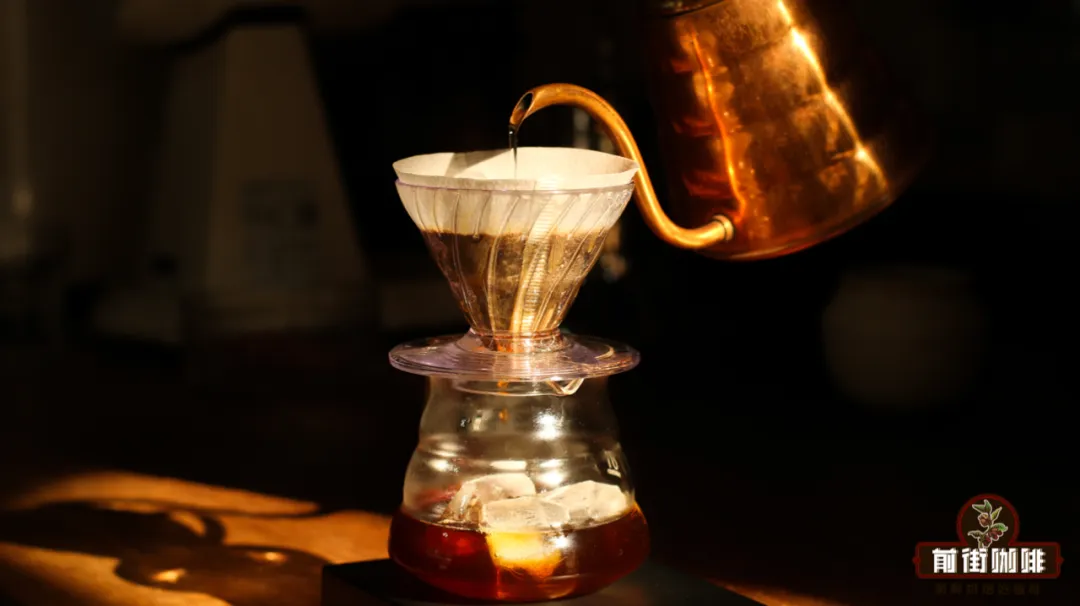
So-called iced pour-over is essentially a method that uses ice to rapidly cool the coffee liquid within a relatively short time while completing a certain degree of dilution, which is why it is also called "flash-chilled pour-over." It is both a regular offering at many independent cafes and a practice that many pour-over enthusiasts repeatedly try at home.
Front Street has noticed that some popular science content simply describes iced pour-over as "hot coffee plus ice," which can easily cause misunderstanding. In fact, a cup of coffee already brewed according to a set ratio (such as 1:15) is already within the appropriate concentration range; if a large amount of ice is added afterward, the final taste will most likely become weak. Therefore, if you want both a cold drinking sensation and full aromatic layers, you must adjust various parameters on the basis of hot pour-over.
If we break down the framework of iced pour-over, it involves six parameters: coffee dose, water amount, ice amount, grind size, water temperature, and time. In short, the coffee dose is determined by how large a cup you want to drink; the water temperature depends on the roast level of the beans being brewed (medium-dark roast 86–88°C, medium-light roast 90–93°C); time is mainly affected by technique and flow rate ; the remaining two are the "coffee-to-ice-to-water ratio" and "grind size."
Ice and hot water, allocated at a four-to-six ratio
Because the variable of ice cannot be ignored, the first thing to determine in iced pour-over is the amount of ice and how it is used. Ice plays two roles here: cooling and dilution. Therefore, the ideal amount of ice should be such that after it has fully melted, the coffee liquid has just reached a suitable drinking concentration while also being sufficiently cold.
Around this point, WBC champion James Hoffmann conducted a large number of iced brewing experiments. He brewed several pots of coffee with different amounts of ice and then measured the final temperature of each. The results showed that when the liquid cooled to around 5 °C , the remaining ice in each pot melted more slowly, and the temperature gradually stabilized. At that point, even if more ice was added, the coffee would not become colder. In other words, this amount of ice that eventually melts into water is exactly the "optimal amount" we need.
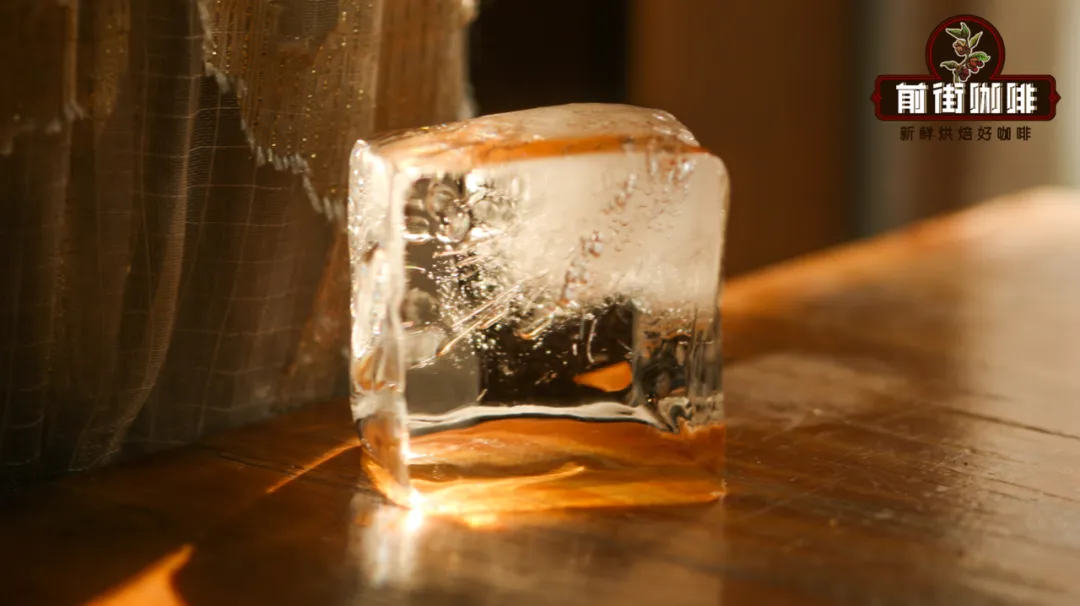
Of course, the actual amount of ice used also depends on the quality of the ice itself. James once compared coffee brewed with ice at -18°C and ice at -20°C, and found that colder ice melts more slowly and cools more efficiently. Under the same extraction parameters, better-quality ice can more quickly produce a sufficiently cold pour-over. If your home refrigerator cools well and the ice mold is large enough, the ice produced will be harder, so you can reduce the amount of ice; conversely, if you use an ice maker or small ice cubes that are not cold enough, you will need to increase the amount of ice to cool the coffee.
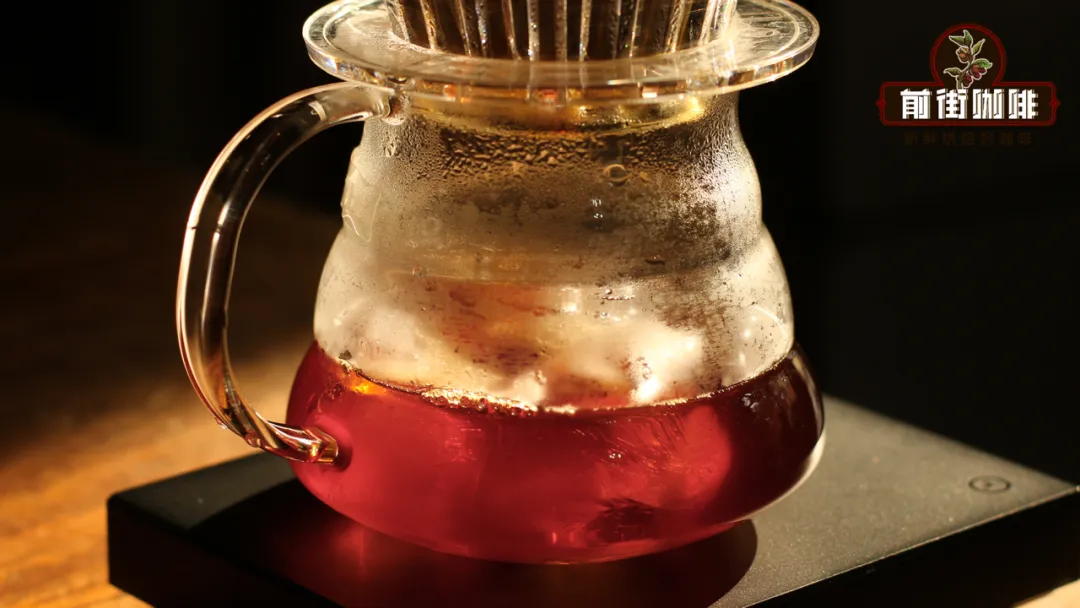
After combining a large amount of data, James concluded that the ratio of ice to water can be controlled at 4:6. For example, Front Street's commonly used single-serving 15 g dose (for hot brewing, a 1:15 coffee-to-water ratio) corresponds to iced brewing parameters of 90 g ice plus 135 g hot water; if you can confirm that the ice temperature is low enough, you can reduce the ice ratio to about 80 g ice plus 150 g hot water.
Grind finer to retain more aroma
Regarding iced pour-over, there is one fact that must be faced: after coffee cools, aroma intensity declines, and sweetness and layering weaken as well. This is also why, when customers hesitate between cold and hot, Front Street always emphasizes that if you want to taste the flavors, it is best to choose hot.
Grinding the coffee finer is mainly to compensate for the insufficient extraction time caused by the smaller amount of hot water. Second, a finer grind also helps increase the extraction yield, allowing the coffee to release more flavor substances under the rinse of less hot water. Taking the EK43s grinder used by Front Street as an example, if a certain coffee's hot-brew setting is 10, it can be adjusted to 9.5 for iced brewing. Taking the C40 hand grinder as an example, 24–26 clicks is a relatively moderate hot pour-over grind, and for iced brewing it can be adjusted finer by 2–3 clicks.
Small stream, pour slowly
As mentioned earlier, iced brewing uses less hot water than hot brewing. If you still rinse the coffee bed with the usual large stream, the brewing time will inevitably be greatly shortened, and many flavors that are only released in the middle and later stages will not have time to dissolve before the target water amount has already been poured. Therefore, we need to simulate the rhythm of hot brewing and redistribute the hot water that should be poured. Front Street's usual approach is to increase the number of pours, or consciously control a small stream , to bring the time back to around 2 minutes.
If you find all the above iced brewing plans too cumbersome and do not want to bother calculating, Front Street has one last trick: take out a small spoon and stir it~
After adding the coffee grounds, pour in the full target water amount of 150 g all at once, then use a small spoon to stir about 10 circles in the same direction so that the grounds and water make full contact. Once all the coffee liquid has flowed into the server, remove the dripper, swirl the coffee liquid to mix it evenly, and once the ice has completely melted, it is ready to enjoy.
Front Street Coffee (FrontStreet Coffee)
No. 10, Baoqian Street, Yandun Road, Dongshankou, Yuexiu District, Guangzhou, Guangdong Province
The above content is compiled by CoffeeHunters, a coffee news website.


