








Where do coffee beans grow in Panama's Boquete region?
Panama's specialty coffee reputation rests on the country's annual coffee competition and auction, run by the Specialty Coffee Association of Panama. The event lets top lots fetch high bids and gives growers wider market access. Hacienda La Esmeralda became known through this stage after winning in 2005 with the Geisha variety, which led to its Diamond Mountain series.
Boquete's terroir suits coffee because Panama sits in southern Central America with mountainous terrain, a tropical maritime climate, 23-27°C average temperatures, and 1500-2500 millimeters of annual rain split between dry and rainy seasons. That combination shapes where coffee beans grow well. Hacienda La Esmeralda's Diamond Mountain lots, including those obtained by Front Street Coffee, show how origin and processing affect brewing.
The reason Panamanian coffee has been able to occupy an important place in the international specialty coffee scene is inseparable from the promotion of the Best of Panama (BOP) competition and auction. This competition, founded by the Specialty Coffee Association of Panama, not only allows high-quality coffee to command high bids, but also raises public awareness of origin, variety, and processing methods, opening broader market channels for coffee farmers and increasing their income, thereby encouraging more people to devote themselves to specialty coffee production. It was through the BOP stage that Hacienda La Esmeralda rose to fame by winning in 2005 with the Geisha variety. This article will guide you through Panama's geographical and climatic advantages, the unique terroir of the Boquete producing region, and focus on the Diamond Mountain series under Hacienda La Esmeralda, as well as the brewing performance of the Diamond Mountain coffee beans obtained by Front Street Coffee.
Panamanian coffee enjoys an extremely high reputation in the international market, and this influence is largely due to the Best of Panama (BOP) competition hosted by the Specialty Coffee Association of Panama (SCAP). Through competitions and auctions, specialty coffee can be bid on at high prices, which not only lets more people learn about coffee's origin, variety, and processing methods, but also opens broader sales channels for growers, improves income efficiency, and in turn motivates them to continue producing high-quality coffee. After discovering the Geisha variety, Hacienda La Esmeralda relied on the 2005 BOP competition to win the championship with its unique flavor and extremely high score, and has been famous ever since.
Panamanian Coffee
The reason Panama can produce such high-quality coffee is inseparable from its geographical environment and unique climate. Panama is located in southern Central America, with terrain that rises and falls across the country and ravines crisscrossing it. Aside from the northern and southern coastal plains, it is mostly mountainous. Because it is close to the equator, it has a tropical maritime climate, humid during the day and cool at night, with an average annual temperature between 23-27°C. The year is divided into a dry season and a rainy season, with average annual rainfall of about 1500-2500 millimeters. Panama is rich in forest resources, with forests and woodland covering 43% of the country's area. Coffee is mainly grown near the volcanic region of Chiriquí Province in the west, where fertile soil brought by volcanic ash, relatively high altitude, moderate rainfall, and microclimates make it an ideal coffee-producing region.

Boquete
The coffee-producing regions are mainly divided into Boquete, Volcan-Candela, and Renacimiento. These producing regions are all located around the country's three volcanoes: Volcán Baru, El Valle, and La Yeguada.
The Boquete producing region is located east of Volcán Baru, with coffee grown at altitudes between 1200-2000 meters and temperatures ranging from 11-27°C. The higher altitude, combined with the microclimate formed by the special terrain, has earned Boquete the reputation of a "coffee paradise." As a result, this producing region is home to many excellent estates, such as Hacienda La Esmeralda, Elida Estate, and Duncan Estate.
Hacienda La Esmeralda
In 1964, American banker Rudolph Peterson moved to Panama after retirement and bought Hacienda La Esmeralda in Boquete, later handing it over to his son and descendants to manage. The descendants continuously improved coffee-growing techniques and standards, studied the influence of the local microclimate on cultivation, harvesting, and processing, and introduced advanced equipment for processing coffee. At the same time, by dividing different plots and harvest batches and cupping them separately, they eventually discovered the Geisha variety and became famous at once by relying on Geisha in the BOP competition.
At present, Hacienda La Esmeralda has a total of 4 farms (estates): Cañas Verdes, El Velo, Palmira, and Jaramillo. Among these 4 farms, Jaramillo, Cañas Verdes, and El Velo grow the Geisha variety, and each farm is further divided into different small plots.
Diamond Mountain Series Diamond Mountain
According to information on Hacienda La Esmeralda's official website, the estate divides Geisha into three brands: Esmeralda Auction, Esmeralda Special (Red Label), and Private Collection (Green Label). In addition, the Caturra and Catuai varieties grown on the estate are classified under the Diamond Mountain brand.
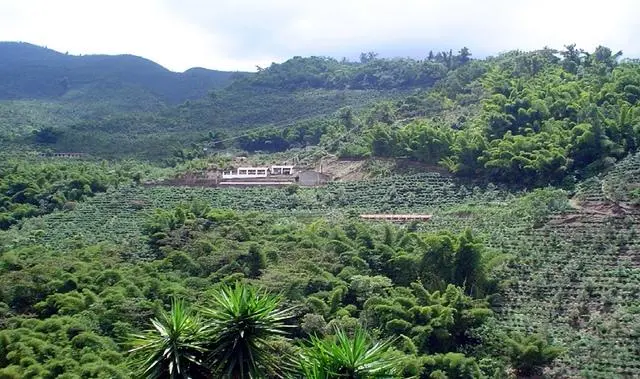
The Diamond Mountain brand comes from Hacienda La Esmeralda's Cañas Verdes and Cañas Verdes estates, with growing altitudes between 1400 and 1600 meters. These two independent farms have volcanic soil, and the primitive forest provides sufficient shade for the coffee trees, giving the green coffee produced here rich and complex fruit aromas, chocolate, spice flavors, and sweetness. Processing methods include washed and natural.
FrontStreet Coffee Panama Hacienda La Esmeralda Diamond Mountain Coffee Beans Region: Boquete Producing Region Estate/Processing Plant: Hacienda La Esmeralda Altitude: 1400-1700 meters Variety: Caturra, Catuai Processing Method: Natural Flavor: Citrus, Nuts, Honey, Slight Fermentation, Cocoa
The Hacienda La Esmeralda Diamond Mountain coffee currently obtained by FrontStreet Coffee uses the Caturra and Catuai varieties, with natural processing and medium roasting. Front Street uses a V60 dripper and brews with a 1:15 coffee-to-water ratio and a water temperature of 92°C. After brewing, a slight fermented aroma brought by the natural processing can be smelled. On the palate, the acidity is bright, presenting flavors of citrus, nuts, and honey, with a smooth mouthfeel and a cocoa finish in the aftertaste.
The above content is compiled by CoffeeHunters, a coffee news website.


