








How Did Upside-Down Street Coffee Become a Tradition?
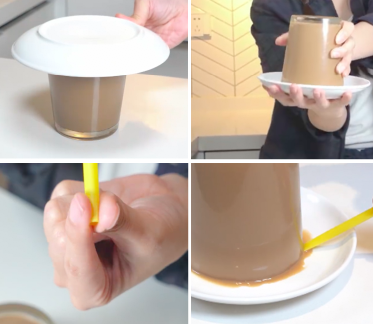
Kupi Khop is a traditional drink from Meulaboh, the capital of Aceh Province in Indonesia, whose name translates to upside-down coffee. The cup is flipped onto a saucer with the coffee inside, and drinkers either sip through a flattened straw pushed into the gap between cup rim and saucer, or lift the saucer to their lips and let the coffee flow out slowly.
The method drew attention recently when a social media user demonstrated the flip-and-sip move, and commenters soon identified it as an existing Indonesian practice rather than a new invention. The serving style has practical roots in local drinking habits, and it now circulates online as a viral example of street coffee culture from the Aceh region.
In the coffee world, it seems like anything can be reinvented, even the way we drink coffee. Recently, a netizen shared a jaw-dropping method on social media—flipping the coffee cup upside down on a saucer and sipping through a straw from the gap. This seemingly bizarre practice is actually a traditional drink called Kupi Khop from the Aceh region of Indonesia. What historical and cultural stories lie behind it? Why do locals still insist on this seemingly ungraceful way of drinking? This article will take you on a journey to find out, while also exploring the unique flavors of Indonesian coffee and related recommendations from Front Street Coffee.
▲
Click to follow | Daily specialty coffee culture magazine Coffee Workshop
In a coffee shop, holding a saucer in one hand and lifting a cup with the other, unhurriedly enjoying your coffee—that's probably the most classic image of coffee tasting in everyone's mind. However, in this era where everything can be pushed to the limit, even the act of drinking coffee can be taken to new heights.
Recently, a netizen on social media had a wild idea: covering the saucer over a cup filled with coffee, making the cup's rim fit tightly against the saucer's bottom, then quickly flipping the whole thing over, and inserting a flattened straw through the gap between the cup's mouth and the saucer to sip. This move left onlookers stunned. Some remarked, "My silence is deafening," while others joked, "Aren't they considering the feelings of the sealing machine?" But soon, sharp-eyed netizens pointed out that this upside-down way of drinking coffee is actually a "viral drinking method" in Indonesia.
This drink is called Kupi Khop, which translates to "upside-down coffee," and is a specialty beverage from Meulaboh, the capital of Aceh Province in Indonesia. Its presentation is simple: a cup turned upside down on a saucer, containing coffee. Faced with such a drink, the usual way of drinking obviously won't work. Customers receiving the coffee will insert the straw provided by the shop into the gap and sip, or they can go local and, like the locals, bring the saucer to their lips, letting the coffee slowly flow out from the gap and sipping it gradually.
Reading this, many might wonder: why do Indonesians drink coffee in this way, similar to "how a cat drinks water"? It doesn't look very dignified. Actually, this has something to do with the local environment in Indonesia. It's said that the Kupi Khop drinking method originated from outdoor workers. In areas with dense mosquitoes and insects, workers in open environments worried about bugs or dust falling into their open coffee, so they simply turned the cup upside down and sipped slowly from the saucer.
Moreover, at that time, thermos bottles were not yet common. After flipping the coffee upside down, the cooling rate would slow down, so workers didn't have to worry about the coffee getting cold quickly, and the flavor could be preserved longer.

In modern society, the problems locals once worried about can be easily solved with sealed cups or thermos bottles, and this less elegant way of drinking coffee should have been phased out by the times. But even today, many coffee shops in Meulaboh still sell Kupi Khop. The reason this drink hasn't been eliminated is partly to preserve the local specialty coffee, and partly to commemorate the local national hero, Teuku Umar.
At the end of the 19th century, this general sacrificed his life heroically while fighting against Dutch invaders. To honor him, the Indonesian people have always kept the upside-down coffee, which resembles the shape of Teuku Umar's iconic dome hat, and also express their stance against foreign cultures eroding local coffee culture.
But frankly speaking, upside-down coffee might just be the most suitable way to drink Indonesian coffee. Most Indonesian coffee uses Robusta beans, and the preparation is quite primitive: grind the coffee beans and put them directly into the cup, pour in hot water, cover with a saucer, and flip it over—a cup of upside-down coffee is ready in no time.
So this method of sipping from the saucer not only prevents debris from falling into the cup but also avoids drinking unfiltered coffee grounds—it's a win-win.
To cater to modern tastes, upside-down coffee has now been improved, allowing for additions like milk or condensed milk to make an upside-down latte, with a more pleasing overall flavor. However, watching the locals' bold technique in making upside-down coffee, if you didn't know any better, you might think you were buying rice noodles from a street stall at a night market.
Image source: Internet
Disclaimer: Some images in this article are from the Internet. For some content on the website, such as images, we will respect the original copyright and indicate the source. However, due to the large quantity, some images and texts may not be credited in time. Please forgive us. If the original author has any disputes, they can contact the website for handling. Once verified, we will correct it immediately. Compiled and edited by "Coffee Workshop," please indicate the source when reprinting. If there is any infringement, please inform us for deletion. Thank you~!
The above content is compiled by CoffeeHunters, a coffee news website.


