








Is It Normal for the Coffee Bed to Collapse After Blooming?
A coffee bed that puffs up and then collapses during blooming is usually normal. The dome forms because wet coffee particles stick together while gases release and lift the bed. When a crack breaks that stable structure, the gas loses support and the bed sinks. Since the grounds did expand, they were still degassing, so stale beans can be ruled out.
Water volume, grind size, and pouring technique are the three factors that decide whether the dome holds or caves in. A full, regular rise points to fresh beans within their flavor window, while no rise at all suggests long storage. Blooming uses a small amount of hot water to wet the bed evenly, then rests for several tens of seconds before the main pour.
During the blooming phase of pour-over coffee, the coffee bed usually forms a fluffy "hamburger" dome, which is an important signal for judging the freshness of coffee beans. But some friends have noticed that after pouring water, the coffee bed briefly puffs up but then quickly collapses—is this normal? This article will analyze the causes of "expand first, then collapse" from three angles: water volume, grind size, and pouring technique, and combine Front Street Coffee's brewing experience to give specific judgment and adjustment suggestions, helping you master the blooming stage more precisely.

Blooming is a key preparatory step in pour-over coffee: use a small amount of hot water to evenly wet the coffee bed, then let it sit for several tens of seconds. When the coffee bed rises smoothly and forms a full, regular "dome," it usually indicates that the coffee beans are still relatively fresh and at their optimal flavor window. Conversely, if the coffee bed shows no sign of puffing up, or even collapses inward directly, it most likely means the beans have been stored too long and lack freshness, and the brewed coffee will probably taste disappointing as well.
However, besides these two common situations, some attentive friends have reported to Front Street that they encountered a third condition: after pouring water, the coffee bed briefly bubbles and puffs up, but then immediately begins to sink, and the coffee bed suddenly caves in. Is this situation normal?
Why does the coffee bed collapse immediately after expanding?
The reason blooming can puff up into a "hamburger" is mainly that the coffee particles stick to each other after contacting water, while gases are continuously released, lifting the entire coffee bed upward and forming a loose yet stable degassing structure.
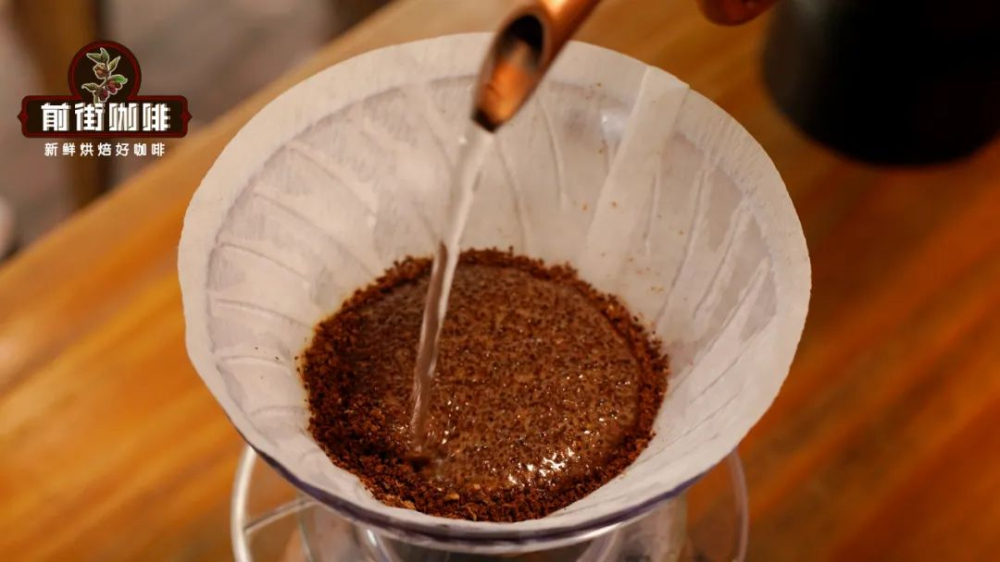
Once the stable structure between particles is broken by an "external force" and a large crack that cannot bond back appears somewhere in the dome, the gas loses the support of the coffee bed and naturally collapses downward. Since the particles did expand after absorbing water, it shows that these coffee grounds were still in a "degassing" state at that time, so we can first rule out stale coffee beans.
Coffee beans that have almost completely released their gases will basically show no sign of puffing up during blooming, and the flavor will be noticeably damaged.
So what causes this phenomenon of "expanding first, then collapsing immediately"? Based on Front Street's brewing experience, there are mainly the following reasons.
Too much water poured
Generally speaking, the saturated water absorption of coffee grounds is about twice their own weight, so whether in daily brewing tutorials or baristas' extraction insights, the water used for blooming is often twice the coffee dose—that is, 15 grams of coffee corresponds to 30 grams of water. But for beginners who are not yet skilled at flow control, sometimes they inevitably pour too much water by accident. If they are also brewing light-roast beans with relatively weak water absorption, not only will more blooming liquid drip into the server, but the dome may also be "pressed" down by gravity.
Take the 15-gram dose commonly used by Front Street for brewing Yirgacheffe as an example. Pouring 30 grams in a small stream in circles from the center can just wet all the coffee particles, and the dome formed remains stable at 30 seconds. If more than 45 grams of hot water is used for blooming, you will find that the water level in the coffee bed rises somewhat, more coffee liquid flows into the server, and after all the blooming liquid has dripped through, the hamburger dome that just puffed up will also shrink slightly.
The coffee grounds are ground too coarse
Friends familiar with pour-over parameters should know that a delicious cup of coffee depends on an even and moderate grind size. For pour-over beginners, Front Street usually suggests first visually estimating a granulated-sugar-like coarseness, then judging whether fine-tuning is needed—coarser or finer—based on whether the extraction time falls within a reasonable range (about 2 minutes). If conditions allow, it is best to equip a No. 20 standard sieve with a 0.85 mm aperture for sifting, and control the grind setting within a coarseness that gives a 70–80% pass-through rate.
The most obvious consequence of grinding coffee too coarse is that before water has time to penetrate into the particles, it has already flowed into the server, resulting in under-extraction. During the blooming stage, when larger coffee particles first contact water, their surfaces release gas and make the coffee bed expand first; as hot water flows through the gaps between the large particles into the server, these cracks do not have time to "bond" back, and the dome quickly begins to shrink, appearing collapsed.
The pouring force is too strong
Gently pouring in a small stream in circles from the center outward is the blooming technique most people use, and the hamburger formed this way will slowly expand from the middle to the surroundings until it fills the entire bottom of the dripper.
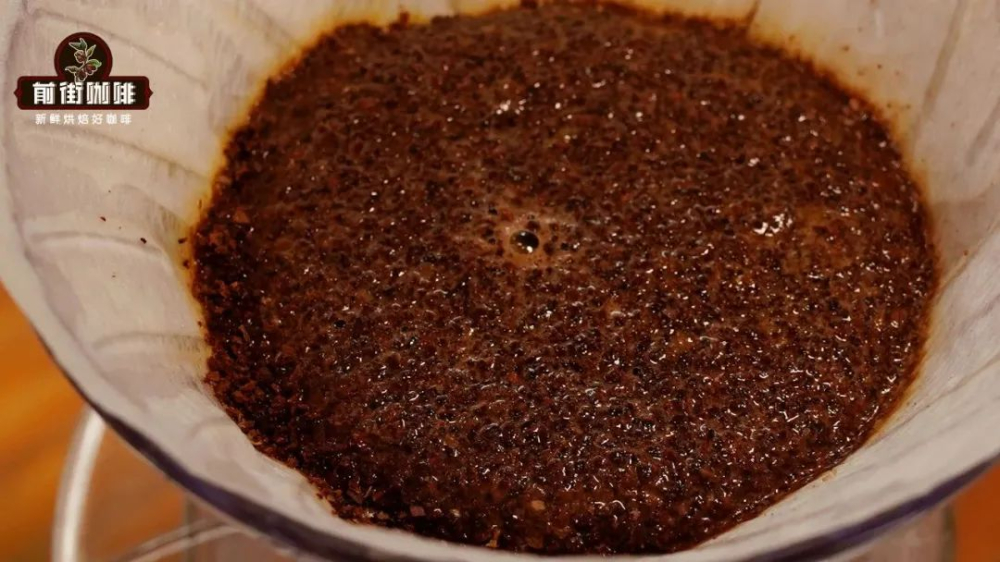
But if a more aggressive pour is used, focusing only on a small circle in the center, then the water column will directly strike the coffee bed, causing the distance between particles to increase. The center can puff up mainly because gas release blocks the water from descending; after all the gas has been released, the water begins to flow downward, leaving behind a hollow coffee bed, which naturally tends to collapse downward.
In summary, the coffee bed puffing up and then collapsing during blooming is clearly not a normal phenomenon. Although it cannot directly indicate that the coffee tastes wrong, it does reflect that there is a problem with our parameters or technique. We need to combine this with the final taste to find the cause, then "prescribe the right remedy" and solve it from the details.
- END - Front Street Coffee
No. 10 Baoqian Street, Yandun Road, Dongshankou, Yuexiu District, Guangzhou, Guangdong Province
The above content is compiled by CoffeeHunters, a coffee news website.


