








Is making coffee in a coffee pot with 30 grams feasible?
Doubling the dose from 15 grams to 30 grams changes pour-over extraction more than most people expect. With the coffee-to-water ratio held steady, the total brewing water nearly doubles, so pouring takes longer and the drip finishes later. The thicker coffee bed slows flow in the final stage, water pools above the grounds, extraction drags past two and a half minutes, and the cup turns dull and muddy.
The fix is not one setting but a set of adjustments. Grind slightly coarser to keep flow moving through the deeper bed, bloom with more water and a gentler pour, and split the pour into more, smaller stages. For a 02 dripper the dose fits with room to spare; on a 01, expect a tighter bed. A coffee enthusiast brewing for a crowd should watch the liquid level, not the clock.
During holidays and festivals when family and friends gather, there’s always someone who expects coffee lovers to brew a pot on the spot. But when the dose jumps from the usual 15 grams to 30 grams, the same technique can easily cause water to pool in the final stage, drag out the time, and make the flavor dull and muddy. Why does extraction change when the dose increases? Front Street Coffee breaks down the challenges of large-dose pour-over one by one, from dripper model and blooming method to pouring rhythm, and offers adjustment plans for both 02 and 01 drippers, helping you brew coffee close to your daily standard even for a crowd.

Relatives: “You know about coffee, right? Hurry up and make everyone a cup to try~”
Me: ……
I wonder if coffee enthusiasts returning home for the Spring Festival have also experienced a similar scene:
Under the watchful eyes of a group of relatives and friends, so that everyone can get a few sips, you simply weigh out dozens of grams of beans at once and boldly brew a big pot.
As a result, after all that, the liquid level in the final stage starts to rise, the total extraction time far exceeds two and a half minutes, and the flavor becomes dull and muddy, completely different from the cup you usually drink yourself. Where exactly is the problem?
Around this phenomenon, Front Street is here today to talk with everyone—when brewing this kind of large-dose coffee for multiple people, what details need special attention.
After the dose increases, why does this change happen?
Most people have a small-capacity dripper like the 01, or usually brew only one or two servings, with a relatively fixed dose, and rarely exceed 20 grams in daily brewing. Over time, we have long adapted to this “small-dose” operating logic: how much water a certain bean should pair with, how strong the flow should be, when to stop pouring and when to resume… every step is handled with clear confidence.
However, when the dose suddenly jumps to 30 grams, under the premise of keeping the coffee-to-water ratio unchanged, the total brewing water nearly doubles (or even more). The pouring itself will take proportionally longer, so the overall time for the drip filtration to finish naturally rises along with it.
In addition, no matter which style or model of dripper is used, once the dose increases, the coffee bed必然 rises and thickens, and the total time required for water to pass through the coffee grounds and fall into the server is also prolonged. Take the usual 15 grams used by Front Street as an example: placed in an 01 V60, it reaches about half the height of the cone, and it usually finishes dripping in 1 minute 50 seconds to 2 minutes 10 seconds; while brewing with 30 grams, you can see from the outside of the dripper that the coffee bed has already piled up to two-thirds of the cone. If you still follow the “small-dose” pouring habits, by the time all the coffee liquid has dripped through, it will take at least 2 minutes 40 seconds or more.
In other words, if you simply increase the single-brew dose, and the increase is obvious (for example, jumping directly from 15 grams to 30 grams), the coffee’s steeping time will be dragged out, and the bitter and miscellaneous components in the final stage are more likely to be brought out, making it easier to taste a bitter, messy, heavy, dull, thick and sluggish mouthfeel. Front Street’s view is that at this point you can make targeted adjustments according to the model of the dripper on hand, so that the final flavor stays as close as possible to your usual small-dose brewing performance.
When you have a large dripper on hand (02)
If you usually brew a single serving (15 grams) with a small dripper, when brewing for multiple people (30 grams), switch to a large dripper and convert the parameters proportionally, but to replicate the extraction model of the small dripper, two points still need attention: the blooming state and the flow rate.
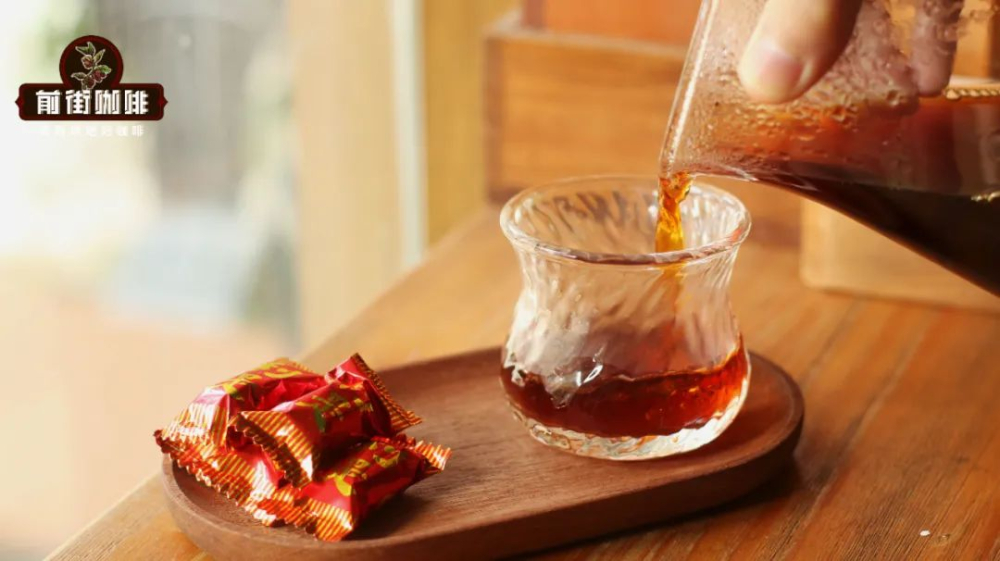
A larger dose means a thicker coffee bed, which requires more hot water to saturate all the particles and also allows more time for them to release gas. For example, when Front Street brews 30 grams of coffee with a conical 02 V60, the closer to the center, the thicker the coffee bed, so the bloom uses 60 grams of water and waits 35 seconds. When pouring, first concentrate on the center in a small circle, so the particles in the “C position” absorb water first and slowly spread out, and the gas will be expelled toward the surroundings, making the blooming effect more thorough.
Entering the main extraction stage, the pouring flow should be a bit larger than usual: first, it can raise the coffee bed and correspondingly increase the contact area between coffee and water; second, it can appropriately compress the contact time between coffee and water, preventing the coffee from steeping too long and causing over-extraction.
For example, when brewing a small dose, keep the flow rate at 5–6 ml/s; when brewing a large dose, you might as well increase it to 10 ml/s, and keep the total extraction time at around 2 minutes 30 seconds.
When you only have a small dripper on hand (01)
Everyone knows that the 01 dripper was originally designed to fit only 15–20 grams of coffee. If you insist on using this small device to brew 30 grams, it is clearly an “overload” operation. If you don’t believe it, just look: during blooming, the swollen dome almost fills the entire dripper, leaving even less room for subsequent pouring, and the final stage may even clog and retain water. So in order for a large dose to complete the process smoothly, we need to plan a new brewing scheme.
First, regarding grind size, Front Street suggests adjusting it coarser appropriately to reduce the resistance encountered by the water. Taking the EK43s used for shop production as an example, when brewing a large dose, baristas will adjust the setting coarser by 0.3–0.5 marks, and the No. 20 sieve pass rate drops from about 80% to 75%, with the goal of appropriately speeding up the flow rate.
In terms of pouring technique, you can use multiple pours, while controlling the flow according to the expansion of the coffee bed to avoid overflow.
The coffee-to-water ratio is still 1:15, with 30 grams of coffee corresponding to 450 grams of hot water, which can be divided into 5 pours. The first bloom pour is 50 ml, and each of the remaining 4 pours is 100 ml. The bloom is still poured starting from the center; the second pour is in a small circle, the third pour’s circle is a bit larger than the second, the fourth pour’s circle is a bit larger than the third, and the final fifth pour is poured in the center, with a total extraction time between 2 minutes 40 seconds and 3 minutes.
- END - Front Street Coffee
No. 10, Bao’an Qian Street, Yandun Road, Dongshankou, Yuexiu District, Guangzhou, Guangdong Province
The above content is compiled by CoffeeHunters, a coffee news website.


