







What does the ICO report say about world coffee production in 2023/24?
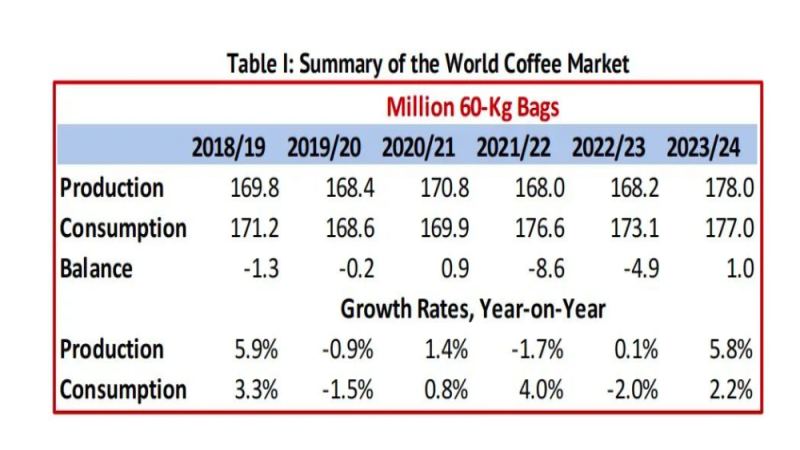
The International Coffee Organization reports that global coffee production in the 2022/23 coffee year grew just 0.1% to 168.2 million bags. For 2023/24, output is forecast to rise 5.8% to 178 million bags, which could leave a market surplus of about 1 million bags.
Regional results diverged sharply: the Americas reached 100.5 million bags, helped by Brazil's 8.4% biennial rebound, while Asia, Oceania and Africa fell 4.7% and 7.2%. Arabica production in the Americas rose 1.8% to 94.4 million bags, and Robusta fell 2.0% to 74.2 million bags, with El Niño pressuring key world coffee producing countries such as Vietnam and Indonesia.
The latest report from the International Coffee Organization (ICO) shows that global production in the 2022/23 coffee year grew by only 0.1%, reaching 168.2 million bags, with growth almost at a standstill. Behind this trend is intensifying regional divergence: the Americas expanded steadily, while Asia, Oceania and Africa saw marked declines due to adverse weather. At the same time, the knock-on effects of the COVID-19 pandemic caused world coffee consumption to fall by 2%. Looking ahead to 2023/24, El Niño may continue to hit Asian producing regions, but a recovering global economy is expected to drive a rebound in consumption, with production forecast to rise 5.8% to 178 million bags, potentially leaving a surplus of 1 million bags in the market.
According to the latest report released by the International Coffee Organization (ICO), global coffee production in the 2022/23 coffee year grew only slightly by 0.1%, reaching a total of 168.2 million bags. The near-stagnation in growth is closely tied to divergent regional performance—producing regions in the Americas continued to expand, while the rest of the world generally contracted.
Production in Asia, Oceania and Africa fell by 4.7% and 7.2% respectively, to 49.84 million bags and 17.9 million bags. This decline was mainly due to the impact of unfavorable weather on major producing countries, with Vietnam and Uganda seeing particularly significant reductions. These regional production losses were offset by growth in the Americas, especially a 4.8% increase in South America, mainly driven by Brazil's 8.4% biennial production rebound, bringing total production in the Americas to 100.5 million bags.
In addition, Arabica coffee production in the Americas rose 1.8% to 94.4 million bags, while Robusta coffee production fell 2.0% to 74.2 million bags.
Overview of the World Coffee Market
The adverse weather conditions that emerged in 2022 and persisted into 2024 will have a negative impact on the outlook for 2023/24. El Niño is expected to affect Asian regions, especially Indonesia and Vietnam. Indonesia's meteorological agency (BMKG) says two-thirds of the country could face drought and high temperatures. Vietnam likewise faces drought and hot weather, further increasing pressure for reduced output.
Earlier, affected by the knock-on effects of the 2019 COVID-19 pandemic—including rising living costs, reduced disposable income, persistently low inventories and global economic problems—world coffee consumption in 2022/23 fell by 2% to 173.1 million bags.
The International Coffee Organization also forecasts that the global economy will grow at 3%, and that the coffee industry will adjust to the situation of sharply lower inventories. Global coffee consumption is expected to grow 2.2% to 177 million bags. Among this, non-producing countries are playing a positive role in driving consumption growth, with coffee consumption in these countries expected to rise 2.1%. Therefore, the world coffee market is expected to show a surplus of 1 million bags in 2023/24.
Looking ahead, coffee production in 2023/24 is expected to grow 5.8% to 178 million bags. Among this, Arabica coffee production will rise to 102.2 million bags, and Robusta coffee production will rise to 75.8 million bags.
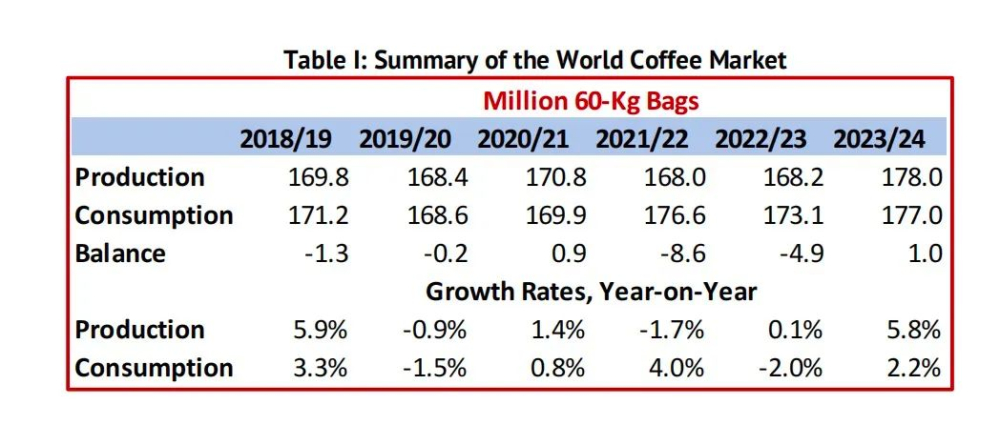
Note: Each bag is 60 kg.
The above content is compiled by CoffeeHunters, a coffee news website.


