







Can Machine-Made Pour-Over Still Count as Specialty Coffee?
Luckin Coffee opened its first flagship store offering pour-over coffee, the only Luckin location currently doing so. A customer video shows the process handled entirely by a machine that mimics a champion barista's parameters: 23 grams of beans, ground and brewed with 88°C water in ten pours over about three minutes. Critics called the cup light and weak, with clogged grounds left unaddressed.
Online reaction split. Supporters said a 20-yuan pour-over meets basic expectations, while critics argued machine brewing cannot be called pour-over because the method depends on the barista's hand. Luckin's move toward specialty coffee is understandable given its budget-focused image, but the episode shows that quality and professionalism still need work before customers feel the price is justified.
Luckin Coffee is known for its low prices and co-branded collaborations. After surpassing ten thousand stores, it began to transform, launching its first flagship store with pour-over coffee, making it the only store currently offering pour-over. However, a video exposed by netizens shows that the entire process is handled by a machine simulating champion techniques, pouring water ten times at 88°C over about three minutes. The result was criticized for being light in color and weak in flavor, with clogged grounds left unaddressed. Supporters argue that a 20-yuan pour-over already meets basic needs, while critics say machine brewing cannot be called pour-over—the essence of pour-over lies in the human touch. Luckin's intention to pursue a specialty coffee path is understandable, but the quality and professionalism still need improvement for consumers to get their money's worth.
▲ Click to follow | Daily specialty coffee culture magazine Coffee Workshop For a long time, Luckin Coffee's image in the public mind has been defined not just by its frequent co-branded collaborations, but by its affordable 9.9-yuan-a-cup pricing. This positioning leads many to see it as a budget-friendly chain brand—less refined than Starbucks, but more approachable. For this reason, when its store count crossed the ten-thousand mark, Luckin chose to use the occasion to upgrade, making its first flagship store a breakthrough. Beyond regular coffee drinks, this store separately offers pour-over coffee, and it is currently the only Luckin store where you can get pour-over. As soon as the news came out, it attracted many curious netizens to visit and check it out.
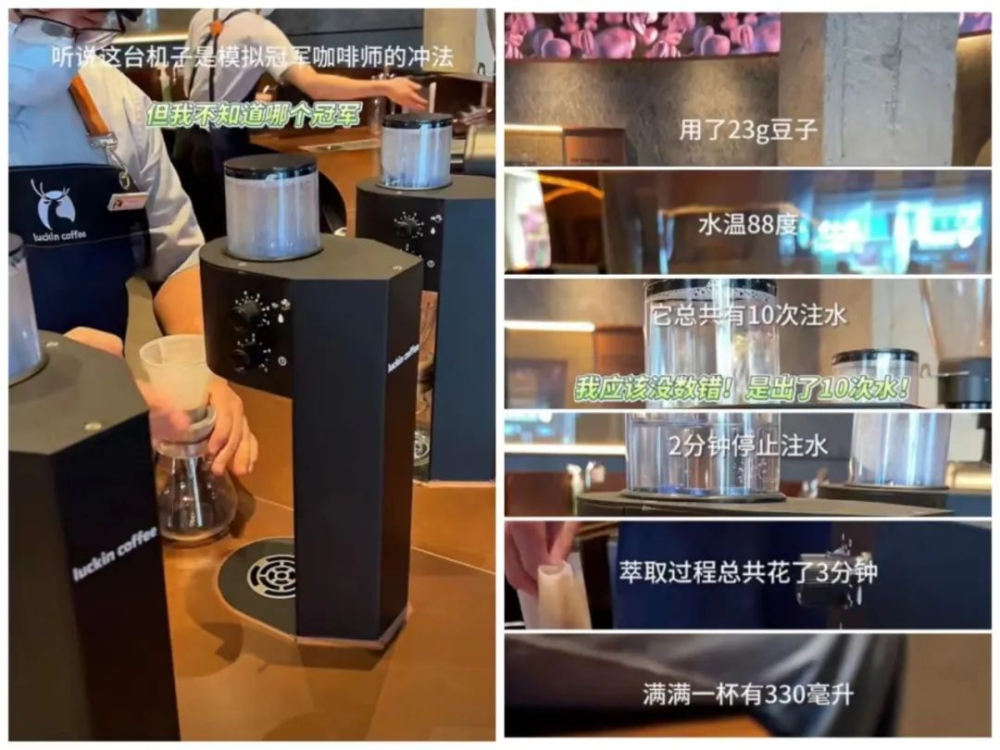
Earlier, a netizen filmed the complete process of making Luckin's pour-over coffee and posted the video on social media. From the footage, this cup of pour-over is noticeably different from what everyone is familiar with. Normally, pour-over involves a barista holding a gooseneck kettle and calmly pouring water into the dripper, but this cup from Luckin does not come from a barista's hands—it relies on a machine that mimics a champion barista's brewing parameters.
The staff first weighs out 23 grams of coffee beans and grinds them into powder, then pours the grounds into the pour-over kettle, places the kettle under the machine's water outlet, and injects 88°C hot water in ten pours. At one point, the coffee bed became clogged, but the staff seemed not to notice, and the machine continued brewing as usual. The entire extraction lasted about 3 minutes, ultimately yielding 330 milliliters of coffee. After receiving the finished coffee and the flavor card, this netizen felt that Luckin's pour-over was on the lighter side in color, with flavors that were not distinct enough on the palate and overall rather weak. When asking the staff, the reply was that the hot version would be a bit lighter.
After watching the entire production process, many netizens bluntly said this is clearly machine-brewed—how can it be called pour-over coffee? "All flash and no substance, might as well just use a Clever Cup," "《Machine-Made Pour-Over Coffee》," "Flooded pour-over," and some simply advised Luckin not to bother with pour-over—wouldn't it be better to just focus on commercial coffee?
However, some netizens pointed out that light-roast beans naturally produce a lighter-colored brew, and besides, what more do you expect from a 20-yuan pour-over? Some netizens who tried it in-store also thought the coffee was quite good, at least satisfying everyday needs.
The flavor experience of pour-over is inherently subjective, and it's hard to judge whether Luckin's cup is good or not based solely on individual netizens' opinions. But looking at the brewing process, some emphasize that the essence of pour-over lies in the person, and coffee made by a machine should not be called pour-over coffee.
Other netizens felt that Luckin's staff were not professional enough during preparation—failing to promptly address the clogged coffee bed and seeming somewhat perfunctory when answering customers' questions. As for Luckin's intention to move toward specialty coffee, netizens are not unable to understand it—they just hope the brand puts more effort into the final product, so that consumers truly feel it's worth spending money on pour-over. Image source: Xiaohongshu Disclaimer: Some images in this article are from the internet. We respect the copyright of original works and will credit the source. However, due to the large volume, some images and text may not have been credited in time. We ask for your understanding. If the original author has any disputes, please contact the website and we will handle it. Once verified, we will correct it immediately. Compiled and edited by "Coffee Workshop." Please indicate the source when reposting. If there is any infringement, please inform us for removal. Thank you~!
The above content is compiled by CoffeeHunters, a coffee news website.


