







Vietnam Coffee Supply Recovers, Prices Adjust Across Global Markets
Vietnam's robusta harvest has come in larger than earlier estimates, easing the tight supply that pushed prices to record levels. As new crop volumes reach exporters, futures contracts have softened, and buyers in Europe and Asia are rebuilding inventories. The shift reflects a market that had priced in shortages and is now recalibrating as shipments resume from ports in Ho Chi Minh City and Da Nang.
At the same time, arabica coffee from Brazil and Colombia faces its own weather pressures, and the spread between the two species has narrowed. A stronger dollar and slower demand in some importing countries add further weight. Traders note that the recovery in Vietnam does not erase broader concerns about climate variability, labor costs, and the pace of replanting in key growing regions.
The Vietnamese coffee market has recently seen a turning point, with prices that had been climbing steadily due to supply shortages beginning to fall back. A survey by the Vietnam Coffee and Cocoa Association shows that coffee prices in the Central Highlands have generally declined, while factors such as improved weather in Brazil, the expiration of coffee futures contracts, and a stronger US dollar have also put pressure on international coffee prices. Although Vietnam's coffee export volume declined somewhat in 2023, its export value hit a record high. This article will analyze in detail Vietnam's coffee price trends, export data, and global market dynamics, providing coffee enthusiasts with the latest market information.
Previously, the Vietnam Coffee and Cocoa Association (Vicofa) had predicted that due to supply shortages, Vietnamese coffee prices would continue to rise in 2024. Vietnam's coffee season usually runs from November to March of the following year. However, when the new season began this November, coffee prices had already climbed to 60,000 Vietnamese dong/kg, setting a record high since the start of a new season. Recently, prices have reached as high as 70,000 dong.
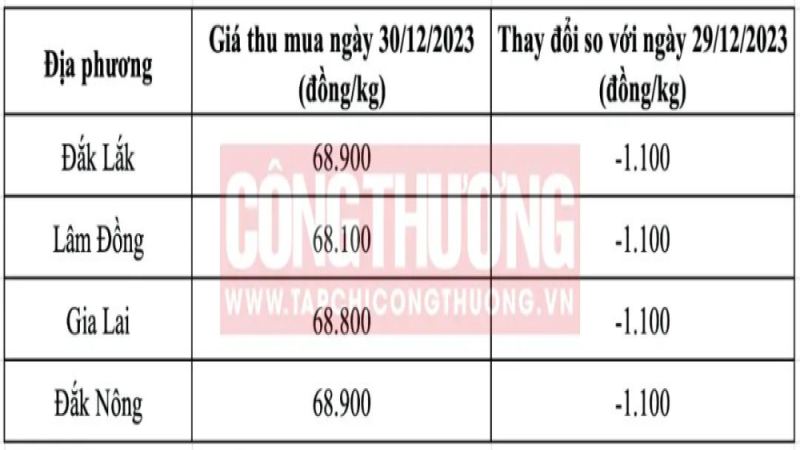
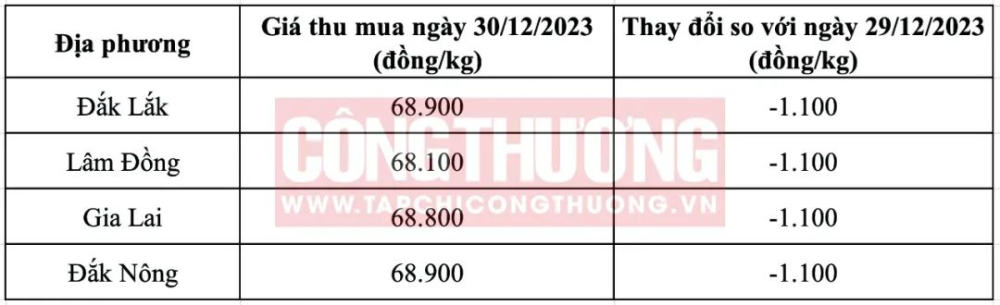
However, the Vietnam Coffee and Cocoa Association recently said that, according to its survey, coffee supply has increased somewhat, so prices will fall back in the near term. The survey results show that coffee prices in the Central Highlands all fell by 1,100 dong/kg, fluctuating between 68,100 and 68,900 dong/kg. Specifically, coffee prices in the Lam Dong production area dropped to 68,100 dong/kg, the lowest among the four areas surveyed. Coffee prices in the Gia Lai production area fell to 68,800 dong/kg. Meanwhile, coffee prices in the Dak Lak and Dak Nong production areas fell to 68,900 dong/kg, currently the highest local price.
According to data from the General Statistics Office, Vietnam's coffee exports continued to surge sharply in December 2023 and reached their highest level in the past nine months, at 190,000 tons, up 53.9% from November 2023, but still down slightly by 3.5% year-on-year. Export value reached US$538 million, up 51% from November 2023 and up 26.4% year-on-year. Looking back at the full year 2023, Vietnam's coffee exports were estimated at 1.61 million tons, down 9.6% from 2022. However, due to the sharp rise in export prices, the average export price of coffee in 2023 reached US$2,604/ton, up 14.1% from 2022. As a result, turnover increased by 3.1%, setting a record high of US$4.18 billion.
In addition to increased Vietnamese coffee supply, other factors in the world market have also caused prices to fall back. Recently, weather in Brazil's main coffee-growing regions has improved, reducing drought concerns and is expected to remain positive in the near future. The expiration of coffee futures contracts and the recovery of the US dollar also slightly pressured prices. According to ICE futures data in Europe, the price of robusta delivered in March 2024 fell by US$95/ton to US$2,481/ton, while the price for May 2024 delivery fell by US$92/ton to US$2,757/ton. On ICE Futures US, the price of arabica delivered in March 2024 fell by 9.7 cents/lb to 188.3 cents/lb, and the price for May 2024 delivery fell by 9.55 cents/lb to 186.2 cents/lb.
As of December 28, standard arabica coffee stocks at ICE Futures US sharply increased by 11,458 bags (60 kg/bag), bringing the total number of coffee bags currently in storage to 258,399. Although this has not broken through the more than 24-year low in reserves, this recovery is a positive signal for the future supply outlook.
The above content is compiled by CoffeeHunters, a coffee news website.


