







What does editor coffee meaning tell us about judging extraction by flavor alone?
Under-extraction and over-extraction both produce unpleasant flavors, and the extraction state of pour-over or espresso can be judged by taste. In 1952, Dr. Lockhart's team found that about 30 percent of coffee beans consists of soluble substances, and surveys led to the Golden Cup standard of 18 to 22 percent extraction yield. Below 18 percent is under-extracted; above 22 percent is over-extracted.
Measuring yield is not required for home brewing, since even a yield inside the Golden Cup range can carry negative flavors. Sourness, sweetness, and bitterness in the cup point to what went wrong. Grind size, water temperature, and brewing rhythm are the practical adjustments, and the article explains how each change shifts the balance toward a balanced cup.
When brewing coffee, under-extraction or over-extraction will both bring unpleasant flavors. Starting from the Golden Cup extraction standard, this article explains the origin of the 18%~22% extraction yield, and details how to judge whether coffee is under-extracted or over-extracted by tasting flavor expressions such as acidity, sweetness, and bitterness. At the same time, for common extraction problems in home brewing, it provides practical suggestions for adjusting grind size, water temperature, and brewing rhythm, helping coffee lovers easily brew a balanced and tasty cup.
When certain unpleasant flavors appear in coffee, many people begin to speculate about the cause, and among them, under-extraction or over-extraction is often the most commonly mentioned conclusion after analysis. So, for beginners who have just come into contact with coffee, how can they judge whether the cup in front of them is under-extracted, just right, or already over-extracted?
First, let's talk about what under-extraction and over-extraction actually mean. In 1952, Dr. Lockhart and his research team discovered that about 30% of coffee beans consists of soluble substances, and the degree to which these substances are extracted directly changes the final flavor direction of the coffee. Based on this discovery, they immediately launched a survey of American consumers' coffee preferences.
After repeated rigorous verification, the final conclusion was: when the coffee's extraction yield falls between 18% and 22%, the taste is the most popular and also the best. This is what we now call the "Golden Cup" extraction standard. If the coffee's extraction yield is below 18%, it is classified as under-extracted; and when the extraction yield is above 22%, it belongs to over-extraction.
However, Front Street does not recommend judging whether a cup of coffee is properly extracted directly by measuring the extraction yield. On the one hand, we are not doing academic research; on the other hand, even if the extraction yield is within the Golden Cup range, unpleasant negative flavors may still appear.
The main issue this Front Street article aims to solve is the practical problem everyone encounters when brewing coffee at home: how to judge whether extraction is appropriate. Therefore, Front Street more strongly recommends identifying the coffee's extraction state based on the flavors you taste.
So, what flavors do under-extraction and over-extraction each bring?
Although Front Street has shared this passage many times, it still needs to be emphasized again here, because only by understanding this principle can you truly understand the meaning of under-extraction or over-extraction: the flavor substances in coffee beans can be roughly divided into three categories—acidic substances, sweet substances, and bitter substances. Although at the very beginning of extraction they are all released together, their release speeds are completely different.
Acidic substances are mainly released in large amounts in the early stage, sweet substances are mainly released in large amounts in the middle stage, and bitter substances are mainly released in large amounts in the later stage. It is precisely the different proportions of these three substances that create coffee's ever-changing flavors.
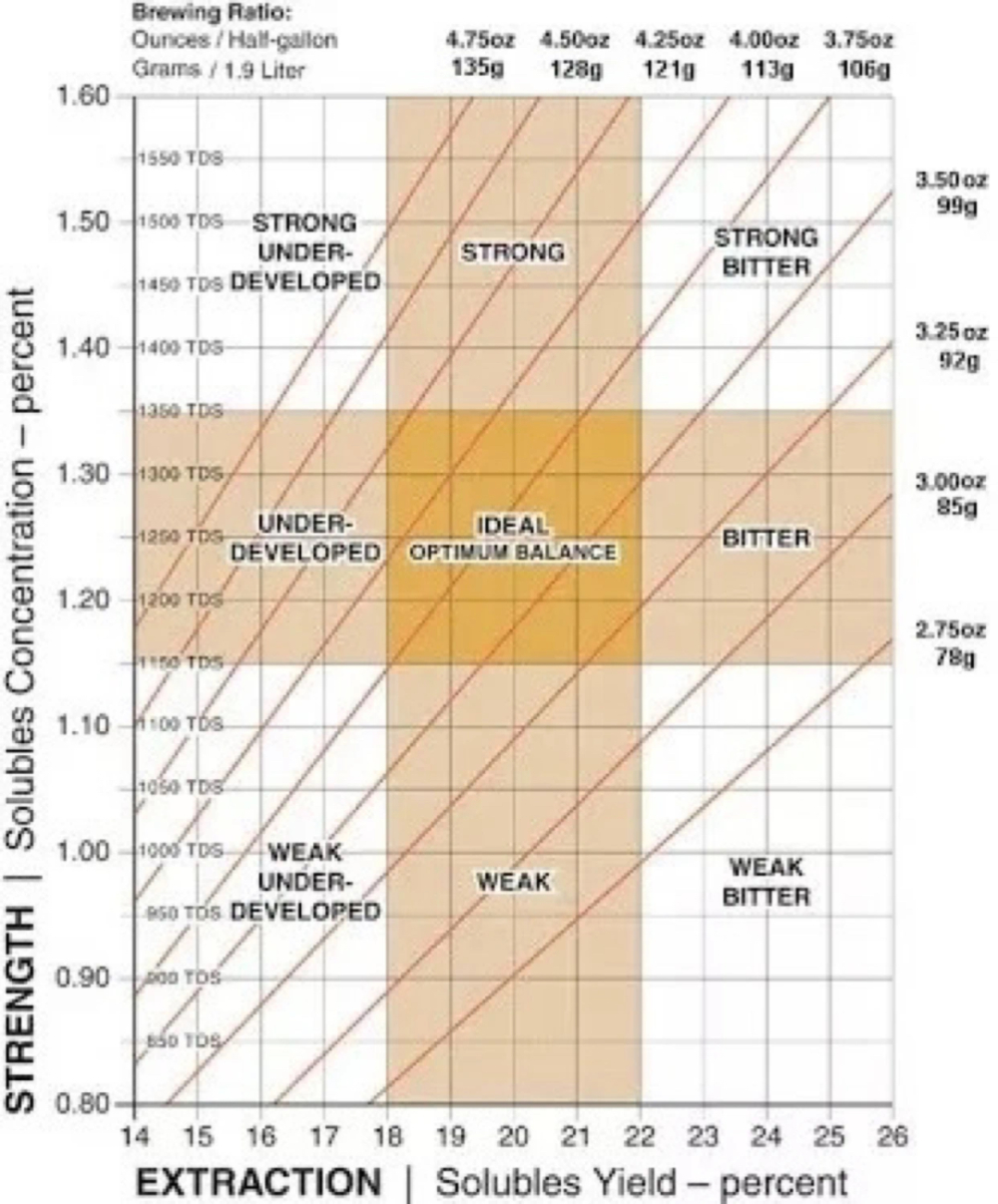
Under-extracted coffee usually leans toward the acidic end in taste, with an unpleasant sharpness when drunk, or other obvious negative flavors, and may also have mouthfeel problems. For example, acetic acidity and sharp sourness are the most common negative expressions of under-extraction. Second, there is almost no aftertaste after drinking, and if there is any, it is very likely to have a green, unripe feeling like eating unripe fruit.
In addition, it may be accompanied by a relatively obvious salty taste. The salty taste in coffee actually always exists; it is just that under proper extraction, it is masked by flavors such as acidity, sweetness, and bitterness. When under-extracted, however, the components that can cover the salty taste are reduced a great deal, so the salty taste naturally becomes prominent.
Over-extracted coffee, meanwhile, feels more prominent and obvious. When you taste relatively strong bitterness such as burnt bitterness or bitter miscellaneous flavors in a cup of coffee, you can judge that this cup is over-extracted.
Because over-extraction means extracting a large amount of the bitter substances from the coffee. Although a normally extracted cup of coffee also contains certain bitter substances, because they account for a relatively small proportion, we are not very likely to notice them.
But when extraction enters the later stage, bitter substances begin to be released in large amounts, and this breaks the balance of flavor, causing the whole cup of coffee to tilt toward the bitter end. In addition to bitterness, this cup of coffee will also carry negative sensations such as dryness and emptiness. Dryness is mainly because polyphenols bind with proteins in saliva, producing a rough mouthfeel; emptiness means the coffee tastes heavy and dull, without any layering, and cannot stir the taste buds.
So, after encountering these two situations, how should they be improved?
Under-extraction mainly occurs because the brewing time is too fast, and the water fails to fully dissolve the substances in the coffee particles; over-extraction is due to brewing for too long, bringing out all the substances that should not have been extracted.
Therefore, when such problems occur, we only need to control the brewing rhythm well, or correct under-extraction or over-extraction by adjusting extraction strength such as grind size and water temperature, and then we can brew coffee with a suitable taste.
- END -
Front Street Coffee (FrontStreet Coffee)
No. 10, Baoqian Street, Yandun Road, Dongshankou, Yuexiu District, Guangzhou, Guangdong Province
The above content is compiled by CoffeeHunters, a coffee news website.


