








What Seesaw's Store Closures Mean for Specialty Coffee
Seesaw Coffee has closed stores in multiple Chinese cities, including its Chongqing MixC location, all outlets in Wuhan, and several sites in Shanghai and Beijing. The Wuhan stores were set to stop operating after December 31, and the company told customers with stored-value card balances to request refunds through its mini-program or spend the balance on merchandise.
The shutdowns mark a sharp turn for a brand once described as a pioneer of creative coffee, which expanded quickly after several financing rounds and talked publicly about reaching 500 stores. Reaction among drinkers has been mixed, with some expressing regret and others questioning the chain's competitiveness as specialty coffee brands pull back on expansion.
Recently, the news that multiple stores of the specialty coffee brand Seesaw Coffee have been closing one after another across the country has sparked heated discussion. From the Chongqing MixC store to all stores in Wuhan, and then to multiple locations in Shanghai, Beijing, and elsewhere, Seesaw's wave of store closures seems to be spreading. This brand, once regarded as a "pioneer of creative coffee," expanded rapidly after securing multiple rounds of financing, but now its pace of opening stores has clearly slowed, drifting further and further from the "500 stores" goal once proposed by its founder. Consumers have reacted mixedly, with some expressing regret and others believing it lacks core competitiveness. Whether Seesaw can turn things around in the future is worth continued attention.
▲
Click to follow | Daily specialty coffee culture magazine Coffee Workshop
As the year-end approaches, the news that the specialty coffee brand Seesaw Coffee (hereinafter referred to as "Seesaw") has closed stores in multiple cities across the country has sparked extensive discussion and attention on social platforms.
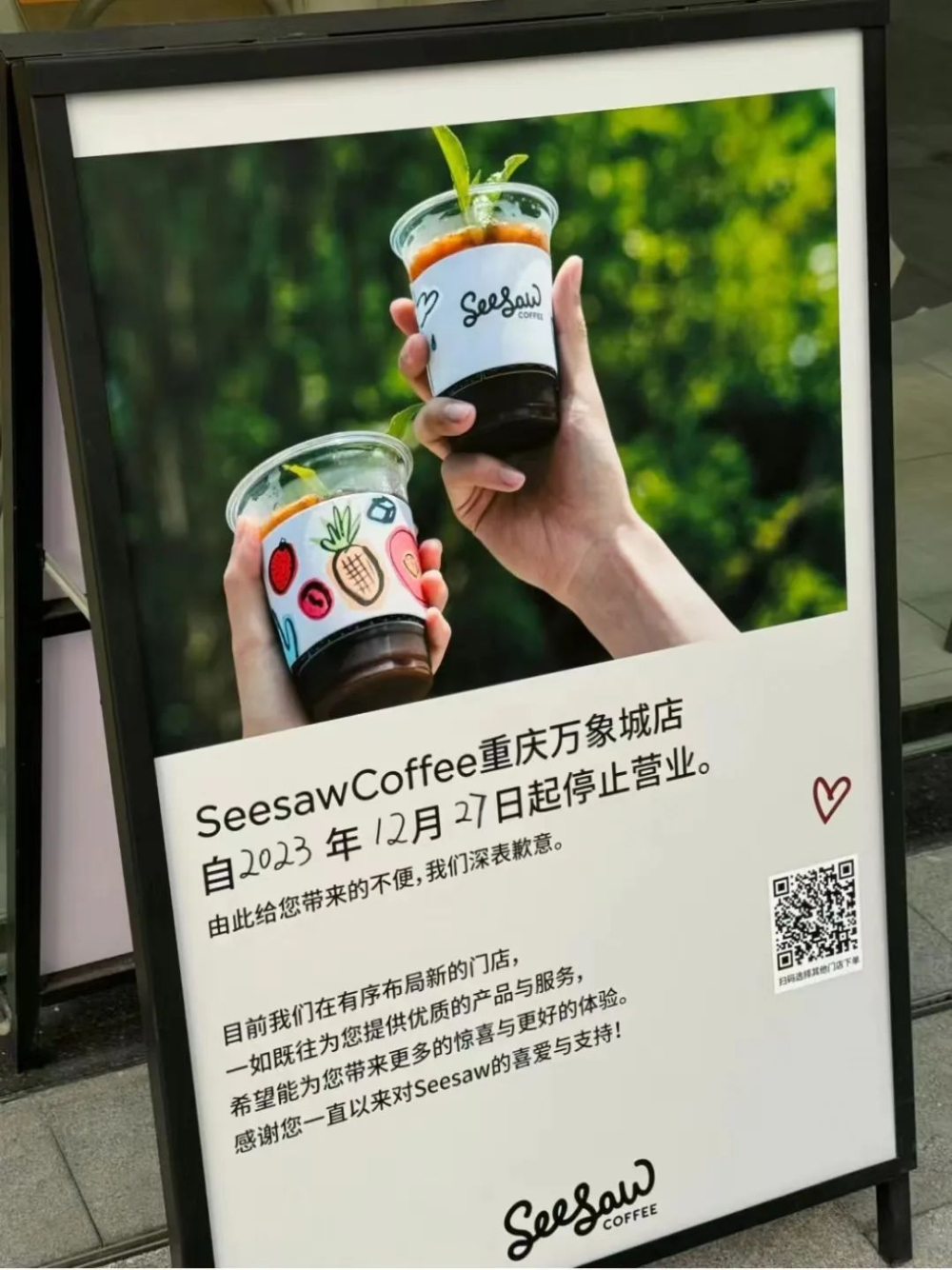
Previously, netizens successively posted that the Seesaw Chongqing MixC store had already ceased operations. According to the announcement, the store officially closed starting December 27, and the company did not explain the specific reason, only stating that it was orderly advancing the layout of new stores.
Soon after, netizens noticed that, following the closure of its first Chongqing store, Seesaw in Wuhan would also fully withdraw, with all stores planned to stop operating after December 31. Enthusiastic netizens also reminded that if there was still a balance on stored-value cards, customers could apply for a refund through the mini-program, or purchase merchandise and have it mailed home.
Searching Xiaohongshu with the keyword "Seesaw store closure" reveals many posts from coffee lovers saying that the Seesaw they frequently visited had already closed. For example, the Shanghai K11 Art Mall store closed on May 30, the Bailian Century store ceased operations on September 22, and stores such as Shanghai Changning International and Beijing Oriental Plaza were no longer operating, with notices once posted at their entrances reading "Store Adjustment, Temporarily Closed."
In response to the news of Seesaw's closures in multiple places, some netizens expressed great regret and lamented that a beloved coffee brand was withdrawing from the local market; others believed that the coffee industry is currently undergoing a "major reshuffle," and that this brand's coffee tastes mediocre, is priced on the high side, and lacks a clear core competitiveness, so "store closures are also within expectations."
It is understood that Seesaw was founded in Shanghai in 2012 and is one of the earlier brands in China to enter the specialty coffee field. It gained wide acclaim for its pursuit of specialty flavors and holds a place in the hearts of many coffee lovers. In 2020, Seesaw focused on developing creative coffee products, and through a differentiation strategy brought the brand widespread industry attention, which also led many consumers to call it a "pioneer of creative coffee."
At the same time, Seesaw also attracted the attention of many capital investors. Between 2017 and 2022, Seesaw completed a total of 3 rounds of financing, ranging from 45 million to several hundred million yuan, enabling the brand to expand "fiercely" between 2021 and 2022. However, Seesaw's pace of opening stores has never reached its expected targets.
According to a report by Winshang, Seesaw's founder once revealed plans to reach 200 stores by the end of 2022, with a goal of 500 to 1,000 stores within the next 5 years. However, data from Zhaimen Catering shows that as of December 4, Seesaw had a total of 135 stores nationwide, 70 of which were located in Shanghai, with the rest mainly distributed in first-tier cities such as Beijing, Hangzhou, and Shenzhen.
Entering 2023, Seesaw's pace of opening stores has clearly slowed. Based on public information, Seesaw's most recent opening update was still in August, meaning the brand had not opened a new store for 4 months. Moreover, with successive reports of store closures and withdrawals, it is clearly getting further and further from the "500 stores" goal.
Finally, whether Seesaw can turn the tide in the future coffee market, let us wait and see.
Image source: Xiaohongshu
Disclaimer: Some images in this article are from the internet. For some website content such as images, we will respect the original author's copyright and indicate the source, but due to the large quantity, a few images and texts may not have been credited in time. Please forgive us. If the original author has any dispute, they may contact the website for handling, and once verified we will immediately correct it. Compiled and edited by "Coffee Workshop." Please indicate the source when reposting. If there is infringement, please inform us for deletion. Thank you~!
The above content is compiled by CoffeeHunters, a coffee news website.


