







How did Catimor arabica coffee reach Yunnan small-bean farms?
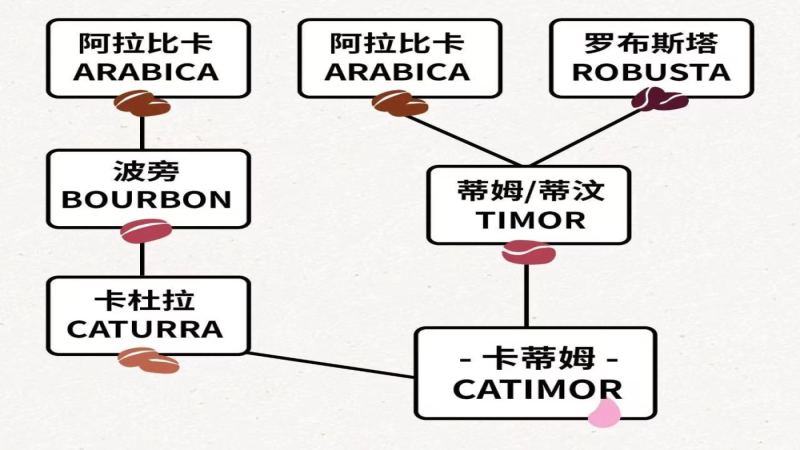
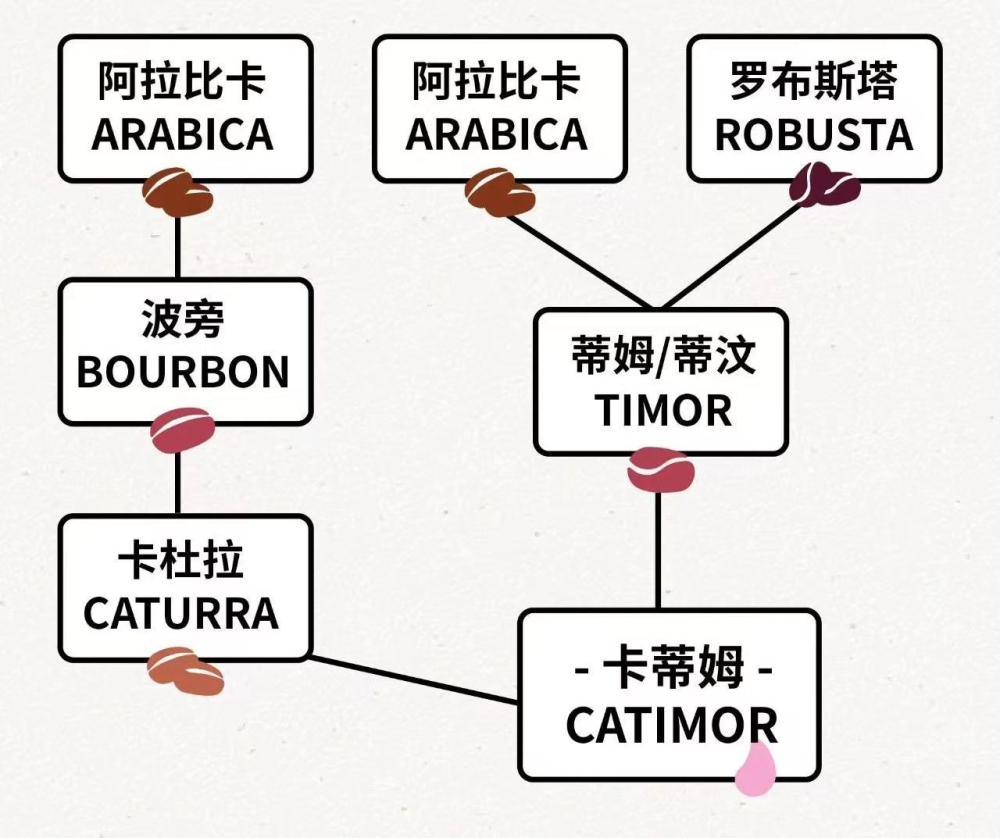
Catimor is not one variety but a group sharing a common line, bred to resist coffee leaf rust. It descends from Timor Hybrid, a natural cross found on East Timor, combined with Caturra, so it carries Arabica flavor potential plus Robusta disease resistance. The group spread widely across the Americas and Asia, and in Yunnan it replaced traditional Typica to become the dominant variety.
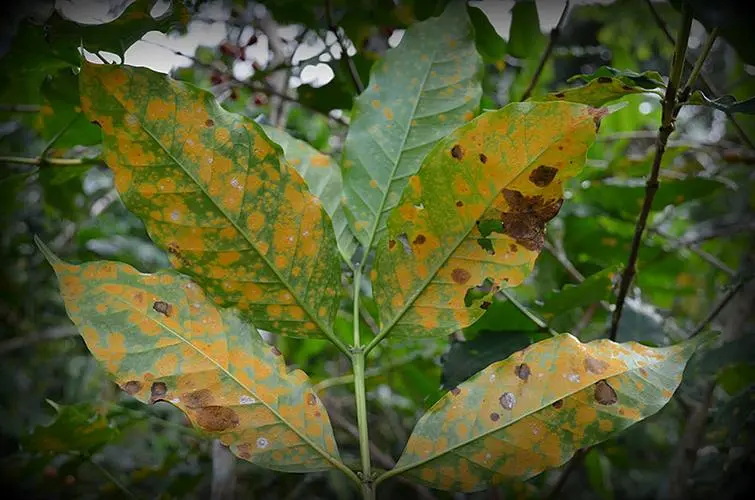
Leaf rust appeared in 1869, hitting Typica estates in India, Java and Sri Lanka. Growers responded by switching varieties, and Bourbon was carried from Réunion Island to Brazil in 1870, where it later mutated into Caturra and, in Costa Rica, Villa Sarchi. Catimor followed the same pattern of hybridization. Front Street Coffee describes Yunnan Catimor as balanced, with notes of nuts, brown sugar and plum.
Catimor is not a single variety, but a group of varieties with similar lineage, born from humanity's efforts to combat coffee leaf rust. From the natural hybrid Timor Hybrid on the island of East Timor to its combination with Caturra, Catimor inherited the flavor potential of Arabica and the disease-resistant genes of Robusta. This variety group is widely planted in the Americas and Asia, especially in Yunnan, China, where Catimor replaced the traditional Typica and became the dominant variety. This article will trace the origins of Catimor, the representative varieties bred in various regions, and its role in Yunnan small-bean coffee, while also exploring the relationship between its flavor performance and growing conditions. Front Street Coffee believes that Yunnan Catimor presents a balanced flavor of nuts, brown sugar, and plum.
Coffee varieties can be divided into three major categories: Arabica, Robusta, and Liberica. Over the long course of the coffee industry's development, many new varieties have emerged through continual transplantation, mutation, and hybridization. Well-known varieties such as Caturra, Catuai, and Catimor are all products of mutation or hybridization. We have previously introduced Bourbon, Caturra, and Catuai; today we will discuss the artificial hybrid bred to resist leaf rust — Catimor.
For centuries, coffee cultivation gradually spread around the world. However, every plant has its own "regional adaptability," and migrating from its native place to other countries requires a period of adaptation before it can survive. But the process has not always been smooth. In 1869, leaf rust began invading Arabica coffee plantations, first affecting Asia, including estates in India, Java in Indonesia, and Sri Lanka, where all the coffee planted at the time was the Typica variety.
After seeing Asian coffee estates ravaged by leaf rust, Europeans also began seeking preventive measures. The solution was to replace varieties, and so they found Bourbon. The French brought Bourbon from Réunion Island to Brazil for cultivation, and in 1870 Brazilian coffee estates switched on a large scale to Bourbon. During cultivation, Bourbon mutated due to adapting to the American climate, producing the variant Caturra; in 1950, Bourbon grown in Costa Rica also mutated into Villa Sarchi. By 1970, leaf rust had spread to the Americas, and Typica, Bourbon, and their variants were still being affected, causing major reductions in coffee production across producing countries and resulting in significant economic losses. So botanists in various countries began researching the use of scientific hybridization to breed new disease-resistant varieties.
In 1920, Timor Hybrid appeared on the island of East Timor. This was a natural hybrid of Arabica and Robusta, belonging to the Arabica coffee plant but carrying Robusta's disease-resistant genes. Crossing Timor with Caturra produced the first-generation F1 hybrid variety group, which is today's Catimor.
Catimor is merely the first-generation cross of Caturra and Timor, with the code T8667, and still needed selective breeding to become stabilized. Therefore, Catimor is not one variety, but a group of varieties with similar lineage. In addition, Timor was also crossed with another Bourbon variant to form the Sarchimor variety group, with the code T5296. These varieties are especially suitable for planting at altitudes of around 700-1000 meters. As new varieties that are high-yielding, disease-resistant, and able to adapt to warm low-altitude climates, they quickly spread through coffee plantations in the Americas. Starting in the late 1980s, coffee laboratories in various countries began developing their own Catimor subspecies.
Costa Rica
T8667 and T5175 are F5 descendants bred by Costa Rica's Tropical Agricultural Research and Higher Education Center (CATIE) from materials introduced from Portugal's H26, selected and developed, with T referring to Turrialba, where the institute is located. Another variety, Costa Rica 95, was bred by the Costa Rica Coffee Institute (ICAFE) and released in June 1995.
Costa Rica95
Honduras
The Catimor variety bred by the Honduran Coffee Institute (HCAFE) is named Lempira and can grow at altitudes of 600-1000 meters.
El Salvador
Bred by the Salvadoran Coffee Institute (ISIC), it is named Catisic and can be planted in acidic soil at altitudes of 600-1200 meters.
Catisic
China Yunnan
Before the 1960s, most of the small-bean coffee grown in Yunnan belonged to two old varieties, namely Typica and Bourbon. Beginning in the 1970s and 1980s, major coffee-producing regions around the world suffered from leaf rust, and coffee practitioners everywhere began trying to solve the problem. In 1990, driven by the foreign-funded company Nestlé, Yunnan introduced the Catimor variety from Central and South America, which had stronger disease resistance and higher yields, to replace the "unprofitable" Typica. Catimor began to be planted on a large scale in Yunnan, and production kept breaking records, but the flavor was not excellent. At the time, Yunnan farmers' green bean processing techniques were also not sophisticated enough, and the coffee batches produced were often sold at low prices, becoming raw material for bulk blends or instant coffee.
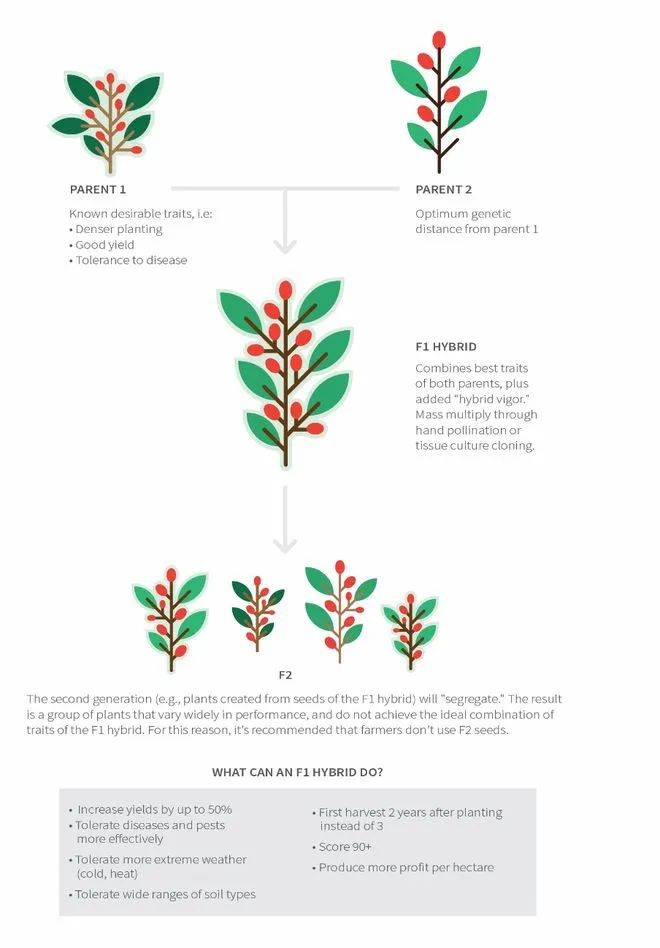
As a combination of Arabica and Robusta, Catimor inherits characteristics from both. The Catimor tree is relatively short, small in size, and heavily branched, allowing compact planting, and it can grow vigorously without shade. It not only has very strong resistance to leaf rust but also has a certain tolerance to common coffee berry disease, which helps increase the fruiting rate of the coffee tree. The fruit also ripens faster than other varieties, so yields are naturally higher.
Because Catimor carries some Robusta genes, it also inherits Robusta's flavor defects. If Catimor is planted at low altitudes, the coffee tastes bitter, and if handled improperly, it can also develop harsh astringency and musty notes. When Catimor is planted at an altitude of 1200 meters, its aroma is still not rich enough, and in many competitions it cannot compare with pure Arabica varieties such as Caturra and Catuai.
Front Street believes that Catimor coffee grown in Yunnan has a balanced flavor of nuts, brown sugar, and plum.
For professional coffee knowledge exchange and more coffee bean information, please follow Coffee Workshop (WeChat public account: cafe_style)
For more specialty coffee beans, please add the private WeChat of FrontStreet Coffee, WeChat ID: qjcoffeex
The above content is compiled by CoffeeHunters, a coffee news website.


