







How does coffee cultivation shape Papua New Guinea's highland beans?
Papua New Guinea grows coffee in five highland provinces, where volcanic soil, rainforest climate, and elevations of 1,200 to 2,500 meters suit Arabica. Coffee arrived during 19th-century colonial rule and was sold to the Australian market. In the 1920s the Typica variety came from Jamaica, and the country later earned the nickname Little Blue Mountain for its washed, balanced cups.
The AA grading system sorts beans by shape and cup quality, so coffee quality reflects both terroir and post-harvest handling. Sigri Estate stands out for its highland conditions, and the washed process gives Papua New Guinea coffee a lingering body with a sweet-acid balance. Typica, the oldest Ethiopian variety, is the ancestor of most Arabica types grown today, including those in these highland gardens.
Papua New Guinea is the largest island nation in the South Pacific and one of the world's important specialty coffee origins. Its highland regions have volcanic soil and a tropical rainforest climate, and the growing belt at elevations of 1,200 to 2,500 meters provides an ideal environment for coffee. From the introduction of coffee cultivation during the colonial period in the 19th century to the introduction of the Typica variety from Jamaica in the 20th century, Papua New Guinea gradually developed a distinctive coffee industry and is known as the "Little Blue Mountain." Front Street Coffee takes you deeper into the main producing regions of the country's five highland provinces, the unique terroir of Sigri Estate, the AA grading system based on bean shape and cup quality, and the lingering body and sweet-acid balance that the washed process gives the coffee.
Papua New Guinea (Independent State of Papua New Guinea, PNG for short) is the largest island country in the South Pacific and also the world's second-largest island. Its western side borders Indonesia, while the eastern half is Papua New Guinea territory. This is a typical island climate, hot and humid year-round, fostering rich animal and plant resources. The unique geographical location creates a pleasant climate in the highland regions, where dense rainforest and volcanic soil add layers to the coffee's flavor, with overall elevations between 1,200 and 2,500 meters, making it an excellent zone for coffee cultivation.
In the 19th century, influenced by the Maritime Silk Road, Britain and Germany colonized Papua New Guinea and made coffee one of the export goods sold to the Australian market, thus beginning the history of coffee cultivation. In the 1920s, colonial fleets introduced the Typica variety from Jamaica, increasing commercial coffee production, and Papua New Guinea coffee has since been renowned worldwide under the name "Little Blue Mountain."
According to information reviewed by Front Street, Typica is the oldest native variety in Ethiopia, and nearly all Arabica coffee varieties today are descended from Typica.
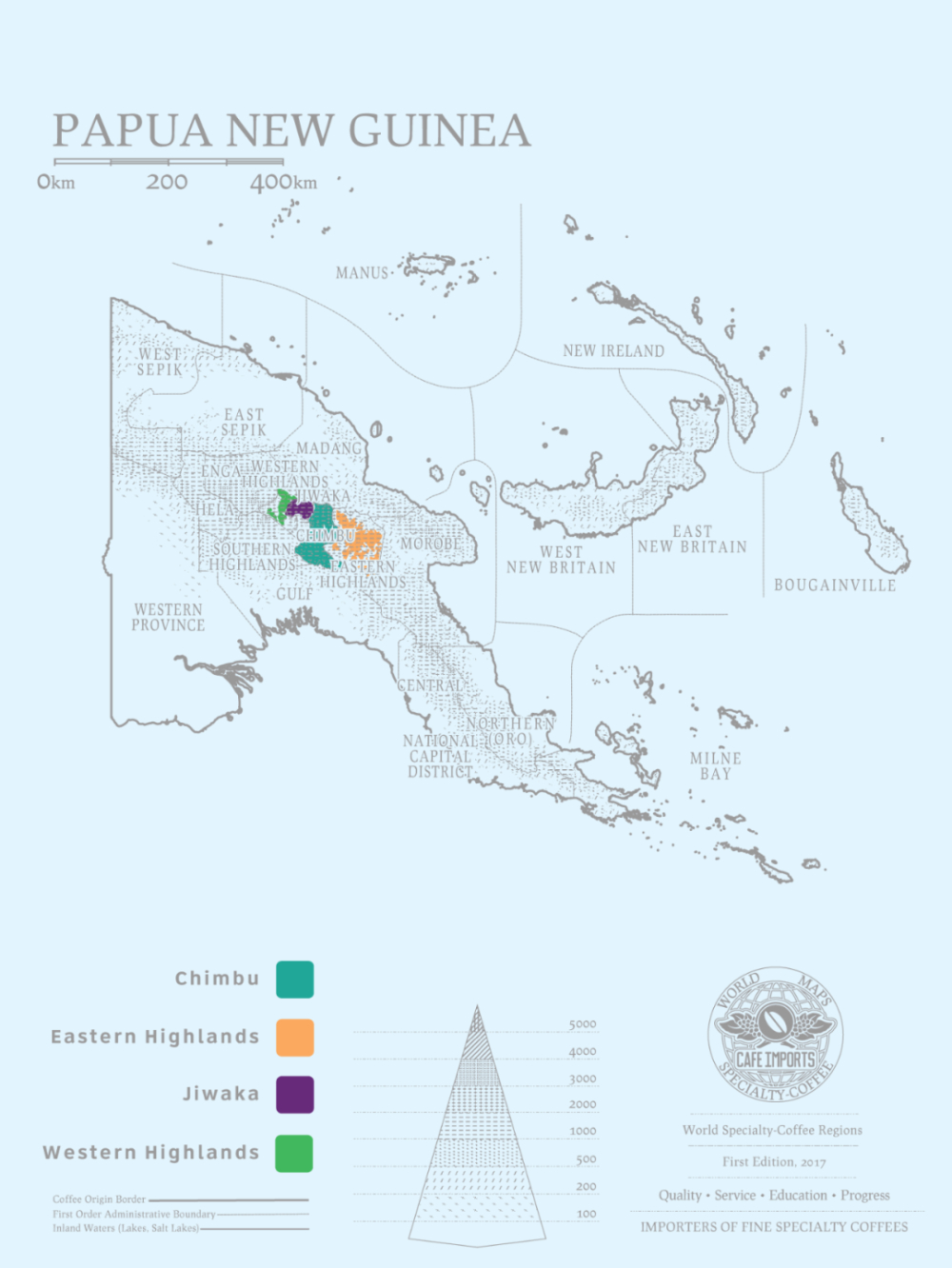
Agriculture occupies an important position in Papua New Guinea's economy, with major crops including coffee, cocoa, coconut, and palm oil. Coffee production is mainly concentrated in five highland provinces:
Western Highlands
Eastern Highlands
Chimbu
Morobe Province
East Sepik Province
Coffee cultivation in Eastern Province is best known for the Arona and Purosa estates, at elevations ranging from 400 to 1,900 meters;
Western Province is represented by the Wahig Valley near Mount Hagen, at elevations of 1,000 to 1,800 meters. Fertile volcanic soil makes the coffee quality in this region particularly outstanding, and the famous Sigri Estate is located here.
In addition to the above two major provinces dominated by Typica, coffee is also grown in other areas, but the quality is relatively lower, mostly Robusta. Robusta coffee is poorer in quality, darker in color, more bitter, and ordinary in flavor expression, and is mainly used for instant coffee production.
About 85% of Papua New Guinea's coffee production comes from smallholder cultivation, and smallholders join local cooperatives to share processing equipment. Although it borders Indonesia, because of different coffee varieties, overall higher elevations than other Indonesian producing regions (such as Sumatra), and differences in processing methods, these factors together create the uniqueness of the beans' flavor. Unlike the dull aroma and low-toned taste of traditional Indonesian coffee, specialty beans produced in Papua New Guinea usually use the washed process, and whether made as a single-origin pour-over or used in espresso blends, they can present a lingering body, balanced sweetness and acidity, and a full mouthfeel, which is quite close to the flavor of South American coffee beans.
Affected by climatic conditions, the coffee harvest season on the island runs from April to September each year. After harvesting ripe, fully red coffee cherries, they are sent to the estate's own washing station for processing. After washing, the parchment is removed from the green beans, and then various grading steps are carried out.
PNG's coffee bean grading system differs from that of other countries (such as Kenya or Colombia), which measure only by screen size. It also comprehensively considers bean shape, color, cup quality, and the presence of defects. Export coffee beans are classified by quality, from high to low as follows: AA, A, X, PSC, and Y.
The first three grades are given estate coffee names; the latter two belong to smallholder coffee, among which PSC stands for Premium Smallholder Coffee.
The above content is compiled by CoffeeHunters, a coffee news website.


