







Is instant coffee carcinogenic due to acrylamide?
No, the acrylamide found in coffee does not make it carcinogenic at normal drinking levels. A test of 59 freshly made coffee samples from 20 brands in Fuzhou detected low levels of acrylamide in every sample, but the amounts were small and China has no regulatory limit on acrylamide in coffee. Acrylamide is a Group 2A carcinogen, a classification based on high-dose animal studies, not on typical human coffee consumption.
Acrylamide forms naturally during the roasting process when sugars and an amino acid react at high heat. It is not added by manufacturers. The same reaction occurs in baked and fried foods. For instant coffee acrylamide, a daily intake of several cups delivers far less than levels shown to cause harm in animals, so ordinary consumption is not considered a cancer risk under current food safety assessments.
Recently, the Fujian Provincial Consumers' Council released a comparative test report on freshly made and sold coffee. In tests of 59 samples from 20 brands in Fuzhou, low levels of acrylamide, a Group 2A carcinogen, were detected in all of them. After the news spread through self-media, it quickly triggered public concern. In fact, acrylamide in coffee is naturally produced during the roasting process, not artificially added. This article will analyze the testing background, the source of acrylamide, and carcinogenic doses to help readers view this test result rationally and avoid being misled by sensational headlines.
▲
Click to follow | Daily specialty coffee culture magazine Coffee Workshop
Recently, our coffee has been blamed again!
On December 6, the Fujian Provincial Consumers' Council published an article titled "2023 Comparative Test Results and Consumption Reminders for Freshly Made and Sold Coffee," stating that it joined with the Fuzhou Consumers' Council to conduct comparative tests on 59 freshly made and sold coffee samples from 20 coffee brands in Fuzhou through online and offline ordering.
It is reported that the samples in the test involved several mainstream brands such as Luckin, Starbucks, Lucky Cup, Tims, KFC, McDonald's, and others, including Americano, latte, and flavored latte types of coffee. The tests mainly covered 8 items: energy, carbohydrates, protein, fat, trans fatty acids, total sugar, caffeine, and acrylamide.
In the section on test results, the Fujian Provincial Consumers' Council mentioned, "It is worth noting that low levels of acrylamide, a Group 2A carcinogen, were detected in all 59 samples in this test (currently China has no restrictive or prohibitive regulations on acrylamide in coffee)."
As multiple self-media outlets integrated and spread the graphics, the news that "mainstream coffee brands were found to contain carcinogens" was instantly forwarded across major social platforms, sparking broader discussion. People began to wonder whether the coffee they had ordered also had food safety issues, and even became "wary" of these chain brands around them.
The image shows some of the sampled products in the test.
Saying "carcinogens were detected in coffee" is actually nothing new. There were many reports mentioning this issue back in 2018, mainly targeting Nescafe, Luckin, and Starbucks. The current "carcinogen testing" covers several mainstream brands on the market, drawing attention from multiple sides.
So the question is, what exactly is the "acrylamide" that was detected?
A search shows that acrylamide is an organic compound that can damage the human nervous system. In the WHO's list of four categories of carcinogens, it belongs to Group 2A carcinogens, meaning that although it has a clear carcinogenic effect in animal experiments, conclusions from human studies have not yet been determined. Many epidemiological studies show that acrylamide is associated with kidney cancer, endometrial cancer, and head and neck tumors, but these carcinogenic effects are only "suspected."

Image: CCTV News
In fact, coffee beans themselves do not contain acrylamide, nor is it added later. It is naturally produced during the roasting process. Frying and baking foods containing carbohydrates and protein at high temperatures (above 120°C) while making them fragrant and browned also produces a certain amount of acrylamide, and its release amount is related to roasting temperature and time. The roasting temperature of ordinary coffee beans almost always reaches over 200°C, so acrylamide is inevitably produced.
In 2005, the Joint FAO/WHO Expert Committee on Food Additives (JECFA), established by the UN Food and Agriculture Organization and the World Health Organization, also mentioned the acrylamide content in various foods in its paper "Health Implications of Acrylamide in Food and Its Risk Assessment." This shows that in addition to coffee, acrylamide also exists in foods such as french fries, biscuits, and grilled meat.
As for the carcinogenic dose, let us first do a simple calculation.
According to data research in the 2010 Journal of Food and Chemical Toxicology, the carcinogenic dose of acrylamide is 2.6–16 μg per kilogram of body weight per day, meaning an adult weighing about 50 kg would need to consume 130 μg of acrylamide per day to reach the carcinogenic dose.
If, according to the tweet posted by the Fujian Provincial Consumers' Council, the acrylamide content in one cup of coffee is 3.39 μg–10.2 μg, and we use the highest experimental result of 10.2 μg per cup for calculation, then for an adult weighing 50 kg, the minimum carcinogenic dose of acrylamide is about 12.74 cups of coffee per day. How many people need to drink 12 cups of coffee every day?
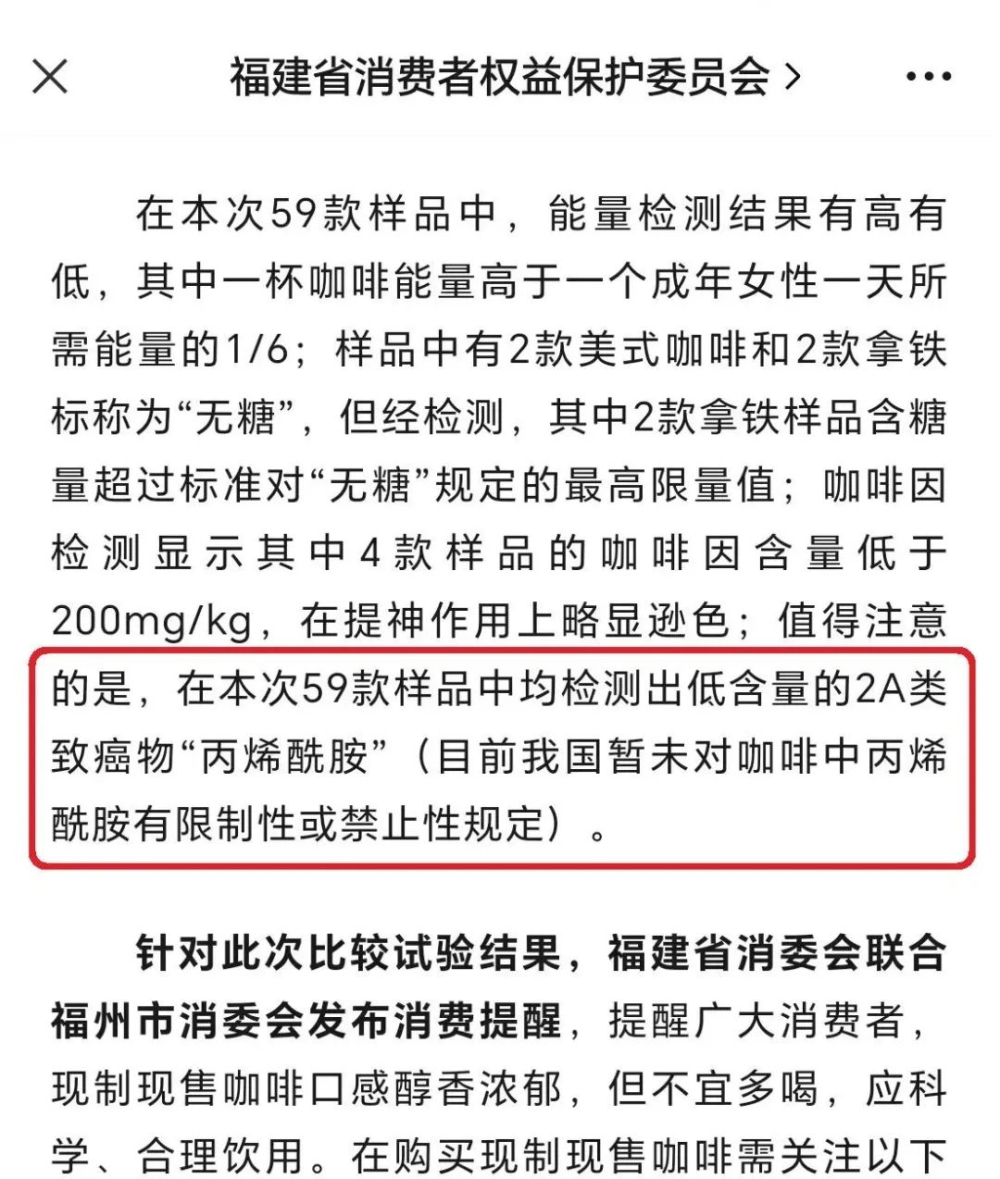
Finally, from the parenthetical note by the local consumers association, "(currently China has no restrictive or prohibitive regulations on acrylamide in coffee)," and from the dosage, the local consumers association should have assessed the test results as sufficiently safe. If there were indeed a safety threat, the relevant products should be taken off shelves or recalled. The local consumers association's carcinogenic warning and the many sensational media headlines inevitably make people more panicked.
Disclaimer: Some images in this article are from the internet. For some content on the website, such as images, we will respect the original author's copyright and indicate the source. However, due to the large quantity, some images and texts may not have been credited in time. Please understand. If the original author has any dispute, they may contact the website for handling. Once verified, we will correct it immediately. Compiled and edited by "Coffee Workshop." Please indicate the source when reposting. If there is infringement, please inform us for deletion. Thank you~!
The above content is compiled by CoffeeHunters, a coffee news website.


