







Why does coffee extraction time decide the flavor balance?
Soluble flavor compounds make up only about 30 percent of a coffee bean; the rest is insoluble woody fiber. Acids, sugars, and bitter compounds dissolve at different rates. Extraction that is too short leaves a thin, sharply acidic cup, while too long lets bitterness dominate. The target is to stop after sweetness peaks but before bitterness takes over.
For a 15 gram pour-over, keep extraction time between 1 minute 50 seconds and 2 minutes 25 seconds. A common misconception is that acidity, sweetness, and bitterness appear in sequence. They actually release at the same time and only peak at different moments. Acid of coffee dissolves fastest, so it peaks early, while bitter compounds rise slowly until late in the brew.
Why is coffee extraction time so critical? It all comes down to the soluble flavor compounds that make up only 30% of a coffee bean. These compounds fall into three categories—acids, sugars, and bitter compounds—each with a different dissolution rate and peak release time. If extraction is too short, the coffee tastes thin and sharply acidic due to a lack of sweetness and bitterness; if too long, bitterness dominates. Therefore, ending extraction after sweetness has been released in abundance but before bitterness floods in is the key to a balanced cup. For a pour-over with 15 grams of coffee, the extraction time is typically controlled between 1 minute 50 seconds and 2 minutes 25 seconds. Additionally, a common misconception is that acidity, sweetness, and bitterness appear sequentially—in fact, they are released simultaneously, only peaking at different times.
What soluble components are actually in a coffee bean? Let's take a look. In a coffee bean, soluble flavor compounds account for only about 30%, while the remaining 70% is insoluble woody fiber. It's a bit like chewing gum—once the soluble flavors are fully extracted, what's left is tasteless "wood pulp."
However, although soluble compounds make up 30%, we don't need to extract all of them. The ideal range is 18% to 22%.
The soluble flavor compounds in coffee beans can be divided into three categories: acidic compounds, sweet compounds, and bitter compounds. Their dissolution rates differ—simply put, each type reaches its own concentrated release peak at different time periods.
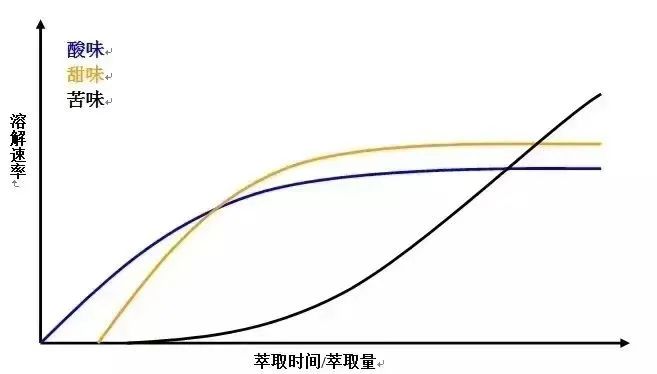
Acidic compounds dissolve fastest, so they peak right at the beginning of extraction and are released in large amounts. Sweet compounds follow closely, dissolving slightly slower than acids, so during the phase when acids are being released heavily, sweetness is only dissolving slowly, not reaching its peak until the middle of extraction. Bitter compounds dissolve slowest—as the graph shows, bitterness initially runs almost parallel to the horizontal axis, rising extremely slowly, and only after acids and sweetness have peaked does its dissolution rate begin to climb gradually. Overall, the longer the extraction time, the more compounds are dissolved, and the richer and more layered the final coffee flavor becomes.
The reason we pay attention to time is to control the release of these compounds and ensure balance between flavors. For example, if extraction time is too short and sweetness hasn't been released in abundance yet, the coffee will taste thin and sharply acidic due to a lack of sweetness and bitterness—this is "under-extraction." Conversely, if extraction continues until bitterness is released in large amounts, bitterness takes over and the coffee descends into unpleasant bitter astringency—this is "over-extraction."
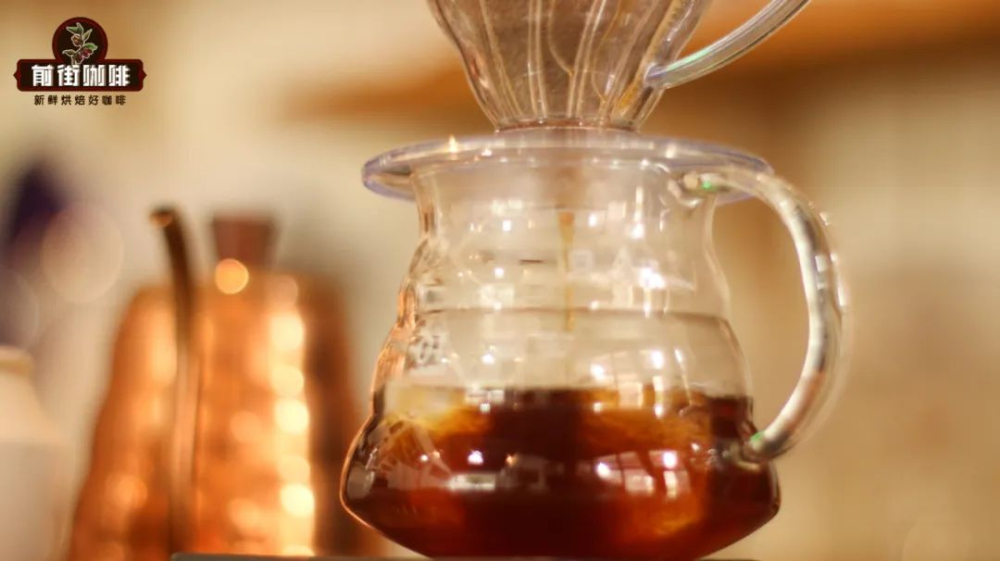
Therefore, we need to stop extracting soluble compounds after sweetness has been released in abundance but before bitterness floods in, so as to achieve a cup with balanced acidity, sweetness, and bitterness.
The most effective way is to control time. For a pour-over with 15 grams of coffee, assuming normal parameters, simply keeping the extraction time between 1 minute 50 seconds and 2 minutes 25 seconds will yield a cup with balanced acidity, sweetness, and bitterness.
Key Misconception
Having covered all that, let's address a common misconception about the release order of acidic, sweet, and bitter compounds. Many people assume that acidity, sweetness, and bitterness are released sequentially, but that's not the case.
Acidic, sweet, and bitter compounds are released simultaneously from the very start—it's just that due to different dissolution rates, each reaches its own dissolution peak at a different point in time. That's where the misconception lies.

For instance, when drinking coffee brewed from a light roast, bitterness is hard to detect, but bitter compounds are actually present—just in smaller amounts, masked by acidity and sweetness.
Front Street Coffee
No. 10, Bao'an Qian Street, Yandun Road, Dongshankou, Yuexiu District, Guangzhou, Guangdong Province
The above content is compiled by CoffeeHunters, a coffee news website.


