








Does ice first or ice last change iced pour-over coffee?
Adding ice before brewing and adding it after both replace part of the hot water with an equal weight of ice, so the recipe stays the same. The difference is timing: ice in the server chills the dripping coffee right away, while ice added at the end cools liquid that has already been extracted.
The test used a washed Geisha from Colombia's Frontera Estate, a coffee with a clear honeysuckle aroma that makes flavor shifts easier to spot. The ratio was 15g coffee to 150ml hot water to 90g ice, ground at Ek43 setting 9.5 with 65 percent passing a No. 20 sieve, brewed at 92 degrees Celsius. Tasting was time-corrected for fairness.
Should ice be added first or last for iced pour-over coffee? This question seems like merely a difference in operational sequence, but behind it may lie the preservation and release of coffee flavors. Front Street Coffee once mentioned the Paragon ice ball in an article; its principle is to rapidly cool the coffee liquid to lock in volatile aromas, allowing drinkers to experience a richer coffee flavor. Inspired by this, we restarted the experiment, using the same Colombian Frontera Estate washed Geisha, to compare the differences between adding ice first and adding ice last in iced pour-over in terms of operation, temperature, aroma, and taste. The experiment strictly controlled the ratios of coffee powder, water, and ice, and corrected the timing difference in tasting. What is the final result? Is there a noticeable difference between the two? This article will reveal the answer for you.
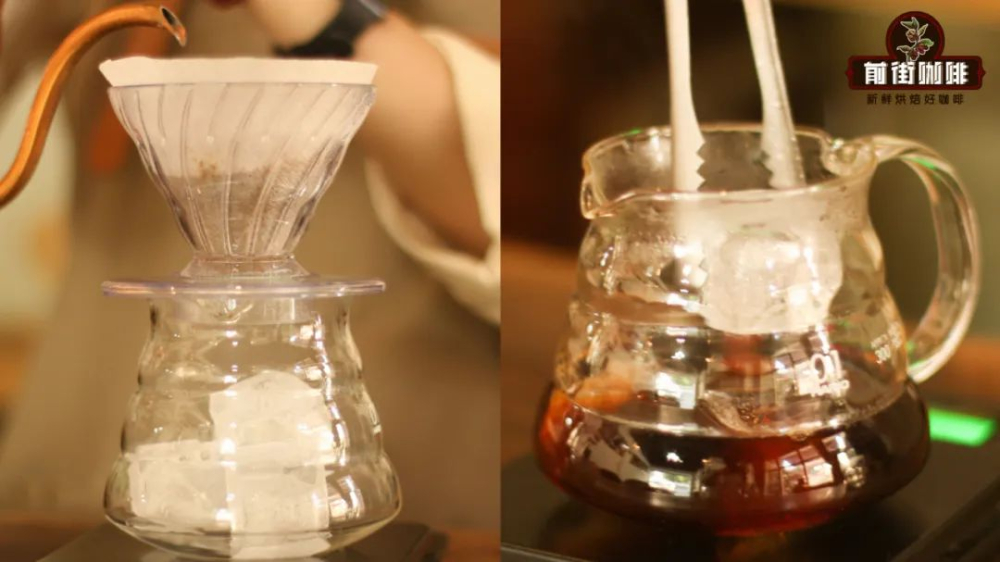
Generally speaking, the difference between these two methods might just be a variation in operational steps. However, Front Street recalled the Paragon ice ball introduced in a previous article—its core function is to rapidly cool the coffee liquid, thereby locking in volatile aromatic compounds, preventing them from dissipating, and allowing the drinker to capture more coffee flavors.
Although the actual effect is not as miraculous as advertised by merchants, on second thought, does adding ice first in iced pour-over also have a similar effect? So we decided to restart the experiment: what exactly is the difference between adding ice first and adding ice last in iced pour-over?
Operational Differences
Setting flavor aside for now, both methods involve replacing an equal proportion of hot water with ice cubes. We briefly explain the operational differences: one is to put ice cubes into the server before brewing, so that the dripping coffee liquid is directly cooled; the other is to add ice cubes after brewing is completed, to cool the already extracted coffee liquid.

Experimental Comparison
This experiment uses a Colombian Frontera Estate washed Geisha, which has a very distinct honeysuckle aroma, helping us more clearly identify flavor differences in the iced brew comparison.
Coffee powder amount: 15g Powder-to-water-to-ice ratio: 1:10:6, i.e., 15g powder, 150ml hot water, 90g ice Grind setting: Ek43 at 9.5, 65% passing through a No. 20 sieve Brewing water temperature: 92°C Brewing method: three-pour
The first pour of the three-pour iced brew is the same as hot brew, using twice the powder amount of water (30ml) for a 30-second bloom; the second pour uses a fine stream in a large circle to pour 70ml of hot water, and after the drip reaches the bottom, pour the remaining 50ml of hot water in a small circle, then wait for the drip to complete.

To compensate for the time difference caused by tasting, the iced pour-over with ice added first starts brewing 20 seconds earlier than the one with ice added last, and subsequent tasting also starts with the ice-first cup, thus correcting the staggered timing.
Both brewing times are 1 minute 30 seconds. Regardless of the order of ice addition, after brewing is completed, the coffee and ice must be shaken to allow the ice to rapidly cool the coffee and fully integrate the two.

After shaking evenly, at the 2nd minute for each, the iced pour-over with ice added first has a temperature of 7°C, and the iced pour-over with ice added last has a temperature of 13°C.
(The black thermometer corresponds to ice added last, the white thermometer corresponds to ice added first)
In terms of aroma, the honeysuckle aroma of the iced coffee with ice added last is slightly more intense than that with ice added first. When tasting, both cups of Frontera Geisha present rich honeysuckle floral notes, citrus acidity, and honey-like mouthfeel, with no very obvious difference. If forced to distinguish, the mouthfeel of the ice-added-last version is a bit more rounded. Subsequently, Front Street let the two cups sit for five minutes and tasted again, and the results were almost completely identical.

From this, it can be concluded: There is not much difference between iced pour-over coffee with ice added first and ice added last. The slight difference initially tasted was mainly because the ice added last melts more slowly, and at the 2nd minute it had not yet diluted to the same concentration as the ice added first, so the aroma and concentration were slightly more prominent. After five minutes, the concentrations of the two were almost identical, and there was no difference in taste.
Front Street Coffee
No. 10, Bao'an Qian Street, Yandun Road, Dongshankou, Yuexiu District, Guangzhou City, Guangdong Province
The above content is compiled by CoffeeHunters, a coffee news website.


