







How does flat-bottom dripper coffee brewing differ from conical?
Flat-bottom drippers spread the coffee bed evenly, so grounds do not pile up in the center the way they can in conical designs such as the V60. That even bed lowers the risk of channeling and uneven extraction, and it tends to round off sharp layers in favor of a steadier, sweeter cup.
The design traces back to Melitta's 1936 flat-bottom model, and Kalita released its Wave series in 2010. A three-pour recipe built for the flat bed was tested with Front Street Coffee's Colombia Frontera Sidra, with brewing time and tasting notes recorded to show how the flow-guiding ribs shape the water path.
Flat-bottom drippers have gradually gained attention in the pour-over field in recent years, and their extraction performance—brought about by a flat bottom and special flow-guiding structure—is noticeably different from common conical drippers. This article starts from the background of the birth of the Kalita Wave, sorts out the design origins of flat-bottom drippers, the distribution characteristics of their flow-guiding ribs, and their influence on water flow paths, and then compares them with the extraction logic of conical drippers such as the V60. It then uses Front Street Coffee's Colombia·Frontera Sidra as an example to share a three-pour brewing recipe suited to a flat-bottom dripper, recording the actual brewing time and tasting impressions to help coffee lovers understand the unique qualities of flat-bottom drippers in flavor presentation.
Kalita happened to have the same plan. We previously mentioned that in 1959 Kalita made a three-hole fan-shaped dripper through a "reference" approach, but unfortunately this product encountered the then-dominant V60 as soon as it was launched, and most of its market share was taken by the latter. To compete with an opponent like the V60, which enjoys a "protagonist halo," Kalita had to come up with a more competitive product.
Thus in 2010, Kalita officially released the "Wave" series of flat-bottom drippers. However, they were not the originator of the flat-bottom dripper. As early as 1936, the dripper launched by Melitta already used a flat-bottom structure. Coupled with Kalita's previous experience of "referencing" the Melitta fan-shaped dripper, it can be said that Melitta was almost Kalita's product template.
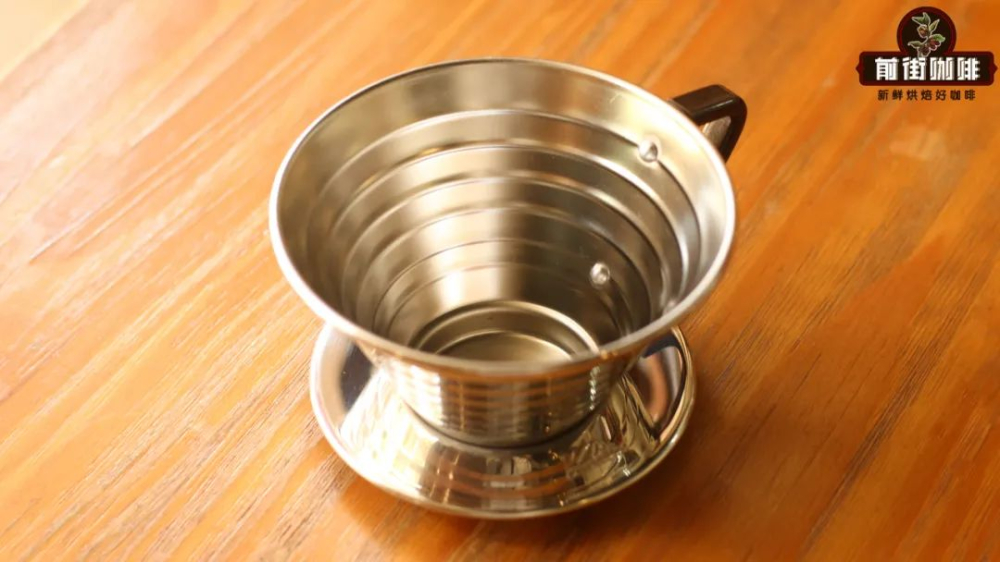
(Kalita Wave series flat-bottom dripper)
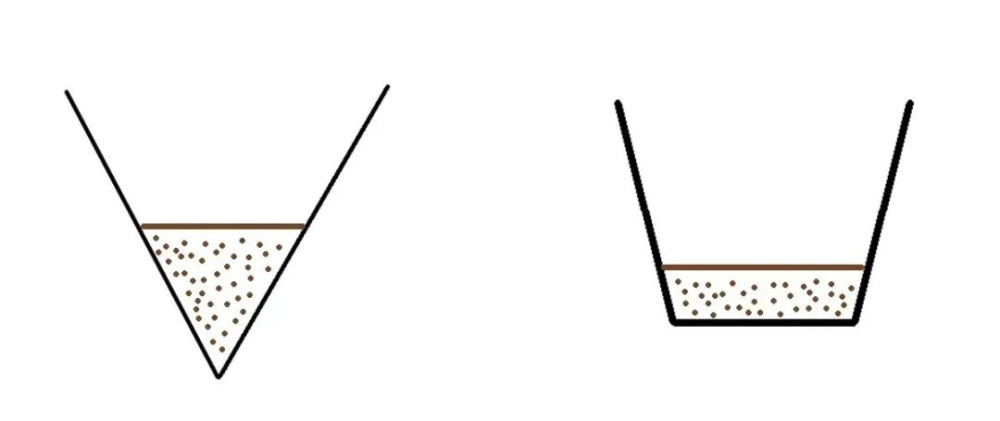
Conical drippers represented by the V60 focus their extraction approach on amplifying the coffee's personality, so the results often have clear layers and a full mouthfeel. But this type of dripper has a common problem: coffee grounds tend to accumulate heavily in the center, and once the bloom is inadequate or there are too many fines, extraction problems are likely to occur. It is precisely for this reason that the conical dripper accessory "Lily Drip" came into being; it allows the central coffee bed to spread evenly to the surroundings, reducing extraction risks during brewing.
Flat-bottom drippers do not have the concern of a concentrated coffee bed. The bottom is flat, so particles can be evenly distributed in every corner. At the same time, because the space is more open, the coffee bed is much thinner than in a conical dripper, allowing hot water to penetrate every coffee particle more fully.
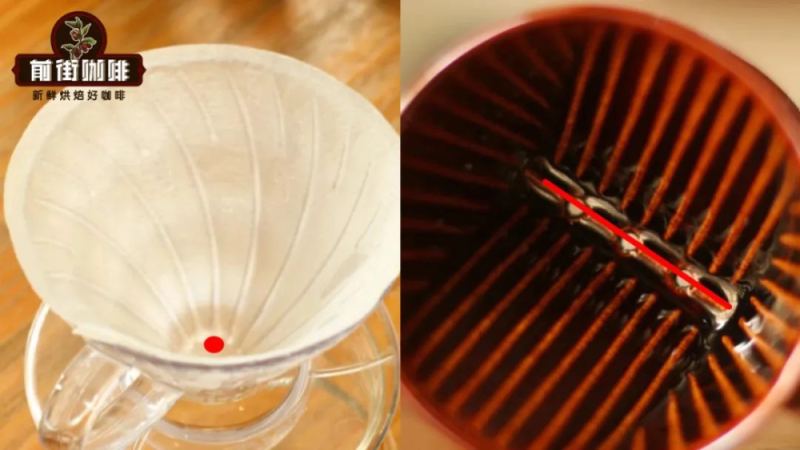
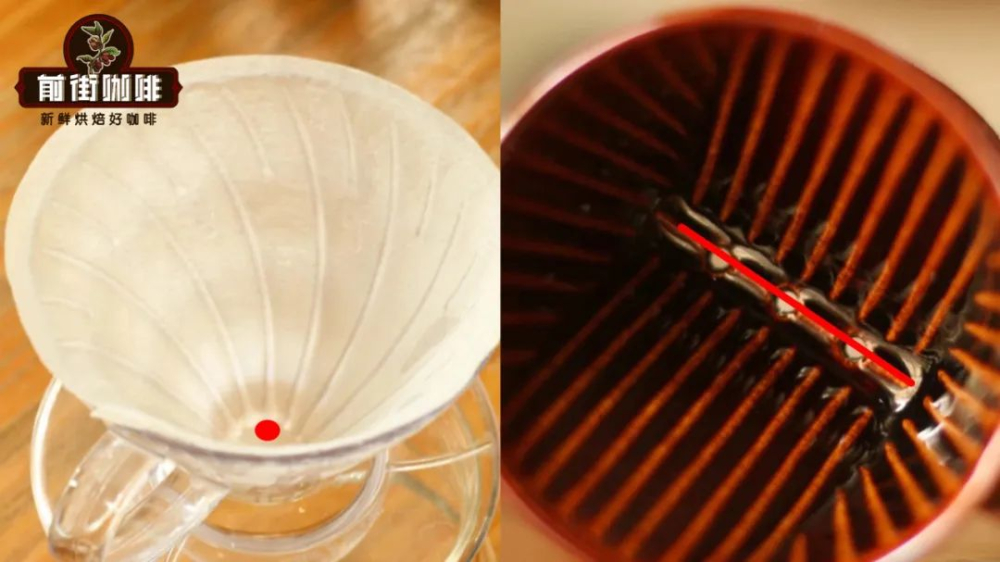
The flow-guiding rib design of flat-bottom drippers is also quite interesting.
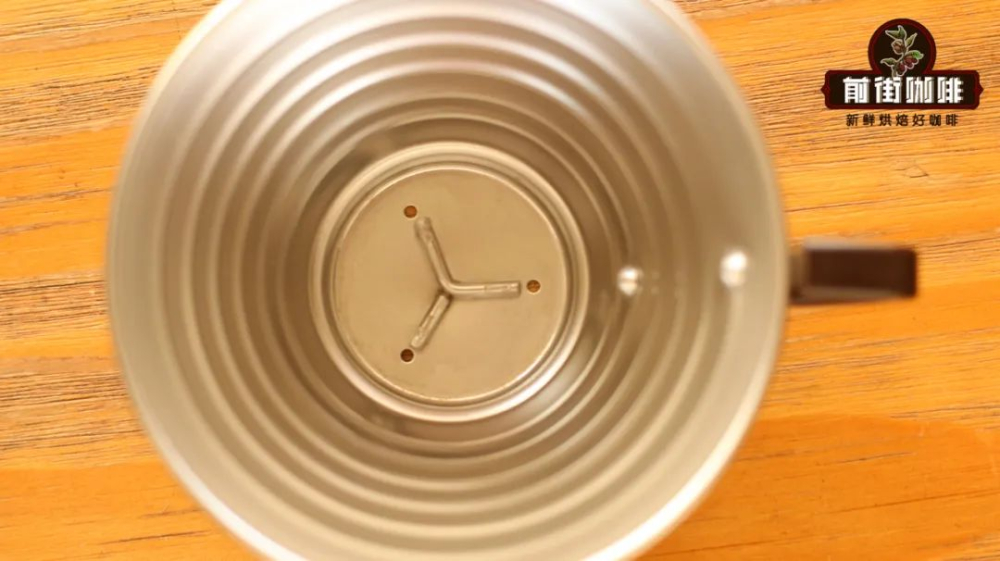
Whether it is the V60 used daily or the fan-shaped dripper we discussed before, the flow-guiding ribs are all located on the dripper wall. The difference with flat-bottom drippers is that some of their flow-guiding ribs are located above the bottom of the dripper.
If the bottom were completely flat, hot water would form a plane, and which hole it flowed out of would depend entirely on luck, making drainage very slow. But after adding flow-guiding ribs to the bottom, the hot water has a guided direction and will flow toward the lower hole positions, thereby improving the seepage speed.
Flat-bottom drippers are paired with cake filters (which is why they are also called cake drippers). Because the filter paper cannot fit tightly against the dripper wall, the flow-guiding ribs on the wall actually do not play much of a role, so Kalita designed ring-shaped ribs for the dripper wall. The flat-bottom drippers with flow-guiding ribs seen online are precisely the style launched by Melitta in 1936, as mentioned at the beginning.
Brewing sharing for the "flat-bottom dripper"
The wall of the flat-bottom dripper has no flow-guiding ribs, so the drainage speed tends to be slower, which means the grind size needs to be coarser. The beans we brewed this time were Colombia·Frontera Sidra, with sweet-and-sour notes of purple grapes and passion fruit. Next, let's use a flat-bottom dripper to try it and see how the Sidra it brews performs.
Beans used: Colombia·Frontera Sidra Dose: 15g Grind used: Ek43 setting 10, 80% passing through a No. 20 sieve Coffee-to-water ratio: 1:15 (225ml hot water) Brewing temperature: 92°C Brewing method: flat-bottom three-pour
First pour water at twice the coffee dose (30ml) and bloom for 30 seconds. Then begin pouring from the center, gradually circling outward, then slowly pour 120ml of hot water from the outside inward. When the water level is about to reach the bottom, pour the remaining 75ml of hot water in the same way, and wait for the drip to finish.
The brewing time was 2 minutes 05 seconds, while the Sidra brewed with the V60 took about 1 minute 50 seconds. The tasting impression surprised Front Street somewhat, because most descriptions of flat-bottom dripper results lean toward balance.
But after drinking it, Front Street found that, compared with the balance in their impression, the coffee brewed with the flat-bottom dripper actually had more prominent flavors, with all kinds of notes well displayed, and the overall mouthfeel was also relatively mellow. It can be said to be unexpectedly delicious, and everyone can try it at home when they have time.
- END - Front Street Coffee (FrontStreet Coffee)
No. 10, Baoqian Street, Yandun Road, Dongshankou, Yuexiu District, Guangzhou City, Guangdong Province
The above content is compiled by CoffeeHunters, a coffee news website.


