







What happened during the Red Cup Day barista strike
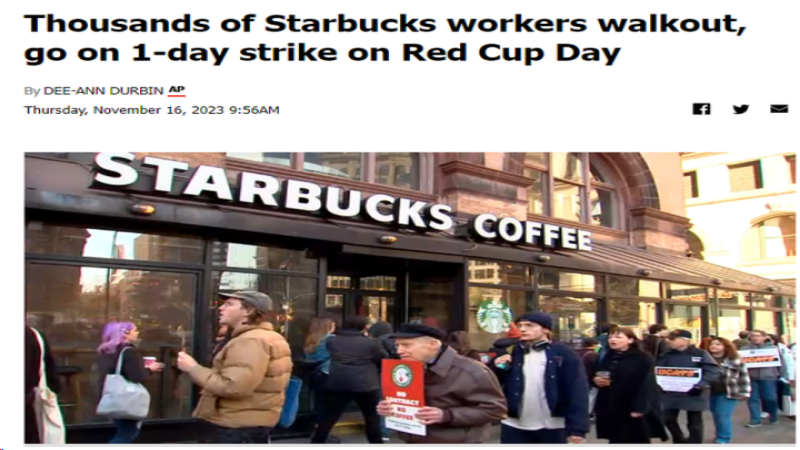
On November 16, 2023, Starbucks' annual Red Cup Day, thousands of employees at more than 200 US stores went on strike. Organizers called it the largest labor action since Starbucks Workers United was founded. Workers chose the chain's busiest order day to disrupt operations and draw public attention to their demands.
Starbucks said the union refused to schedule bargaining sessions. The one-day strike had limited impact on sales, but the public opinion fallout is worth watching. Baristas have long complained about understaffing and overloaded orders. Nearly 380 workers at 14 stores in nine western Washington cities joined, and the union estimated more than 5,000 participants overall.
On November 16, 2023, Starbucks' annual "Red Cup Day," thousands of employees at more than 200 stores across the United States went on strike. Organizers called it the largest labor action since the founding of Starbucks Workers United. Employees chose to strike during this order peak period, intending to disrupt business as much as possible and draw public attention. Behind the strike is baristas' long-standing dissatisfaction with understaffing, overloaded orders, and the company's refusal to listen to their opinions. Starbucks officially responded by saying the union refused to schedule bargaining sessions. This one-day strike had limited impact on sales, but the public opinion fallout is worth watching.
▲
Click to follow | Daily specialty coffee culture magazine Coffee Workshop
According to an ABC News report on November 16, thousands of employees at more than 200 Starbucks stores across the United States held a strike on Thursday. Organizers said this was the largest strike action since the birth of Starbucks Workers United.
It is reported that this strike was initiated by Starbucks Workers United (SWU), which was newly established at the end of last year and is affiliated with the Service Employees International Union (SEIU). Workers United revealed that nearly 380 Starbucks employees at 14 stores in 9 cities in western Washington participated in Thursday's strike.
The choice to strike on November 16 was not accidental, because this day is Starbucks' annual "Red Cup Day."
On Red Cup Day, customers at all Starbucks stores in North America can receive a free reusable cup as long as they purchase a drink. With Thanksgiving approaching, this day is usually one of the busiest order days of the year. Employees deliberately chose to strike on this day in order to disrupt store operations to the greatest extent possible while using the public attention to increase visibility for the event. Starbucks calls this day "Red Cup Day," so employees also called this action the "Red Cup Rebellion."
The union estimated that more than 5,000 employees participated in its organized "Red Cup Rebellion" activities. Workers marched during a certain period and spent the rest of the time visiting non-union stores. About 30 stores also held strikes early on Wednesday, the day before Red Cup Day.
According to a report by CCTV Finance, baristas participating in the strike complained in interviews about Starbucks: "Two baristas have to make 221 drinks in half an hour, and customers have to wait at least an hour to pick up their orders." "The company launches promotional campaigns without notifying stores in advance, orders double while staffing stays the same, and angry customers take it out on us."
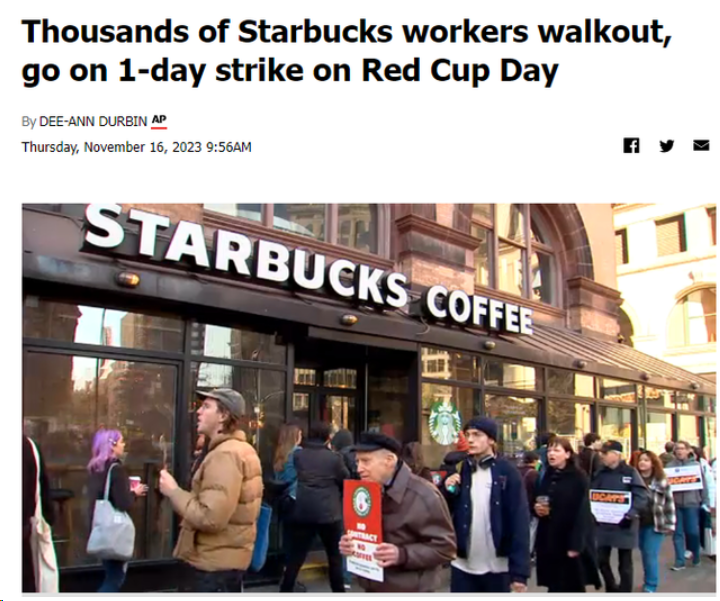
Regarding the reasons for the strike, another barista added: "Starbucks has made it clear that it will not listen to workers' opinions, so we speak up for ourselves through striking."
Outside the Starbucks Astor Place store on the New York University campus, dozens of employees also shouted the slogan "No Contract No Coffee" on the 16th. At the same time, the Astor Place store was packed with teachers and students lining up to make purchases.
It is understood that since a store in Buffalo, New York, became the first Starbucks store to unionize in late 2021, Thursday's Red Cup Day strike was the fifth large-scale labor action initiated by employees. Last year, workers at 110 stores also held a strike on Red Cup Day. The most recent strike occurred in June this year, after reports that Starbucks had removed Pride Month displays from stores.
Starbucks has a total of 235,000 employees and more than 9,000 coffee shops in the United States. Currently, only 363 stores have formed unions, and only more than 200 stores participated in the strike. In addition, many stores participating in the strike did not close and continued to operate, because Starbucks dispatched managers and other employees to fill vacancies at striking stores. Moreover, the strike lasted only one day. Therefore, from a business perspective, this strike had minimal impact on Starbucks. The main impact was at the public opinion level, as employees hoped to win public sympathy through this strike.
In response to the matter, Starbucks officials also issued an emergency statement on Thursday, saying that for more than five months the Workers United had refused to schedule bargaining meetings, and that "Starbucks remains committed to enhancing the partner experience and building a bridge to a better future for every person wearing a green apron."
Disclaimer: Some images in this article are from the internet. For some content on the website, such as images, we will respect the original copyright and indicate the source. However, due to the large volume, some images and texts may not have been credited in time. Please forgive us. If the original author has any dispute, they may contact the website for handling. Once verified, we will correct it immediately. Compiled and edited by "Coffee Workshop." Please indicate the source when reposting. If there is infringement, please inform us for deletion. Thank you~!
The above content is compiled by CoffeeHunters, a coffee news website.


