







How Did Panama's CCD Project Change Coffee Processing?
Panama launched the CCD project, short for Creative Coffee District, in 2018 to modernize traditional coffee processing and give beans more distinctive flavors. The initiative introduced advanced equipment and shared cultivation experience with smallholder farmers. Colombia's La Palma & El Tucan estate joined forces with Panama's Altieri Estate, one supplying bean sources and the other contributing processing technology.
The partnership combined low-temperature anaerobic fermentation, static and dynamic fermentation, and super natural processing, producing a range of unusual flavor profiles. This kind of coffee bean processing lets estates experiment with novel methods while helping local farmers grow higher-quality cherries and raise their income. Estate owners worldwide can travel to Panama to join the research and build partnerships.
In 2018, Panama launched a creative coffee-producing region project called CCD, short for Creative Coffee District, aimed at modernizing traditional coffee processing methods to give coffee more unique flavors. The project not only introduced advanced equipment and technology, but also attracted the renowned Colombian estate La Palma & El Tucan to join forces with Panama's Altieri Estate. One side provided bean sources, while the other contributed processing technology. Through the collision of diverse methods such as low-temperature anaerobic fermentation, static and dynamic fermentation, and super natural processing, many distinctive coffee flavors were born. This article will guide you through the origins of the CCD project, its operations, and the estate stories behind it.
Panama's CCD Project
The CCD project was born in 2018, with the full name "Creative Coffee District," which can be understood as an innovative processing area focused on specialty coffee. The core goal of this initiative is to modernize the traditional processing methods of coffee beans, enabling the final coffee products to exhibit more unique flavor profiles. The project holds strong appeal for estate owners worldwide who are keen to experiment with novel processing methods; they can travel to Panama to participate in research and establish partnerships with local estates.
To advance the project, the organizers introduced advanced coffee processing equipment and technology, improving traditional washed and natural processing methods. At the same time, they shared cultivation experience with local smallholder farmers, helping them produce higher-quality coffee cherries and thereby increase their income. As the project gradually unfolded, the renowned Colombian estate La Palma & El Tucan also joined.
La Palma & El Tucan Estate
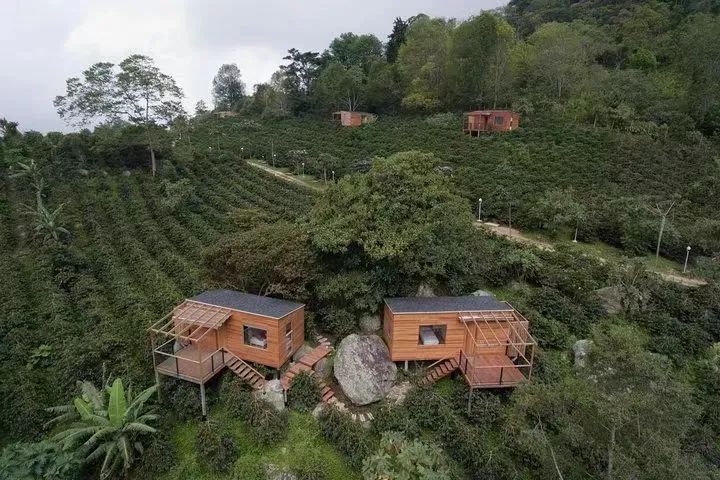
La Palma & El Tucan Estate was established in 2011 in the Eastern Andes region of Colombia. Its founding team has a diverse background, including farmers, businessmen, scientists, and artists.
Most coffee estates are family legacies, passed down from one generation to the next in a smooth transition. La Palma & El Tucan is different; it is the ideal planting site found by its founders after extensive research. As mentioned in yesterday's article, conditions such as high altitude, volcanic soil, sunlight, and humidity are all in the most suitable state for coffee cultivation within the estate's boundaries.
Furthermore, since its establishment, La Palma & El Tucan has not only helped surrounding smallholder farmers improve their cultivation and processing skills but has also been dedicated to cultivating unique coffee flavors. While respecting tradition, it continuously innovates, creating many coffees with diverse styles to meet the preferences of different consumers.
Coincidentally, Panama's CCD project provided an additional research platform. Thus, in 2018, La Palma & El Tucan teamed up with Altieri Estate to join this project. Altieri Estate is a local Panamanian estate responsible for supplying coffee beans, while La Palma & El Tucan contributed processing technology. One solved the local bean source issue, and the other addressed the processing technology problem, creating a perfect synergy.
Special Processing Methods Born in the CCD Project
In the CCD project, many distinct processing methods can be seen, such as low-temperature anaerobic fermentation, static fermentation processing, dynamic fermentation processing, super natural processing, and more, with endless combinations emerging.
By bringing together different technologies from various estates, combining and innovating coffee bean processing methods, and enabling coffee beans using entirely new processing techniques to present unique flavors, this is precisely one of the main objectives of the CCD project.
Front Street Coffee
No. 10, Bao'an Qian Street, Yandun Road, Dongshankou, Yuexiu District, Guangzhou, Guangdong Province
The above content is compiled by CoffeeHunters, a coffee news website.


