








Can the steam hiss tell you how long to froth milk?
When steaming milk, the hiss from the steam wand tracks how much air is entering the pitcher. A short hiss means less air and thinner foam; a long hiss adds more air and thickens it. That single cue helps fix the common faults of foam that is too thin, too thick, coarse or separated.
Once the foam reaches the thickness a drink needs, lift the pitcher so the tip is fully submerged and switch to texturing, which tightens the bubbles. Stop when the milk hits 55-65 degrees. The result should be fine, smooth and fluid enough for latte art, and knowing how to make froth for coffee this way removes most guesswork.
When steaming milk, the sound coming from the steam wand actually holds important clues for judging the condition of the milk foam. Many people practicing latte art easily run into problems such as milk foam that is too thin, too thick, coarse, or separated, and one of the keys to solving these problems lies in the "hiss~hiss" sound during steaming. This article starts from the principle of steam air intake, explains the milk foam states corresponding to different sounds, and through an experiment comparing short hisses with long hisses, shows how to use the length of the sound to control the amount of air intake, ultimately producing ideal milk foam that is fine, smooth, highly fluid, and suitable for latte art. The article also retains Front Street Coffee's related recommendations and address information, making it suitable for coffee lovers to refer to during daily practice.
Actually, to make a decent latte, the milk foam needs to meet several conditions: fine texture, smoothness, and good fluidity. When you usually practice latte art, which details do you pay special attention to? Have you ever noticed the sound made by the steam wand while steaming milk? In fact, these sounds can provide very practical references for judging the state of the milk foam.
The most common mistakes when steaming milk foam include foam that is too thin, too thick, coarse, and separated. So how can we use the sounds produced during milk steaming to make judgments?
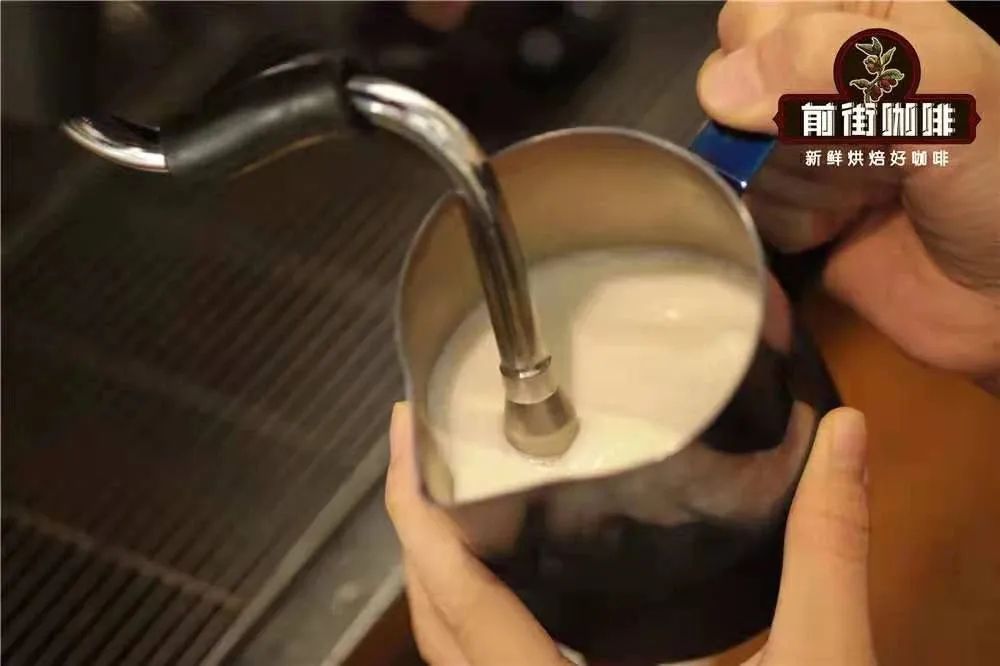
First, let's understand how the sound is produced when steaming milk. The steam wand of an espresso machine releases high-temperature steam. If the steam is fully submerged in the milk, the milk temperature will rise quickly. When the steam tip is only partially submerged, that is, half in the milk and half exposed to the air, air is drawn into the milk, and the proteins in the milk wrap around the air to form milk foam. When the milk foam reaches the ideal thickness (the steaming time can be adjusted according to different drink types), lift the milk pitcher upward so that the steam wand is completely submerged in the milk, entering the texturing stage to make the foam denser, and stop when the temperature reaches between 55-65 degrees.
From this, a pattern can be summarized: the amount of milk foam, that is, its thickness, depends on how much air is introduced. During the air intake process, a "hiss~hiss" sound similar to tearing paper is produced. We can use this "hiss~hiss" sound as a basis for judging how much air has been introduced.

Next, an experiment will explain this: using the same milk pitcher and the same amount of milk, rely on the "hiss~hiss" sound to compare the effect of different air intake durations on the final milk foam result.
Short hiss
After starting to steam, let the surface rotate and expose the steam tip. At this point, a "hiss~hiss" sound is produced, but the "hiss" only lasts about 0.5 to 1 second, then lift the milk pitcher upward, submerge the steam wand in the milk, and enter the texturing stage. After that, a sharp, piercing sound continues until steaming ends. The milk foam produced this way is on the thin side, almost close to having no foam at all, with strong fluidity, and the surface shows no obvious change, making it very difficult to complete latte art. The mouthfeel also feels too light and thin.
Long hiss
After starting to steam, let the surface rotate and expose the steam tip. Once the air intake process begins, the "hiss~hiss" sound appears, and the "hiss" lasts about 7 to 8 seconds. After that, submerge the steam tip and enter the texturing stage, during which there is a heavy, substantial air-drawing sound until steaming ends. In this case, it can be seen that too much milk foam has been introduced, and the foam is thick, has poor fluidity, and is relatively coarse in texture. This state is closer to cappuccino milk foam. The mouthfeel is heavier and it separates easily; this is more like cappuccino milk foam.

When making latte coffee, however, milk steaming requires first finding the right angle and position between the steam wand and the milk pitcher during steaming. After turning it on, let the surface rotate and expose half of the steam tip so that air enters and produces a "hiss~hiss" sound. After about 2 seconds, submerge the steam tip (it is not recommended to submerge it too deep, nor too close to the pitcher wall) and enter the texturing stage. At this time, a steady, subtle air-drawing sound is produced until the temperature reaches between 55-65℃ . The milk foam obtained this way will be relatively fine, smooth, and highly fluid, suitable for latte art, with a moderate milk foam mouthfeel.
In summary, the duration of the "hiss" sound can show that the longer the milk foam is steamed, the more air is introduced, and the thicker the foam becomes; the shorter the steaming time, the less air is introduced, and the thinner the foam becomes; and when there is no air intake, a continuous sharp, piercing sound appears.
Left: thin milk foam Right: thick milk foam
Therefore, we should first find the right angle between the steam wand and the milk pitcher, then first judge whether air is being introduced during steaming by whether there is a continuous sharp, piercing sound, and then determine the milk foam thickness based on the length of the "hiss" sound. So during daily practice, everyone can pay more attention to these sounds; they are very helpful for judging whether the milk foam has been steamed properly. Of course, the most important thing is still to practice more.
- END - Front Street Coffee (FrontStreet Coffee)
No. 10 Bao'an Qian Street, Yandun Road, Dongshankou, Yuexiu District, Guangzhou, Guangdong Province
The above content is compiled by CoffeeHunters, a coffee news website.


