







What Latte Coffee Milk Ratio Works With Pour-Over Brews?
Pour-over coffee sits at roughly 1.3 percent concentration while espresso reaches about 9 percent, so milk poured into a light brew quickly takes over the cup. To keep both elements present, brew stronger first: use medium to dark roast beans, grind so about 75 percent passes a No. 20 sieve, and brew at 88 to 90°C with a 1:9 to 1:11 coffee-to-water ratio.
Then add 80 to 100 milliliters of whole milk heated to 60 to 70°C. That approach keeps the ratio in a range where coffee still reads through the milk, rather than ending up with coffee-flavored milk. Avoid pouring milk into the brewing kettle itself, since cleanup and slow filtration make it impractical and the result is usually flat.
Want to make a delicious milk coffee at home with pour-over gear, but always end up with too much milk flavor or coffee that's lost its sweetness? The problem lies in concentration, beans, grind, water temperature and milk quantity. Pour-over coffee has a concentration of only about 1.3%, while espresso is as high as around 9%, so adding milk directly easily lets the milk overpower the coffee. Front Street Coffee, drawing on brewing experience, gives practical parameter suggestions one by one—from choosing medium-dark roast beans, a grinding standard of 75% passing rate through a No. 20 sieve, a water temperature of 88–90°C, and a 1:9–1:11 coffee-to-water ratio, to adding 80–100ml of whole milk heated to 60–70°C—to help you make a pour-over milk coffee with a balance of coffee and milk.
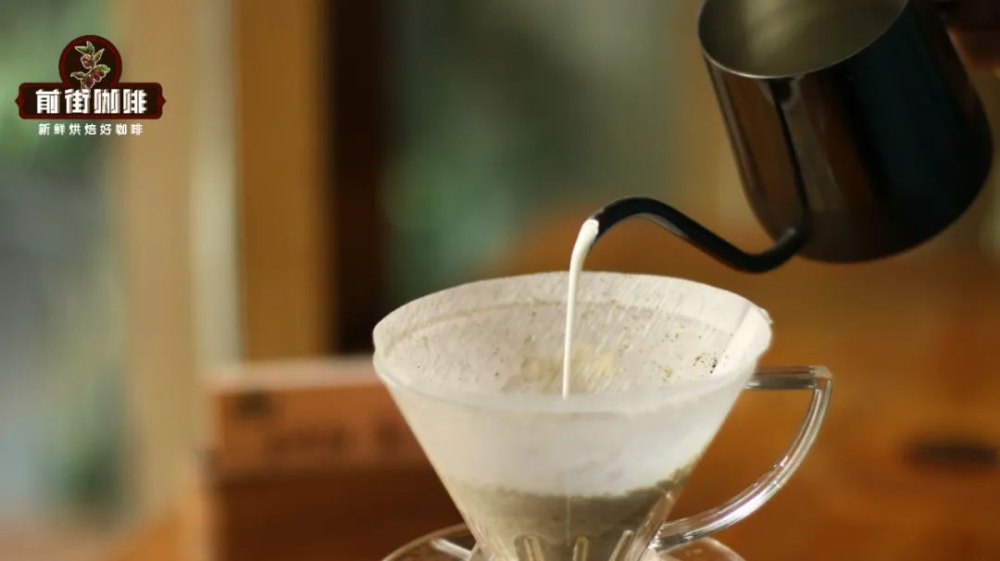
Hold on~Don't even think about pouring milk into the pour-over kettle. Cleaning a kettle covered in milk stains is annoying enough, and you still have to go through a long wait for it to filter, only to end up with a cup of "coffee-flavored milk" with no highlights—really not worth it. Front Street Coffee suggests everyone give up this idea as soon as possible.
Back to the point. A customer chatted with Front Street Coffee, saying that compared to black coffee, they prefer milk coffee, but they only have pour-over equipment at home, so after brewing the coffee they directly add a little fresh milk and drink it as a "latte." But after trying a few times, either the milk flavor overpowered the coffee, or the coffee lacked that hint of milk fragrance. So they asked Front Street Coffee how to make this homemade pour-over milk coffee smoother.
How to choose coffee beans? The base of a regular latte is espresso, and by comparison pour-over coffee is much lighter. Front Street Coffee has tested it: espresso has a concentration of about 9%, while pour-over is around 1.3%, and pour-over mostly uses single-origin beans, focusing on showcasing the beans' own flavors. Adding milk to black coffee that is already low in concentration easily lets the milk, originally a supporting player, take over and cover the coffee's flavor—somewhat wasteful. So to get a decent cup of pour-over milk coffee, choosing the right beans is the first step.
According to Front Street Coffee's practice for homemade milk coffee, to make coffee and milk complement each other, choosing medium to dark roast beans often gets twice the result with half the effort. If the beans you bought don't indicate the roast level, you can look for words like chocolate, caramel, nuts, hazelnut, peanut, cream, cocoa in the flavor description. On Front Street Coffee's bean list, Queen's Estate, Mandheling, and Bird of Paradise are all quite suitable for making pour-over milk coffee.
Coarse grind or fine grind? How high should the water temperature be?
Medium-dark roast beans are heated longer and have a looser internal structure, so they absorb water more easily and release flavor during extraction. If ground too fine, the coffee tends to develop toward a burnt-bitter direction. Front Street Coffee suggests using a No. 20 sieve, controlling the passing rate at 75%, with the store's EK43s setting at 10.5; for home operation, reaching the coarseness of coarse granulated sugar is enough.
As for water temperature, Front Street Coffee uses hot water measured in the kettle at 88–90°C for brewing. Many people brew dark roast coffee into a burnt-bitter taste precisely because the water temperature is too high. Of course, water temperature that is too low will also make the coffee flat and tasteless.

Should the coffee-to-water ratio be adjusted? How much milk is appropriate to add? To keep the milk from stealing the show, the black coffee acting as the "base" must be stronger, and the proportion of milk cannot be too large, otherwise the milk coffee just becomes a cup of coffee-flavored milk.
To get a black coffee with a rich mouthfeel that also retains the main aromatic substances, you should first appropriately lower the coffee-to-water ratio. Based on Front Street Coffee's brewing experience, this ratio is more suitable between 1:9 and 1:11. Taking 15 grams of coffee powder to extract 1–2 servings as a reference, choose a 1:10 coffee-to-water ratio, that is, pour in 150 grams of hot water.
As for how much milk to add, it's actually the same as the latte tutorial Front Street Coffee previously shared—it depends on which milk quantity's taste you prefer. Front Street Coffee tested with the above beans: under a 1:10 coffee-to-water ratio, about 130ml of coffee liquid is extracted, then 80–100ml of milk is added, and the mouthfeel of the two is just balanced.
Which kind of milk is better, and should it be heated in advance? For milk selection, Front Street Coffee more recommends whole milk, which not only pairs better with the aroma of medium-dark roast beans, but also brings a richer oily mouthfeel, so it doesn't taste too thin.
Friends who have learned latte art should know that the temperature for steaming milk for hot milk coffee is usually set at 55–65°C, because proteins denature or break down when heated above 70°C, causing the milk foam to collapse, and too high a temperature also makes it hard to feel the coffee's sweetness. Therefore, when making pour-over milk coffee at home, you can heat the milk in advance to 60–70°C for later use.
- END - Front Street Coffee (FrontStreet Coffee)
No. 10, Baoqian Street, Yandun Road, Dongshankou, Yuexiu District, Guangzhou, Guangdong Province
The above content is compiled by CoffeeHunters, a coffee news website.


