








How do you bring out sweetness in coffee with pour-over brewing?
Most sugars in coffee beans are transformed and degraded during roasting, and the remaining sweet-tasting molecules are easily masked by acidity and bitterness. Controlling extraction so bitter compounds do not over-extract gives a basic level of sweetness, while pursuing high sweetness means accepting a real risk of over-extraction.
For medium-light roasted beans, the four-word formula is finer grind, higher water temperature, larger water flow and faster extraction. Medium-dark beans, being porous, suit a high-concentration, low-extraction approach with a Kono dripper and a simple one-pour technique, producing full sweetness with restrained bitterness. Variable-temperature brewing is offered as a further option.
Most of the sugars in coffee beans have already been transformed and degraded during roasting, and the remaining sweet-tasting molecules are easily masked by flavors such as acidity and bitterness. In this article, Front Street will break down the underlying principles of high-sweetness extraction and explain in detail the four-character brewing formula "High, Fine, Big, Fast"—finer grind, higher water temperature, larger water flow, faster extraction—using medium-light roasted beans as the experimental subject, demonstrating step by step the specific parameters and techniques for each stage; for medium-dark roasted beans, which are porous and cannot withstand aggressive extraction, the approach of "high concentration, low extraction" is recommended, paired with a Kono dripper and a simple one-pour technique, which can likewise produce a cup of coffee with full sweetness and restrained bitterness. At the end, variable-temperature brewing and other diverse extraction methods are also introduced for enthusiasts to try freely.

The answer to this question is certainly yes, but one point must first be clarified: the sugars in green coffee beans are basically all transformed and decomposed during the roasting process, and the concentration of the remaining sweet-tasting molecules is already too low to be directly detected by smell, because they are masked by other, stronger flavors. Conversely, once we taste or smell sweetness in coffee, it often means that the intensity of those flavors that mask sweetness has decreased, and only then does the sweetness become apparent.
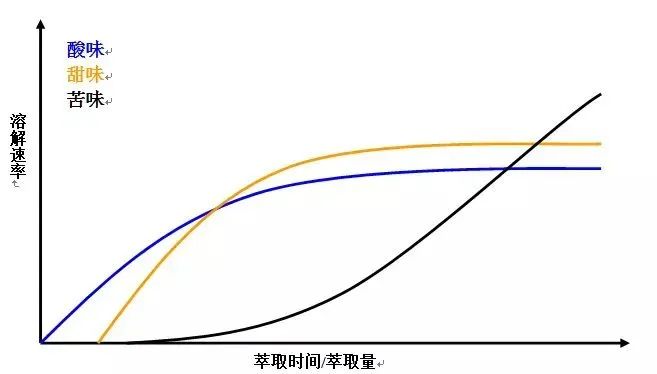
How can you make pour-over coffee show a more abundant sweetness? Normally, as long as you control the extraction of bitter compounds and prevent them from over-extracting, the coffee will display a basic level of sweetness, so most people usually choose relatively safe, conservative brewing plans. But if you pursue the ultimate high-sweetness experience, you must be mentally prepared to take on the risk of over-extraction! High risk often comes with high reward, and the diagram below can help everyone understand this logic~
From the diagram, it is easy to see that sweet-tasting substances are mainly released in concentrated form during the middle and later stages of extraction. Therefore, when you always find the sweetness insufficient with your current method, you might adjust your extraction strategy to cover the full range, so that the flavor in the cup becomes more balanced—neither acidity nor bitterness dominates, and the sweetness is highlighted as a result. Coincidentally, a formula that fits exactly this extraction approach is circulating online! It allows you to extract abundant aroma in a relatively short time, with moderate acidity, while avoiding over-extraction, ultimately presenting a cup of coffee with outstanding sweetness. This four-character mnemonic is: High, Fine, Big, Fast. Does it sound a bit confusing at first? Next, we will use medium-light roasted beans as the test subject and actually demonstrate how to put this formula into practice!
Fine: Make the grind finer
Taking medium-light roasted beans as an example, Front Street's daily grinding parameter is EK43 setting 10; if you want to raise the sweetness another level, you can slightly tighten the grind, lowering the setting from 10 to 9.5. The purpose is to increase the total surface area of the coffee particles, allowing hot water to penetrate more quickly into the particles and complete extraction!
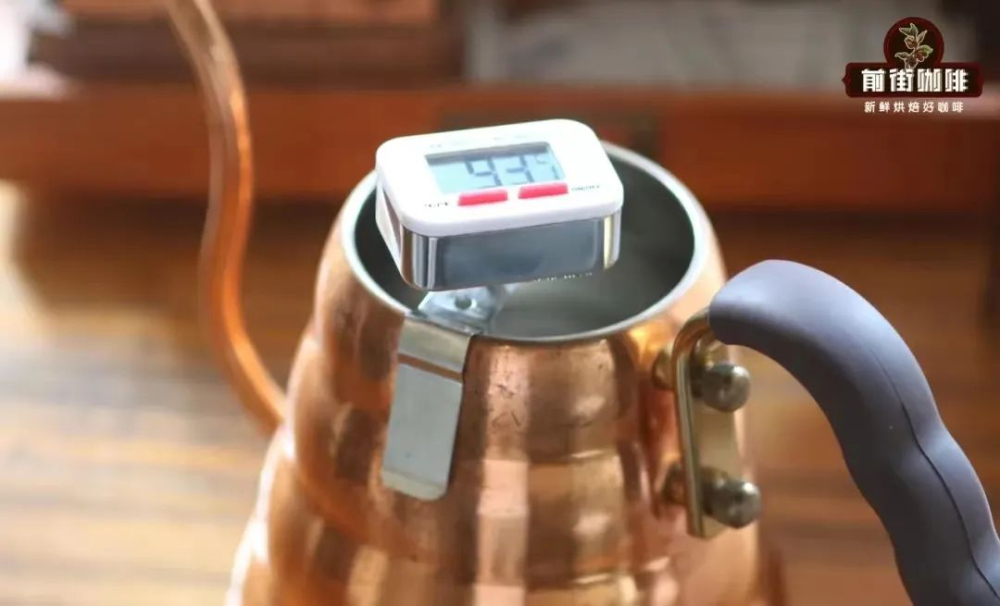
High: Raise the water temperature
On the basis of a finer grind, the second step is to raise the water temperature, for example from the original 92°C up 2°C to 94°C, with the aim of improving extraction efficiency during the blooming stage. Once the extraction rate during blooming is increased, the hot water poured afterward can more quickly bring out the aromatic substances hidden in the coffee grounds.
Big: Increase the water flow
During the actual brewing, still use the conventional three-stage pouring: 15g of beans, a coffee-to-water ratio of 1:16, with the three stages using 40 grams, 120 grams, and 80 grams of water respectively, and use a large flow of water for each stage. Lifting the coffee bed is a major advantage of a large water flow—once the bed is opened up, its surface area increases accordingly, and hot water can extract more sweet and acidic substances in a shorter time.

Fast: Shorten the extraction
Because a large flow of water is used from beginning to end, combined with a V60 dripper that has internal ribs to guide the flow and speed up drainage, the overall extraction time will be noticeably shorter than the conventional "alternating large and small flow" method. This design not only ensures that sweetness is fully extracted, but also prevents bitter compounds from being over-released. After brewing is finished, you will be able to drink a cup of coffee with noticeably higher sweetness than your everyday result! (Provided there is no over-extraction.)
A high-sweetness brewing plan for medium-dark roasted beans
The extraction logic for pursuing high sweetness with medium-dark roasted beans is the same as above, but this type of bean is relatively porous and belongs to the "delicate" category, unable to withstand the rigors of the high-intensity extraction methods above. Therefore, for dark roasted beans, Front Street's recommendation is: high concentration, low extraction! Raise the brewing concentration while lowering the overall extraction yield, and in this way the bitterness extracted in the final stage can be significantly reduced, naturally making the sweetness more prominent.
Specific parameters: 15g of beans, grind setting at EK43 10.5 (tested with a No. 20 sieve, 75% passing rate), coffee-to-water ratio no longer the conventional 1:15 but tightened to 1:13, water temperature 88°C, and a Kono dripper.

For the technique, choose the simplest one-pour method! First pour in 30ml of hot water and bloom for 30 seconds, then starting from the center of the coffee bed, pour continuously in small circles with a gentle force and slow rhythm, pouring the remaining 165ml all at once, and a cup of high-sweetness dark roasted coffee is complete!
In this article, Front Street has only briefly sorted out the underlying principles of high-sweetness extraction. In fact, around this principle, many brewing paths for enhancing sweetness have been derived, such as the rather special variable-temperature brewing method, which reduces the release of acidity and bitterness by switching water temperatures at different stages. So there is no absolute standard in brewing—feel free to let loose and personally experience the various different experiences brought by diverse extraction methods~
- END - Front Street Coffee
No. 10, Baoqian Street, Yandun Road, Dongshankou, Yuexiu District, Guangzhou, Guangdong Province
The above content is compiled by CoffeeHunters, a coffee news website.


