








How to Use Coffee Pot Vessels Wisely in a Café Setting
A coffee shop owner recently reported that a customer broke a handmade wood-fired teapot, refused a discounted compensation of a few hundred yuan, accused the shop of extortion, and left without paying. The incident, posted on social media on October 13, drew online debate over whether cafés should use expensive vessels and how much responsibility customers bear for accidental damage.
The dispute highlights a practical gap: costly serving ware adds visual appeal but not necessarily better flavor, and few customers know how to use coffee pot vessels of this type or what they cost. Owners can reduce risk by documenting the value of handmade items, displaying consumption records, and setting clear damage policies, while customers should expect to cover unintentional breakage.
Recently, a coffee shop owner encountered an upsetting incident: after a customer accidentally shattered a handmade wood-fired teapot in the shop, they not only refused to compensate but also tried to quietly drive away. The owner proposed a discounted compensation plan of a few hundred yuan, but the customer accused the shop of extortion. The incident sparked heated discussion online: should coffee shops use expensive vessels? How much responsibility should consumers bear for unintentional damage? This article outlines the incident, various viewpoints, and explores reasonable ways to resolve similar disputes.
▲
Click to follow | Daily specialty coffee culture magazine Coffee Works
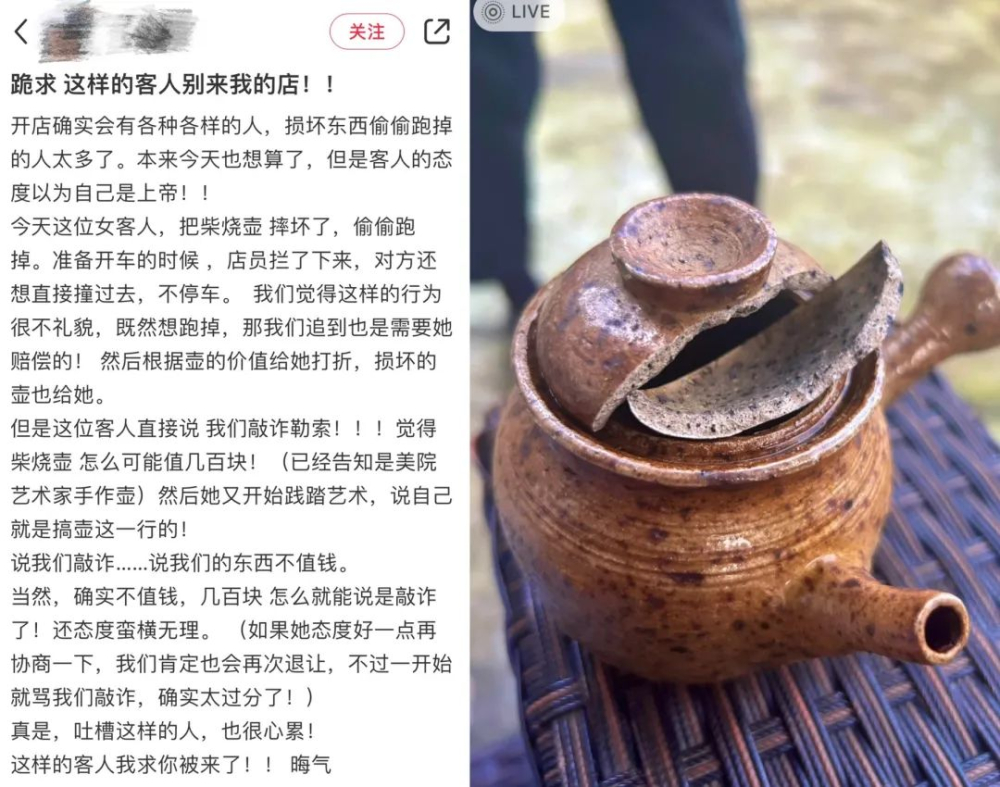
In the business of running a shop, you inevitably encounter all kinds of customers. There are the warm-hearted ones, the particularly meticulous ones, and those who don't quite follow the rules. On the evening of October 13th, a coffee shop owner posted on social media about a troublesome incident they had encountered: a customer broke a handmade wood-fired teapot in the shop and then actually tried to quietly drive away, but fortunately was stopped in time by the staff.
The owner said that the two parties then began negotiating compensation. Considering the teapot already showed signs of use, he offered a discounted compensation amount of around a few hundred yuan and agreed to give the damaged teapot to the customer. Unexpectedly, upon hearing the amount, the other party immediately accused the owner of "extortion" and retorted, "How could a wood-fired teapot possibly be worth a few hundred yuan?" In the end, the customer left without paying any compensation. The owner sighed helplessly: "I beg you, customers like this, please don't come to my shop!!"
In the comments section, some netizens expressed confusion about the compensation amount: "Do coffee shops use such expensive teapots? Show her the consumption record, otherwise saying a few hundred yuan with no proof is indeed hard to accept." So, would a cup of coffee costing a dozen yuan taste better if served in vessels worth hundreds or thousands of yuan? Obviously not. Expensive vessels, aside from providing visual appeal, perhaps have no other practical function.
At this point, a netizen familiar with handmade vessels pointed out in the comments: "A few hundred yuan for a wood-fired teapot is a huge bargain; our shop's wood-fired teapots start at 2k." The reason is that wood-fired teapots require repeated firing, have a low yield rate, and each piece has a different ash-falling effect, making each one unique.
Clearly, a "finished" wood-fired teapot is difficult to produce, and if easily shattered, it is indeed regrettable. But tableware is, after all, a consumable, and operators should have an awareness of the risk of product damage—they can't just put all losses on consumers whenever a problem arises. However, what angered the shop owner most was not the damage to the wood-fired teapot itself, but the customer's attempt to flee after damaging it and their attitude toward resolving the issue.
Passing netizens suggested: "Calling the police is the most appropriate way to handle it," "Just call the police directly, reasoning with him is useless"... In such situations, calling the police is indeed a viable option, because the police can clarify the division of responsibility, and in such incidents both parties are often at fault. The consumer may have acted unintentionally, but if the shop uses expensive vessels for service, it certainly also has an obligation to warn of their value; otherwise, unnecessary disputes are easily triggered.
According to the owner, this "handmade teapot" was created by an artist from an art academy, not purchased from the market, and since their family is in the ceramics industry, they only asked for compensation at cost price. If a situation arises where neither the compensating party nor the shop can make a reasonable calculation, it is even more appropriate to call the police and have a third party fairly verify and handle the entire matter.
For the shop owner, the original intention may simply have been to let customers appreciate beautiful vessels while making the café more distinctive. When enjoying a coffee costing tens of yuan, being able to admire exquisite vessels is indeed a pleasure.
However, damage to coffee shop vessels is actually not an isolated case.
Overall, the rights of consumers and operators are often corresponding. If a similar incident occurs, one should first acknowledge one's own fault and then negotiate a corresponding resolution with the shop, rather than choosing to evade responsibility—evasion cannot solve the problem either.
Image source: Internet
Disclaimer: Some images in this article are from the Internet. For some content on the website, such as images, we will respect the original copyright and indicate the source. However, due to the large quantity, some images and texts may not have been credited in time; please forgive us. If the original author has any dispute, they can contact the website for handling. Once verified, we will correct it immediately. Compiled and edited by "Coffee Works"; please indicate the source when reprinting. If there is infringement, please inform us for deletion. Thank you~!
The above content is compiled by CoffeeHunters, a coffee news website.


