







Should a Coffee Shop Refuse to Give Hot Water?
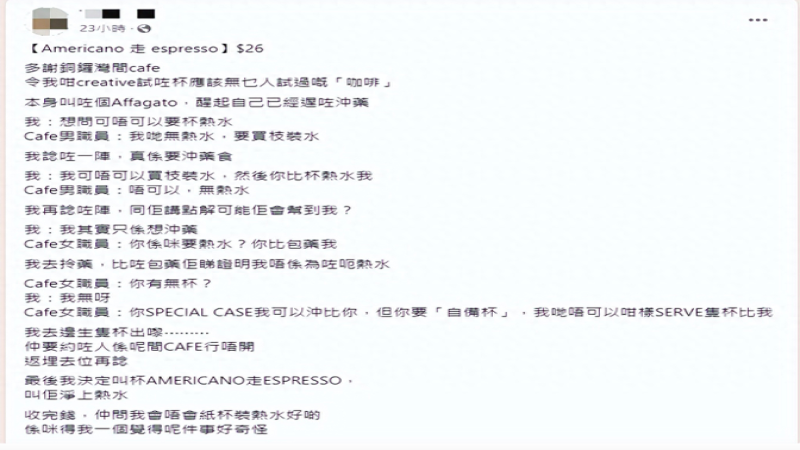
A Hong Kong coffee shop drew criticism after refusing hot water to a customer who needed it to take medicine; one staff member said the shop had none, while another offered help only if the customer brought a cup. In Weihai, Shandong, a milk tea shop charged 10 yuan for a cup of plain boiled water. Both cases show the tension between service rules and customer expectations.
Most cafes accommodate guests who ask for hot water, but some service businesses in Hong Kong emphasize procedure more strictly. At larger chains such as Starbucks, hot water requests are usually handled differently. The incidents also tie into pricing logic: espresso and Americano differ mainly by added water, so a cup of plain hot water sits awkwardly in a menu built on coffee. Street coffee culture depends on both sides showing understanding.
Recently, a coffee shop in Hong Kong sparked discussion after refusing to provide hot water to a customer, and a similar incident occurred in Weihai, Shandong—where a cup of plain boiled water was charged at 10 yuan. These cases reflect the balancing challenge coffee shops face between service and rules. This article reviews the course of events, analyzes the shop's stance and consumers' feelings, and explores hot water service at brands like Starbucks, as well as the operational details arising from the price difference between espresso and Americano. How can coffee shops uphold rules without losing human warmth? Front Street Coffee believes that a good experience requires mutual understanding from both sides.
▲
Click to follow | Daily specialty coffee culture magazine Coffee Workshop
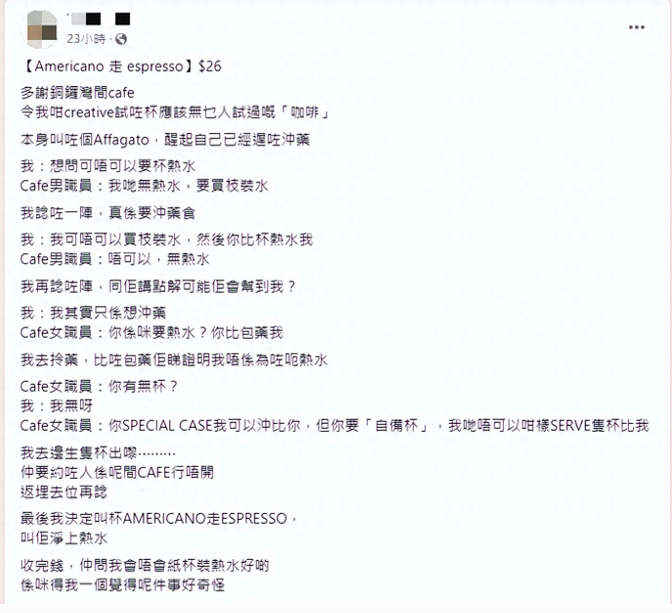
Recently, a Hong Kong netizen posted in a social group, complaining that a local coffee shop could not supply hot water, saying bluntly, "How strange." The netizen explained that at the time they needed to take Chinese medicine and wanted hot water to help mix it, but a male staff member refused on the grounds that "the shop has no hot water," while another staff member was willing to help, on the condition that the customer must bring their own cup.
Such situations are not common. Most cafés usually accommodate guests who need hot water, but some service industries in Hong Kong sometimes place more emphasis on procedure, which is why this somewhat rigid phenomenon occurs. It also calls to mind the advertisement Andy Lau once filmed about the service industry—the line "This kind of service attitude is not good enough today" is precisely a reminder about such phenomena. The shop involved did not explain online why it does not provide hot water.
Of course, this kind of thing is not unique to Hong Kong. On July 2, a woman in Weihai, Shandong, posted a video complaining that a milk tea shop charged 10 yuan for a cup of plain boiled water. According to the person involved, Ms. Wang, she suddenly had a stomachache while shopping and went to buy a cup of hot water. The staff said that if she only wanted a cup of plain boiled water, it could only be charged at the price of a single cup of milk tea, but did not tell her the specific amount. After paying, she found that this cup of plain boiled water had cost 10 yuan.
In response, the merchant said the company has rules: cups are not sold separately, and if sold, they must be charged at the price of a cup of milk tea; bringing your own cup for hot water is free, and the customer was told before payment. Since the person involved did not bring her own cup, the merchant sold it to her at the price of a cup of milk tea, equivalent to a "10 yuan milk tea fee + 0 yuan hot water" service. For Ms. Wang, this outcome was not very acceptable, but the merchant had communicated with the customer in advance, and some netizens also expressed understanding of the merchant's charging standard.
Take Starbucks, for example—it can actually provide hot water for free. As long as you proactively ask the staff, the employees will hand you a cup of hot water.
Generally speaking, as places that sell coffee and other drinks, when coffee shops encounter guests who need hot water, we can handle it flexibly according to the actual situation of the shop. For example, with customers who have not made a purchase, the shop may be more passive. Some customers, influenced by online short videos or posts, exploit loopholes in product pricing to put together in-store products at the lowest cost. For example, some shops stipulate that "because espresso and Americano are priced differently, customers are prohibited from being provided with hot water," and the reason lies in the price difference between the two—if a consumer orders an espresso and pours it into plain water, it is directly "upgraded" into an Americano.
Usually, most coffee shops will comply with requests, but they should explain the specific reasons to the customer to avoid creating an impression of poor service, or silently watch the customer do it themselves. Even today, these news stories can still become topics of discussion among netizens precisely because such incidents are relatively sporadic, and most operators and consumers are not so unfeeling. You are well, I am well, everyone is well—only then can both sides gain a better experience.
Disclaimer: Some images in this article are from the internet. For some content on the website, such as images, we will respect the original author's copyright and indicate the source. However, due to the large quantity, a few images and texts may not have been credited in time. Please forgive us. If the original author has any disputes, they may contact the website for handling. Once verified, we will correct it immediately. Compiled and edited by "Coffee Workshop." Please indicate the source when reprinting. If there is infringement, please inform us for deletion. Thank you~!
The above content is compiled by CoffeeHunters, a coffee news website.


