








What does layering mean in coffee for a coffee enthusiast?
Layering in coffee means the cup changes as it is drunk: a bright acidity first, sweetness emerging after, and a sweet aftertaste on swallowing, rather than one flat taste. Flavor clarity matters just as much, because distinct notes stay identifiable instead of blending into a muddy whole. Bean selection, processing method, fines retention, coffee-to-water ratio and pouring all shape this result.
Processing method is a starting point. Washed lots usually show cleaner, more separable flavors, while natural lots can blur the line between them. During brewing, keeping some fines in the bed adds body, and a moderate ratio with steady pouring helps each stage of extraction arrive in order. The practical aim is a cup whose sweet, sour and bitter notes appear in sequence rather than all at once.
Many coffee enthusiasts hope that the coffee they brew is not just a single flavor, but can present changes and rich sensations in the mouth—this is what is called layering. How exactly is layering defined? It is reflected both in the evolution of sweet, sour, bitter, and salty tastes, and in whether the flavors are clearly distinguishable. To get a cup of coffee with rich layering, you need to start from multiple steps including bean selection, processing method, retention of fines, adjustment of the coffee-to-water ratio, and pouring method. This article will systematically sort out the key points for brewing layering, from conceptual understanding to practical methods, to help you adjust parameters with more direction in daily brewing, making the coffee's flavor expression more three-dimensional and clearer.

What exactly counts as the layering of coffee? When something is labeled with the word "layering," it often attracts more attention than things with a single expression. The same is true for coffee: when it gradually reveals multiple distinct sensations in the mouth, the drinker's pleasure increases noticeably—this is the meaning of layering. Perhaps many friends still find this statement vague, so let us break it down and understand it section by section.
We can start with basic tastes such as sour, sweet, bitter, and salty. When drinking pour-over coffee, if from the first sip to swallowing there is only one taste throughout, such as only sourness or only sweetness, then even if there are no unpleasant negative flavors, the cup can hardly be called outstanding; more often it just feels monotonous. Conversely, if the entry is a bright touch of acidity, then sweetness emerges over the next period, and when swallowing a more obvious sweet aftertaste returns, then this is a manifestation of rich layering at the taste level.
Next is the clarity of flavor, that is, the degree to which various flavors can be identified. Take everyday fruits as an analogy: orange, apple, and watermelon. If you juice them separately and cover the cups and drink them blind one by one, most people can quickly recognize each one's taste. But if the three juices are mixed together, it becomes hard to distinguish their individual characteristics when drinking, producing a muddy feeling. The same is true for coffee: while perceiving multiple flavors, these flavors need to present themselves with different degrees of clarity in order to be called layering; otherwise it will appear chaotic and turn into a muddy experience.
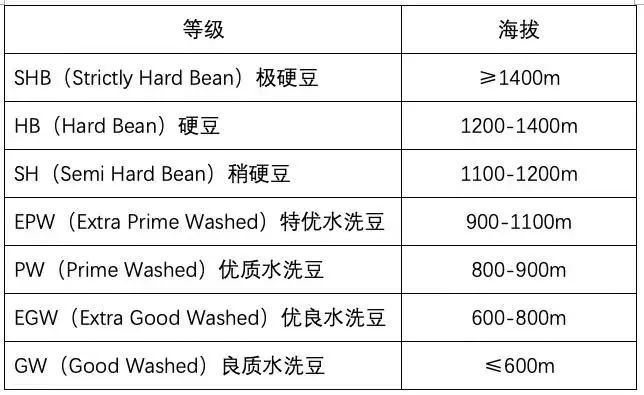
How can you drink a cup of coffee with rich layering? 1. Start with the choice of coffee beans First, you can prioritize beans grown at higher altitudes. The higher the altitude, the slower the coffee fruit matures and the more nutrients it accumulates, so its density and flavor compounds are also richer. This is also one of the reasons many Central American countries use altitude as one of the grading standards for coffee beans.

Next, consider the processing method: natural, honey, anaerobic, and other processing methods often have an advantage in layering performance compared with washed processing. Note that this says advantage, not that they are necessarily more layered than washed. The reason is that these processing methods undergo longer fermentation, allowing more possibilities for substance transformation, so if you pursue layering, coffee beans with a higher degree of fermentation will be a more suitable choice.
2. Retention of fines After coffee beans are ground into powder, some fines with a particle size of less than 0.3mm will always be produced, and we can retain an appropriate amount of fines. Fines are a double-edged sword: too many fines will clog the filter paper, causing over-extraction and bringing negative flavors such as bitterness.
Only by retaining an appropriate amount of fines can you add different flavors to the coffee and thereby enhance layering. This is actually the result of uneven extraction: particles of different sizes have different extraction efficiencies, and fine particles inevitably extract faster than coarse particles. When differences in extraction degree appear, the flavors presented will naturally differ as well. Regarding the phrase "appropriate amount," Front Street Coffee specially conducted an experiment and found that fines accounting for 5% of the total is the most suitable. It will neither cause over-extraction nor clog the filter paper, and at the same time it can extract more flavor layers. 3. Increase the coffee-to-water ratio When the concentration is too high, flavors become blurred, producing a muddy feeling, and various flavors are hard to distinguish. At this time, you can appropriately increase the coffee-to-water ratio to solve it. For example, if you are currently using a 1:14 ratio but the flavor expression is blurred, you can adjust it to 1:15; if it is still blurred, raise it to 1:16. The operation is very simple.
4. Pulse pouring Because different flavor substances are released at different time periods, we can choose the strength of the flavor substances we want through pulse pouring, thereby obtaining the desired layering. At this point, some friends may ask: then why is one-pour brewing not recommended?
With the commonly mentioned one-pour method, the extraction time is shorter than with pulse pouring, because the washing during pouring speeds up the flow rate, causing the extracted substances to be mainly the sour and sweet substances released in the early stage. Pulse pouring, however, allows the substances released in the front, middle, and back stages to each receive a certain amount of extraction, so in the end, in terms of layering, pulse pouring usually provides more. Therefore, by making appropriate adjustments according to the actual situation, brewing coffee with distinct layering will not be a difficult task.
- END - FrontStreet Coffee
No. 10, Bao'an Qian Street, Yandun Road, Dongshankou, Yuexiu District, Guangzhou City, Guangdong Province
The above content is compiled by CoffeeHunters, a coffee news website.


