







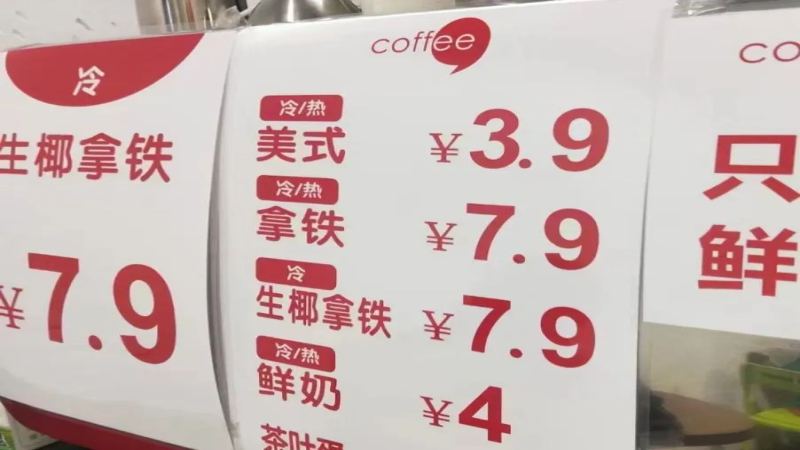
Can single-digit coffee prices hold up without coffee quality?
Coffee priced under 10 yuan has moved from unusual to routine in China. Luckin sells at 9.9 yuan, Cotti at 8.8 yuan and Lucky Cup at 5 yuan, while regional chains and new small shops use low prices as their main draw. A Nantong chain named itself 9.9, and a Qingdao shop called Bushangshi prices nearly everything under 10 yuan.
Large brands dilute costs through supply chain scale, while independent stores use low entry prices to attract first-time drinkers and build repeat visits. Shops charging above 10 yuan without brand strength or clear coffee quality now face a harder test. Upgrades such as SOE beans give smaller stores a way to justify a higher price and separate themselves from the discount tier.
In recent years, coffee priced under 10 yuan has gone from impossible to the norm. Leading brands such as Luckin, Cotti, and Lucky Cup have all entered the fray, while regional chains and even newly opened small shops are rushing to use single-digit pricing as their signature. From Nantong to Qingdao and then to Shanghai, low-priced coffee is blooming everywhere, but the cost pressures and profit logic behind it deserve deeper scrutiny. Giants rely on supply chain advantages to dilute costs, while independent stores try to attract first-timers with low barriers and cultivate repeat purchases. However, when coffee prices are simplified into two camps—"under 10 yuan" and "over 10 yuan"—stores priced above 10 yuan without brand and quality support will face a severe survival test. This article analyzes the underlying logic and future direction of this price war.
▲
Click to follow | Daily specialty coffee culture magazine Coffee Workshop
Today, selling coffee for "single digits" has become an important bargaining chip for many industry players in the fight for customers.
If we rewind the clock a few years, single-digit price tags were almost unimaginable in the coffee world, at most seen only in convenience stores. However, since 2023, brands joining the sub-10-yuan price war have only increased, and low prices have long since gone from a novelty to a common phenomenon.
The ever-emerging "single-digit coffee"
In addition to proactive top players like Luckin at 9.9 yuan, Cotti at 8.8 yuan, and Lucky Cup at 5 yuan, many regional chain brands have also successively rolled out price ranges under 10 yuan. Even some newly opened small shops have voluntarily joined the battle, directly using single-digit pricing as their main selling point.
In Nantong, Jiangsu, a coffee chain simply uses "9.9" as its brand name, and none of the regular products on its menu exceed 10 yuan. The brand has now opened its fourth store and launched a cooperative joint venture model locally.
Also highlighting "cheapness" in its name is Qingdao's "Bushangshi Coffee."
Unless customers upgrade to SOE beans, all coffee in the store is priced according to the "under 10" rule implied by the store name, which makes fellow industry players nervous just looking at it.
In addition, the author noticed on a review platform a café in Shanghai where Americano sells for only 6 yuan, and milk coffees such as latte, cappuccino, Dirty, and flat white are all 9 yuan. Such prices may not seem particularly eye-catching at first in today's extremely competitive coffee track, but considering Shanghai's sky-high rents, one cannot help but look at it differently. According to the owner, the actual usable area is only about 10 square meters, yet the monthly rent is as high as 13,000.
After seeing these cases of extreme competition, one cannot help but ask: how many cups must be sold in a day to earn back the initial investment?
Can small profits but quick turnover really recover the capital?
Ultimately, the essence of a low-price strategy is to stimulate the public's impulse to buy and to fight for market share through small profits but quick turnover. The lower the price, the thinner the profit per cup, and the more necessary it is to cut expenses in other areas to keep a physical store's operations balanced.
The reason giants can master low prices is that they operate on a huge scale, have outstanding supply chain advantages, and naturally have a higher possibility of driving costs down. Some netizens have calculated that even if a cup of Luckin coffee drops to 9.9 yuan, it is still profitable and not a loss-making effort to gain attention. Moreover, the 9.9 yuan coupon only applies to some coffee categories, so the impact on overall profitability is not as great as imagined.
On the other hand, many founders of affordable coffee brands have publicly stated that single-digit pricing looks "unprofitable," but as long as funds are "used where it matters," it is still possible to preserve the gross margin needed to survive. The real operational difficulty lies in how to increase cup output to cover rent, labor, depreciation, equipment wear and tear, and other costs.
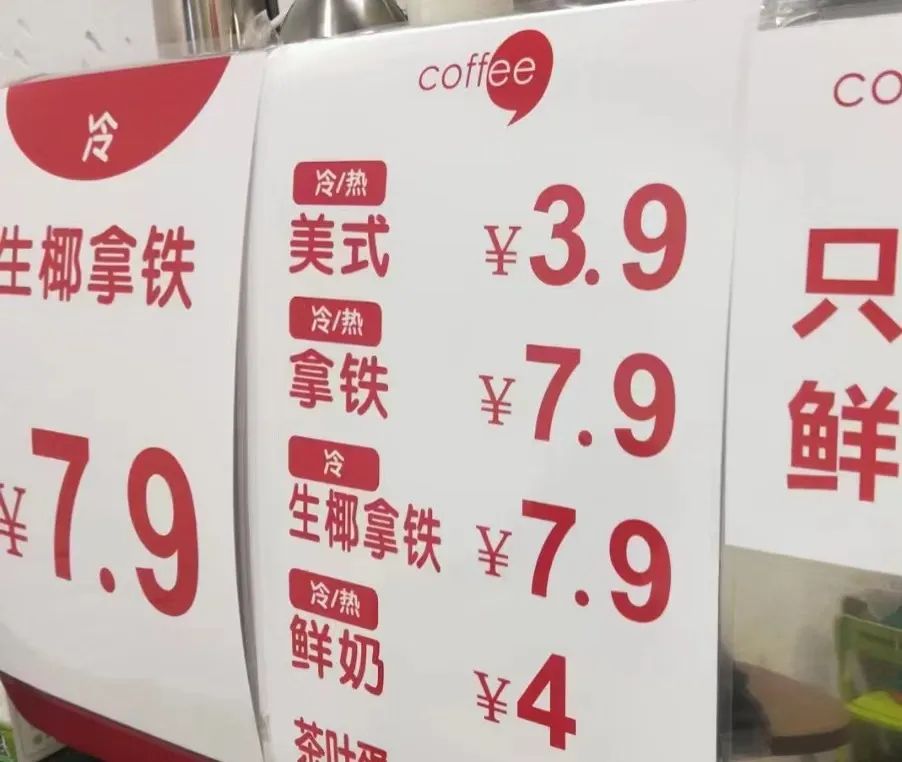
Image source: Fanshou Yige Mianbao
Clearly not profitable, so why still fight with low prices?
You should know that price is always the most sensitive factor that can stir consumers' nerves. On major social platforms, rather than which brand has released a new product, netizens care more about which coffee "deals" can be grabbed. For large brands focused on the "fast coffee" model, long-term low-price promotions are their key trump card for seizing the market.
From the perspective of independent stores, lowering the threshold for drinking coffee is equivalent to giving the curious public an opportunity to try something new. Spending just a few yuan allows them to experience the quality of the store's products, gradually cultivating new entry-level customers into frequent regulars, thereby increasing the overall repurchase rate.
As for how long "single-digit coffee" alone can last, it depends on whether the cost-performance ratio matches public demand and whether the market response can meet or exceed expectations.
Image source: DF81
In the past, the price of a cup of coffee could at least be divided into several ranges (under 10 yuan, 10–20 yuan, 20–30 yuan, 30+), but now coffee seems to be divided into only two camps: "under 10 yuan" and "over 10 yuan." If the price exceeds 10 yuan, and the coffee quality, brand awareness, and marketing are all inferior to stores of leading companies like Luckin, survival will be extremely difficult.
Disclaimer: Some images in this article are from the internet. For some content on the website, such as images, we will respect the original copyright and indicate the source. However, due to the large quantity, some images and texts may not have been credited in time. Please forgive us. If the original author has any disputes, they can contact the website for handling. Once verified, we will correct it immediately. Compiled and edited by "Coffee Workshop." Please indicate the source when reprinting. If there is infringement, please inform us for deletion. Thank you~!
The above content is compiled by CoffeeHunters, a coffee news website.


