








Can a Small-Town Coffee Store Still Survive?
Opening a coffee store in a small county town has become a popular self-employment plan for young people in China, with related notes on one social platform exceeding five million. That dream is now meeting a hard reality: Luckin and Cotti are competing on price, with drinks as low as 9.9 yuan, and both chains are expanding into lower-tier markets.
The pressure arrives alongside a difficult job market. China's youth unemployment rate reached 21.3% in July, and the National Bureau of Statistics said it would stop publishing urban survey unemployment rates by age group from August. The coffee industry's chain expansion is squeezing independent owners, who must weigh lower margins, higher competition, and limited room to differentiate.
The National Bureau of Statistics announced that starting from August, it will suspend the release of urban survey unemployment rates by age group. Previously, the youth unemployment rate in July reached as high as 21.3%, and many young people have set their sights on opening coffee shops in small county towns as a path to self-employment. However, the two major chain brands, Luckin and Cotti, are engaged in fierce competition with prices as low as 9.9 yuan or even lower, expanding aggressively into lower-tier markets, and the survival space of independent coffee shops is being rapidly squeezed. This article analyzes the harsh reality behind the small-town coffee dream one by one, from the shop-opening boom, the impact of the price war, chain expansion data, to the real predicament of independent shop owners, and explores whether independent coffee shops still have a chance to break through.
▲
Click to follow | Daily specialty coffee culture magazine Coffee Workshop
A spokesperson for the National Bureau of Statistics recently said that starting from August, it will no longer publish urban survey unemployment rate data by age group. Previously, data for July showed that the national unemployment rate was 5.3%, among which the unemployment rate for young people was as high as 21.3%. At the same time, many young people who actively choose flexible employment have long made plans for their career path—returning to a small county town to open a coffee shop.
The topic of opening a coffee shop in a small county town has always maintained extremely high discussion heat. On just one social platform, related notes have already exceeded five million. The reason may be that, for these people, compared with enduring the hardships of striving and the heavy pressure of life in big cities, returning home to run a business they love is clearly more attractive.
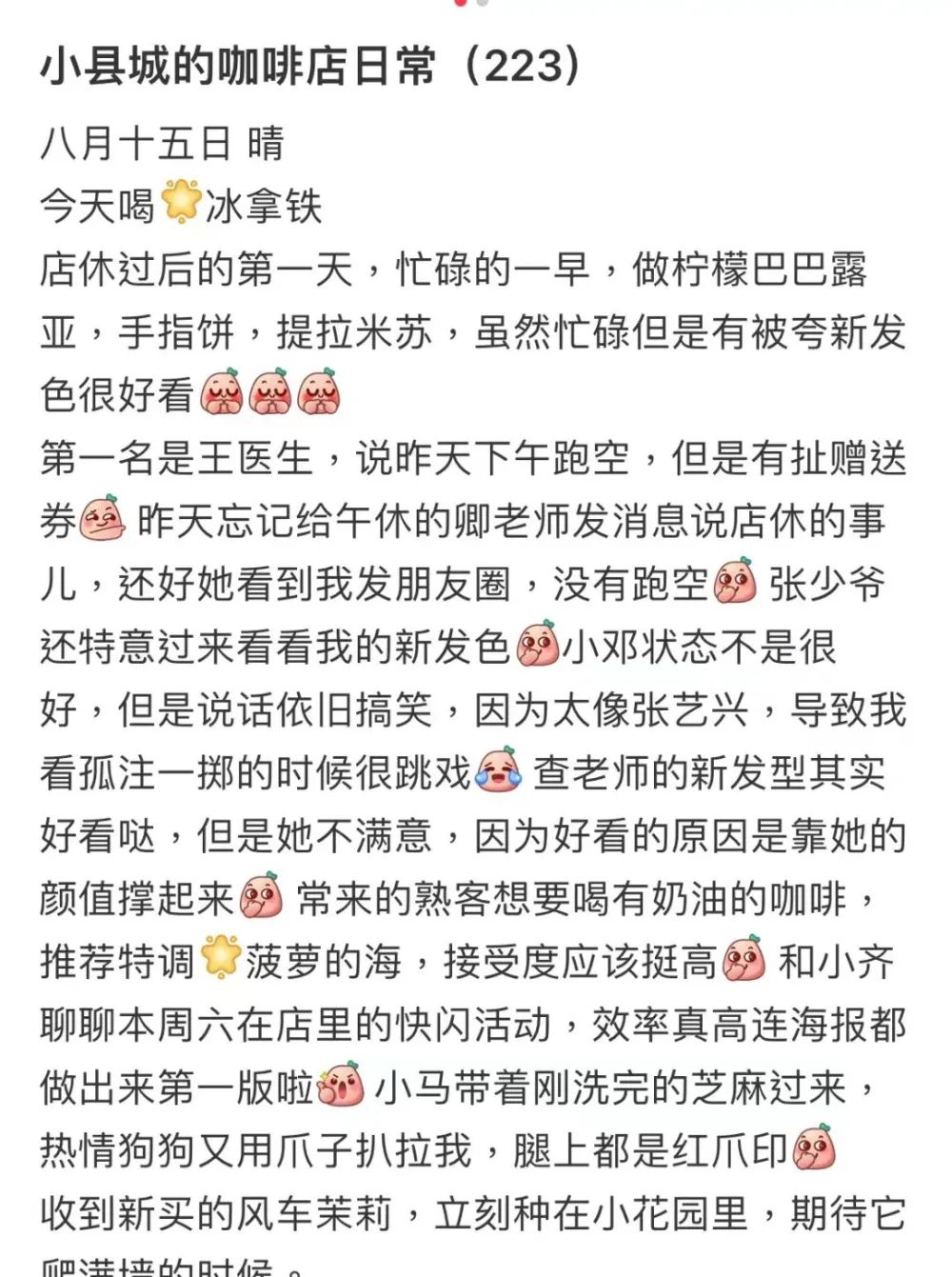
The threshold for opening a shop is not very high, and business hours can be arranged freely. These two points have led young people in towns to regard opening a coffee shop as their first choice for employment. Many "bosses" show off on social media the leisure and comfort of running a coffee shop in a small town.
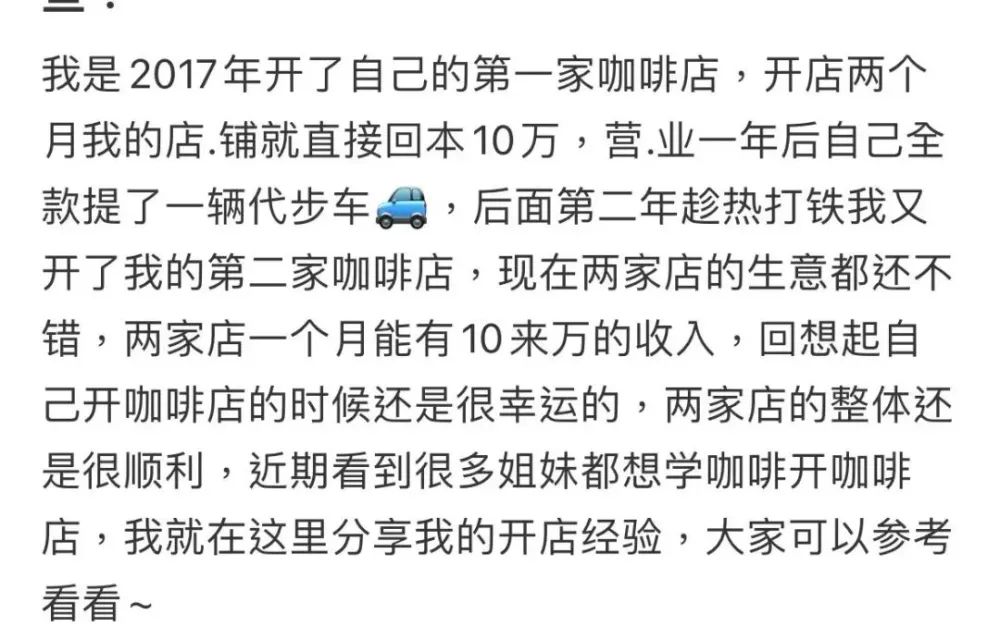
Not only that, many bloggers have also posted their "successful" entrepreneurial insights on the platform, telling how they managed to earn 100,000 yuan a month. As a result, more and more people naturally continue to pay attention to this industry, and the atmosphere for returning home to open a shop has been further pushed up.
These small-town coffee shops belonging to other people were originally meant to pursue a distinctive lifestyle, but in the end they became a unanimous choice that everyone tacitly understood. With so many coffee shops springing up in small places, operators try to shape their own uniqueness while also competing for customers through pricing. It seems that being a boss is not as easy as imagined. Some netizens have vented online about the "pain" of running a coffee shop: not only can they not earn much money, but they are firmly bound by the shop instead.

However, this is only the prelude to the story. Only with capital support can one fight a price war, and the contest between Luckin and Cotti is the core battlefield of this competition. From the data of first-tier cities, the price of a single cup of coffee previously generally ranged from 20 to 40 yuan, and the same was true for Starbucks and Pacific Coffee. For new players entering the market, the way to seize the market is nothing more than a denser store network plus lower prices.
Judging from the marketing moves of the past year or two, prices have dropped from 9.9 yuan all the way to 8.8 yuan, and some even offered 0 yuan. While capital fights one another, coffee consumers have indeed taken full advantage. But independent coffee shop owners may silently become cannon fodder in this melee. They originally planned to operate with a low-price, high-volume strategy, but in the face of the single-digit price war between Luckin and Cotti, they have no room to fight back at all—what you want is profit, what capital wants is the market. Coffee shops priced between 10 and 20 yuan have suffered the most severe blow to sales under the impact of major brands.
According to Luckin's latest quarterly financial report released last week, 1,485 new stores were added in the second quarter. So far, the total number of Luckin Coffee stores has reached 10,836; Cotti expanded from 4,000 stores in June to 5,000 stores in August. The two fundamentally come from the same founder, and their playbook is exactly the same: integrate a large amount of capital, tell a good development story, then integrate more funds, and open more stores.
In the first quarter of 2023, Luckin's revenue turned profitable, and in the second quarter revenue further increased to 4.437 billion yuan, and this model was thereby further verified. Following the pace of frenzied store openings by Luckin and Cotti, more second- and third-tier cities are bound to become the main battlefield for both sides to expand into lower-tier markets. This coffee war has only just begun.
In addition, affected by the economic environment in the past two months, people's consumption patterns have become more conservative, they spend more cautiously, and they calculate unit prices carefully. Some shop owners have reported on social media that due to the close combat between Cotti and Luckin, their turnover is declining rapidly.
The shop-opening boom has suddenly turned into a shop-closing wave. Some shop owners have already felt the chill, saying that the struggle between the two major brands is accelerating the speed at which independent coffee shops go out of business. Even some stores that are still holding on are facing the predicament of order volume being halved due to compressed prices.
A relevant person from Luckin revealed in an interview with the media that the 9.9 yuan anniversary promotion will last at least until the end of next year. Perhaps for those young people who chose to escape the city and return to a small town to open a coffee shop to realize their boss dream: this dream has only just begun.
Disclaimer: Some images in this article are from the internet. For some content on the website, such as images, we will respect the original author's copyright and indicate the source. However, due to the large quantity, there may be a few images and texts that have not yet been credited. Please understand. If the original author has any dispute, they can contact the website for handling. Once verified, we will correct it immediately. Compiled and edited by "Coffee Workshop". Please indicate the source when reprinting. If there is infringement, please inform us for deletion. Thank you~!
The above content is compiled by CoffeeHunters, a coffee news website.


