







Why Are Arabica Beans Central to the Decaf Coffee Boom?
Decaf coffee has become a visible product line rather than a niche request. Tims China added a decaf series to its ordering platform, Starbucks offers a decaf switch and launched a lightly caffeinated range, Blue Bottle released a decaf bean line, and Peets has followed. The shift responds to caffeine-sensitive consumers.
Caffeine intolerance is estimated to affect a large share of the global population, which explains the demand. Decaffeination dissolves and removes caffeine through solvent treatment, and the process makes decaf beans cost roughly 5 to 10 percent more than regular ones. Arabica beans hold 1.1 to 1.7 percent caffeine, Robusta 2 to 4.5 percent.
Recently, discussions about decaf coffee have been steadily heating up on social platforms, with chains like Tims, Starbucks, and Blue Bottle launching decaf product lines one after another, drawing widespread attention. According to statistics, people with caffeine intolerance account for as much as 61.25% of the global population, and the expansion of decaf coffee is precisely a response to this huge and diverse demand. From a technical standpoint, decaf coffee is not simply half the coffee liquid; rather, caffeine is dissolved and evaporated through solvent treatment, making its cost 5%-10% higher than regular coffee beans. Although it is still in the market popularization stage, as the healthy consumption trend rises, whether decaf coffee can become a new growth point for the industry is worth continued attention.
▲
Click to follow | Daily specialty coffee culture magazine Coffee Workshop
Where there is demand, there will naturally be supply!!!
I wonder if you all still remember the trending hashtag on Weibo earlier this month, #OrderCoffeeWithNoteNoCoffee#? This is probably not just a funny meme, but a genuine reflection of a certain real demand in the market. And riding this wave of demand, "decaf coffee" has arrived on cue!
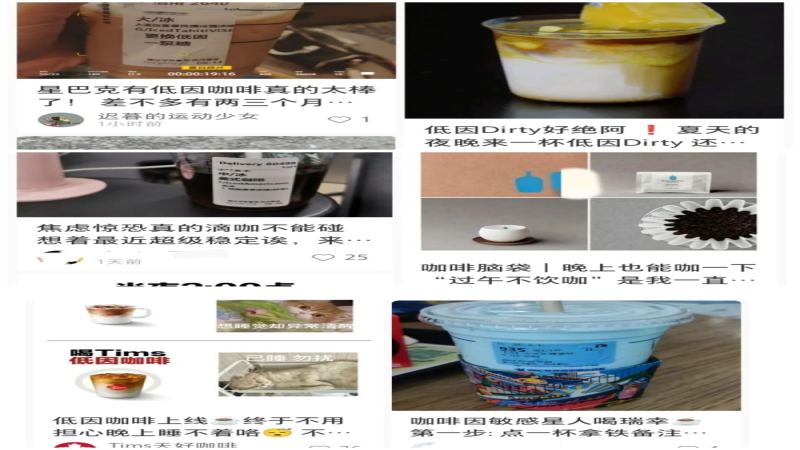
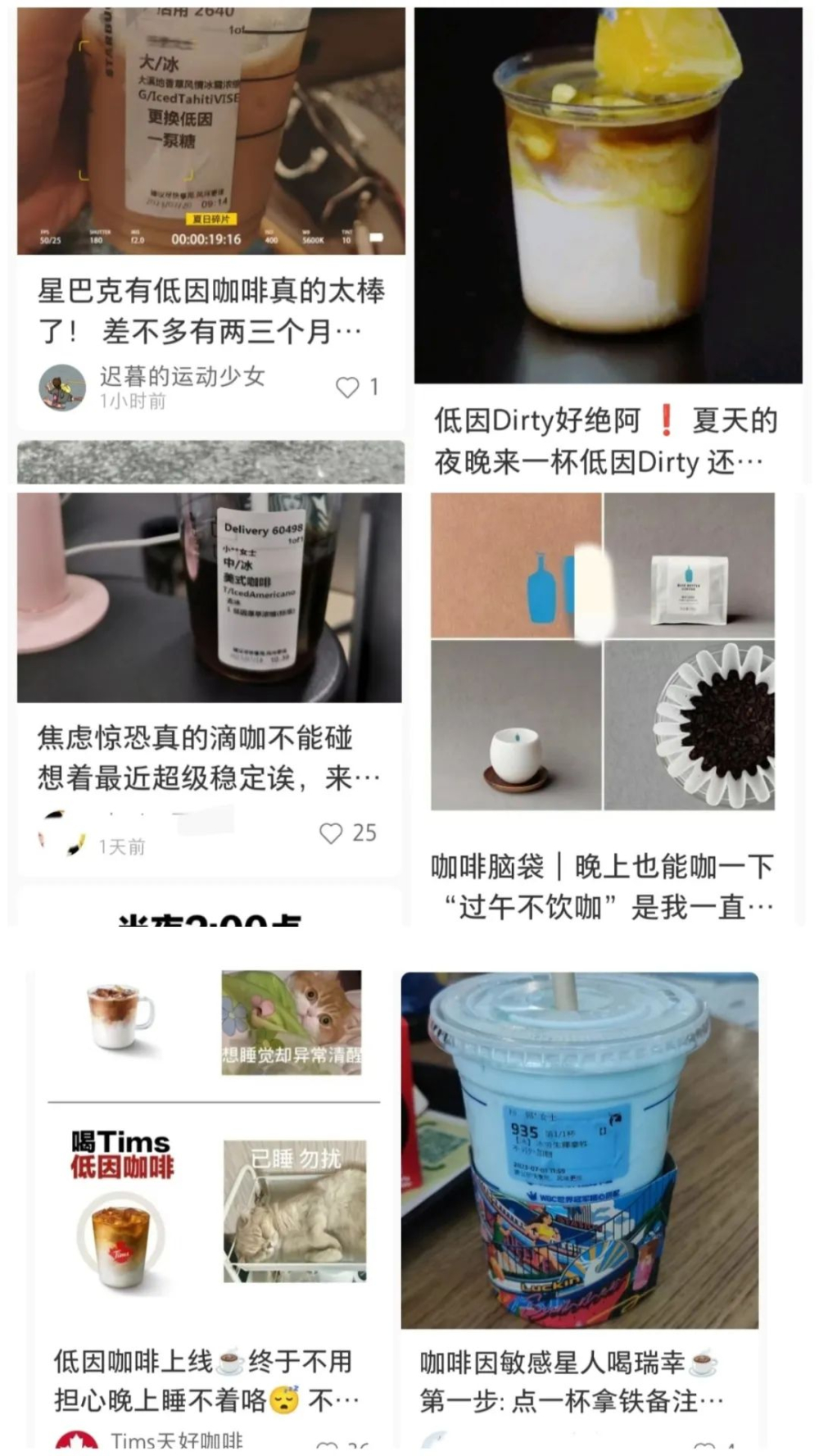
Recently, the number of discussion posts about "decaf coffee" on social platforms has clearly increased, and major coffee chains have quietly launched "low-caffeine new products" in their own stores, successfully attracting the attention of many netizens.
Early last month, Tims China quietly added a "decaf coffee" series to the product categories in its store mini-program; Starbucks had even earlier offered the option to switch to decaf on its mini-program ordering page. Not long ago, Starbucks also grandly launched a new generation of "Raw Coffee" series, which the company stated is a lightly caffeinated beverage line.
Blue Bottle Coffee has also launched a new decaf coffee bean product called "Twilight"; PeetsCoffee and so on... The decaf products of many chain brands have drawn quite a few netizens to visit and review them!!! So, will "decaf coffee" become a new round of popularity in the coffee market?!
Knowledge extension 🔍 The coffee beans we commonly see are mainly divided into two types: Arabica and Robusta. Arabica beans have a caffeine content between 1.1% and 1.7%, while Robusta beans contain 2% to 4.5% caffeine. So-called decaf coffee refers to brewed coffee liquid with a caffeine content not exceeding 0.3%; converted, a cup of decaf coffee must not contain more than 5 milligrams of caffeine.
The layout of decaf coffee product lines continues to expand, a phenomenon that has prompted many netizens to exclaim how great it is! Finally, no more worrying about drinking coffee in the afternoon and being unable to sleep at night!
: "Good news for people with caffeine intolerance"
"Can there be more types of decaf products?"
"Simply the light of pregnancy"...
Of course, many netizens are also confused: isn't drinking coffee all about that hit of caffeine?! But in fact, according to online data, the proportion of people with caffeine intolerance worldwide is as high as 61.25%, and the current expansion of decaf coffee products is precisely to satisfy more diverse and personalized consumer needs, injecting a new growth point into the coffee market.
Although at the current stage, decaf products are still in the popularization period in the market, as the coffee market continues to grow, I believe there will be broader market space in the future for laying out decaf coffee~ allowing more consumers who love coffee but are sensitive to caffeine to achieve coffee freedom.
It is worth mentioning that the decaf coffee products mentioned here are not as simple as halving the coffee liquid. The coffee beans used in decaf coffee products are obtained by soaking them in a solvent to dissolve out the caffeine, then subjecting them to evaporation treatment.
It is reported that their processing cost is 5%-10% higher than that of regular coffee beans, and this may be one of the reasons why decaf coffee products have not yet become rapidly widespread.
However, as the health trend spreads, such products have already gained favor among more and more consumers, and the market has begun to continuously expand decaf coffee products in more forms and flavors. Whether decaf coffee can become a new growth point in the future, let us wait and see~
Disclaimer: Some images in this article are from the internet. For some content on the website, such as images, we will respect the original author's copyright and indicate the source. However, due to the large quantity, a few images and texts may not have been credited in time. Please understand. If the original author has any disputes, they may contact the website for handling. Once verified, we will correct it immediately. Compiled and edited by "Coffee Workshop". Please indicate the source when reprinting. If there is infringement, please inform us for deletion. Thank you~!
The above content is compiled by CoffeeHunters, a coffee news website.


