








How does the coffee beans process shape Huakui 7.0 flavor?
Huakui 7.0 arrived in China in May 2023 and drew doubts: some drinkers found it lacked the strawberry sweetness and creamy body linked to the original Huakui, and questioned whether beans outside the Buku Abel station deserve the name. The coffee beans process behind it is a natural method, typical of Sidamo, which shapes its fruit-forward profile.
The name traces to 2017, when a natural batch of Ethiopian heirloom coffee beans grown at the Buku Abel processing station in Hambela won the TOH natural category with intense strawberry and cream aromas, and a Beijing trader later called it Huakui. The 7.0 crop follows that coffee beans process, though sourcing shifts explain the Yirgacheffe-leaning flavors some tasters note.
Every year before the new crop of Huakui coffee beans arrives at port, the domestic coffee community is already abuzz with discussion. In May 2023, Huakui 7.0 officially arrived in China, but it sparked quite a bit of skepticism: Why doesn't it taste like "Huakui"? Why do the flavors lean toward Yirgacheffe? Is it still Huakui if it's not from the Buku Abel processing station? This article starts from the origins of Huakui, traces how the 2017 TOH champion batch got its name, explains the relationship between Buku Abel village and the surrounding processing stations, describes the flavor profile of Huakui 7.0 and the typical characteristics of Sidamo natural beans, and shares Front Street Coffee's roasting and cupping results for this new batch.

Huakui coffee beans have always enjoyed extremely high attention in the domestic coffee community. Whether professionals or enthusiasts, everyone starts looking forward to the new crop before it arrives each year. What they're hoping for is simply whether the new year's Huakui can still deliver that strawberry-like sweetness and creamy smoothness.
The latest crop, Huakui 7.0, arrived in China in May 2023, and many people grabbed this freshly arrived batch right away. However, a series of questions followed:
"Why doesn't Huakui 7.0 taste like Huakui?"
"This is clearly Yirgacheffe flavor!"
"If it's not a natural batch from the Buku Abel processing station, can it still be called Huakui?"

After Hongshun Company listed Huakui 7.0 green beans, various roasters rolled out roasted products one after another, but doubts about the true identity of Huakui 7.0 kept surfacing. Some felt the flavor was noticeably different from the 2017 champion batch, while others outright denied its Huakui identity simply because the beans didn't come from the Buku Abel processing station.
So what exactly is the definition of Huakui coffee beans?
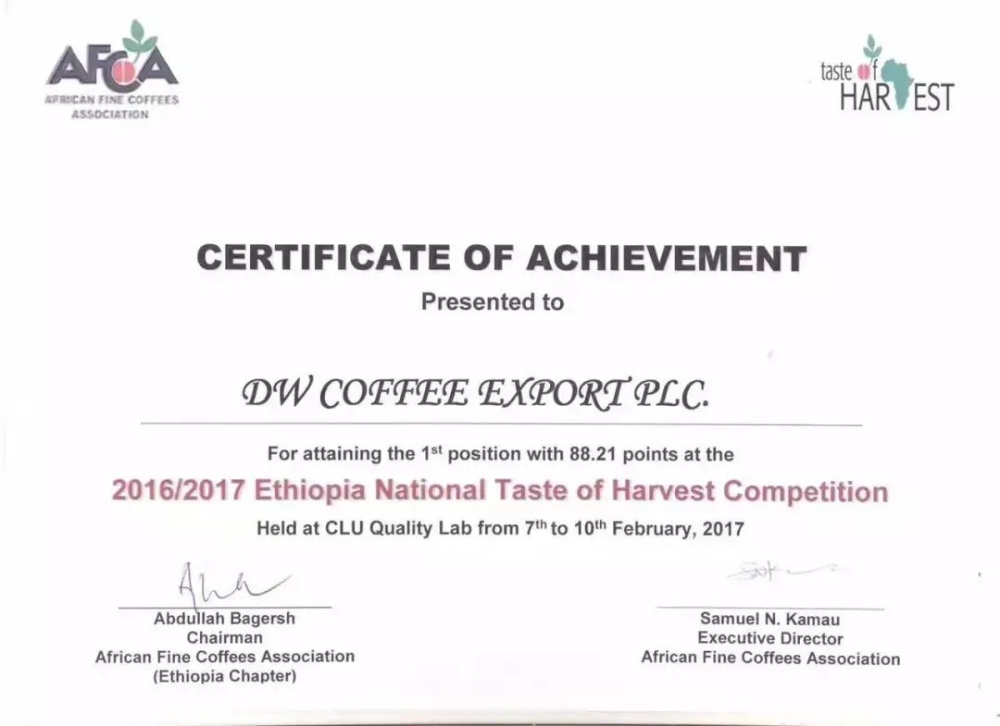
In 2017, at the TOH (a coffee competition held among African producing countries by the African Coffee Association), a natural-process batch of Ethiopian heirloom variety coffee beans from the "Buku Abel" processing station under DW Company in the Hambela region won the natural category championship with its intense strawberry and creamy aromas.
That same year, after the champion batch's green beans were imported by a Beijing green bean trader, they were given the name "Huakui," meaning "chief of a hundred flowers, with a bewitching grace." Chinese coffee fans truly became familiar with Huakui at the 2017 World Coffee Brewing Championship, where China runner-up Li Jianfei used that batch of Huakui beans to defeat the Geisha beans held by many other competitors.
Since then, "Huakui" quickly became a sensation in the domestic coffee community. Many people were captivated by the intense strawberry flavor of the 2017 batch, which created a fixed impression: Huakui must come from the Buku Abel processing station, and Huakui should have a powerful strawberry taste.
(2017 Huakui coffee beans)
After winning the championship in 2017, DW Company further expanded its specialty coffee drying stations in Dimtu town, the core production area of Hambella Wamena Wereda. The raised drying beds are mainly concentrated in five villages: "Buku Abel Kebele," "Tirtiro Goye Kebele," "Seke Bokosa," "Haro Soresa," and "Buku Saysay."
The Buku Abel that everyone knows is actually a village under Dimtu town. Due to translation issues, it was earlier directly called the Buku Abel processing plant or station. A more accurate description would be the processing station within Buku Abel village.
According to Hongshun Company, which handles the import of Huakui coffee beans, Buku Abel village is not large, covering about 25 kilometers in radius. Within the village there are 3 to 5 processing stations, each equipped with 20 to 30 drying beds.
One processing station can roughly cover the red cherries from hillsides within about a 5-kilometer radius. Therefore, each processing station can produce 50 to 100 tons of natural G1 coffee beans per season, which means Buku Abel village can produce approximately 500 tons of Huakui coffee beans each new season.
From the perspective of growing regions and processing plants, among all these estates and processing sites, only the processing station within Buku Abel village covers the small plot that originally produced the champion natural Huakui beans.
Although Buku Abel village accounts for the "lion's share" of processing volume, which is why most Huakui on the market comes from Buku Abel, the harvest range has expanded compared to the original Huakui. Therefore, it doesn't mean that only natural G1 coffee beans from processing plants within Buku Abel village can be called Huakui.
So besides Buku Abel, what's the story with the other Buku xxx?
They're simply neighboring villages. Places that share the same surname must be right next to each other, at most separated by a road. Places just a road apart naturally handle coffee cherries from the same neighborhood, not far apart, and the growing areas have nearly identical climate and terroir.

At the same time, many coffee farmers send their cherries to the processing station in Buku Abel village, so the processing volume of other villages is naturally not as large. For export, the labeling must be truthful—whichever village processed it gets that village's name—but this doesn't change the fact that they're all coffee beans managed under DW Company.
Therefore, the natural G1 coffee beans processed by the five villages—"Buku Abel Kebele," "Tirtiro Goye Kebele," "Seke Bokosa," "Haro Soresa," and "Buku Saysay"—all belong to Huakui.
Why doesn't today's Huakui 7.0 taste like Huakui?
Ultimately, Huakui coffee beans are essentially natural G1 coffee beans from the Hambela region, using ordinary and traditional sun-drying. As an agricultural product, the flavor of coffee beans is inevitably affected by multiple factors each year, including terroir, climate, drying duration, and humidity.
The reason the 2017 Huakui tasted so good was that the timing, conditions, and human effort all came together perfectly, creating that intense strawberry aroma and creamy smoothness.
Tasting that good could be called luck. And luck doesn't come every year. By the 2018 crop, the G1 coffee beans grown in the relevant areas and sun-dried at the relevant processing stations no longer tasted like the 2017 crop, so in theory there is no fixed thing called "Huakui flavor."
To differentiate, domestic green bean companies labeled each subsequent year's batch with an X.0 number. In 2018, Huakui 2.0 was released; in 2019, Huakui 3.0 and 3.1 were released.
During this period, Front Street Coffee discovered through cupping that the flavor and aroma of small-bean Huakui coffee beans were very similar to the 2017 champion Huakui. At first, Front Street tasted flavors close to the 2017 Huakui in the 2018 and 2019 Huakui batches, but they fell short of the 2017 Huakui in body and aftertaste.
(Comparison of small-bean Huakui and Huakui 5.0)
By comparing different batches of Huakui, we realized that the main source of the 2017 Huakui's aroma was some particularly small-bean varieties within the Huakui coffee beans. Similar small beans also appeared in the 2018 and 2019 Huakui batches; sometimes a few sacks of similar small beans would appear among ten sacks. In 2019, we confirmed this information and informed the green bean supplier. Starting in 2020, Huakui split into two types: 4.0 and small-bean Huakui. Therefore, small-bean Huakui does not belong to the 【X.0】 series.
Last year, because the appearance of Huakui 6.0 green beans was not ideal, Front Street Coffee kept selling small-bean Huakui and did not list Huakui 6.0 coffee beans.
As for the new 2023 crop of Huakui 7.0, Front Street Coffee also got its hands on it as soon as the green beans arrived at port. After comparative observation, this year's Huakui 7.0 green beans no longer have many appearance issues.
Because they are new-crop coffee beans, the moisture content is relatively high, and grassy notes will be more obvious. In response, Front Street's roaster adjusted the curve and then roasted the Huakui 7.0 coffee beans to a medium-light level.
Twelve hours after roasting was completed, all Front Street staff conducted a cupping. Through comparative cupping and the cupping results of each participant, it could be seen that the new crop Huakui 7.0 showed citrus aroma in the dry fragrance, berry aroma in the wet fragrance, and after slurping showed citrus-like acidity, the sweetness and mouthfeel of apricot juice, passion fruit aroma, and a tea-like sweet finish.
Looking back at the flavor characteristics of natural coffee beans from the Sidamo region: citrus sweetness, full berry aroma, and tropical fruit flavors—Huakui 7.0 coffee beans can be said to be a typical Sidamo natural coffee.
- END -
The above content is compiled by CoffeeHunters, a coffee news website.


