








Is a Chilled Glass Really Needed for Dirty Coffee?
A frozen glass is not what creates the layers in Dirty coffee. Side-by-side tests with room-temperature, refrigerated, and frozen glasses showed that milk quality drives the separation, while cup temperature mainly affects how cold the drink feels and how long the crema survives on top.
The room-temperature glass produced visible gradients but weak temperature contrast. The refrigerated glass held stable layers and a clear hot-cold difference across the first sips, closer to the chilled result many cafés aim for, so chilling the glass alongside the milk is a reasonable step.
Dirty coffee has become a regular at specialty cafés thanks to its photogenic looks and unique mouthfeel, yet whether an ice-cold cup is essential for making it has long been debated. Through side-by-side tests with glass cups at room temperature, refrigerated, and frozen, Front Street found that milk quality is the real key to layering, while cup temperature mainly affects the chilled sensation and the preservation of crema. The article also traces the method of Dirty's creator, Katsuyuki Tanaka, who did not pre-chill his cup. If you're after a photogenic look and a layered experience, Front Street suggests chilling the cup together with the milk, and paying attention to the optimal tasting window.

In recent years, Dirty coffee has risen rapidly in popularity, and with its striking visual presentation and highly recognizable flavor, it has smoothly become a staple on the menus of many specialty cafés.
When it comes to making Dirty, many tutorials repeatedly stress three points: the hot-cold layers must be distinct, the cup must be chilled, and the milk should preferably be iced-bock. Front Street has already written articles discussing layering and the use of iced-bock. So is the step of chilling the cup really indispensable?
With an inquisitive mindset and a desire to verify by doing, Front Street prepared a controlled experiment this time, using glass cups in three states: room temperature, refrigerated, and frozen. Iced milk (Bright Fresh Pasture) was poured into the bottom of each, then espresso was added, to observe which one could deliver the most ideal "dirty" look and which kept its hot-cold layers longer.
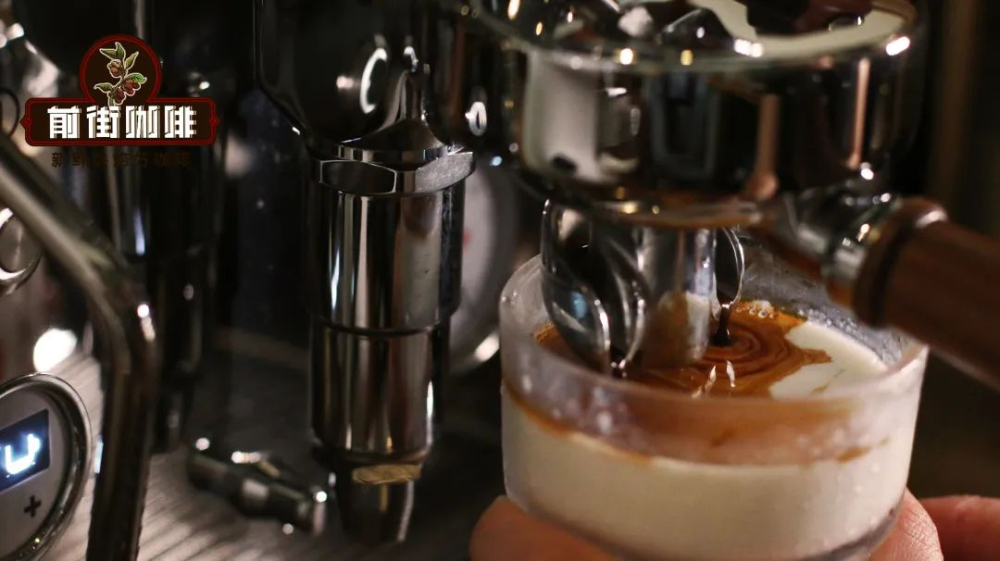
In the experiment, Front Street consistently used 20 grams of coffee grounds and a 27-second extraction time. The Dirty results made in the three cups under different temperature conditions were as follows:
Room-temperature glass cup: the cup temperature was higher than the milk, the layers were clearly visible, accompanied by a gradient "dirty" appearance. On the first sip, the temperature contrast between coffee and milk was rather weak, and by the second sip the milk was already close to room temperature.
Refrigerated glass cup: the cup temperature was almost level with the milk, the color transition zone was wider, and the layered state was stable and long-lasting. The first two sips clearly conveyed the hot-cold difference. After three minutes the crema began to dissipate, and after five minutes it gradually returned to room temperature.
Frozen glass cup: the cup temperature was lower than the milk, the color difference at the layer wasn't especially pronounced, but the coffee "invading" the milk produced the most "dirty"-looking visual. Compared with the previous two, the frozen cup's Dirty retained its crema better, had the clearest hot-cold layers, and stayed drinkable longer. Slightly regrettably, after the glass cup was taken out of the sub-zero environment, ice crystals condensing on its walls formed quite a few small water droplets, reducing transparency, so its photogenic effect was not as good as the previous two.
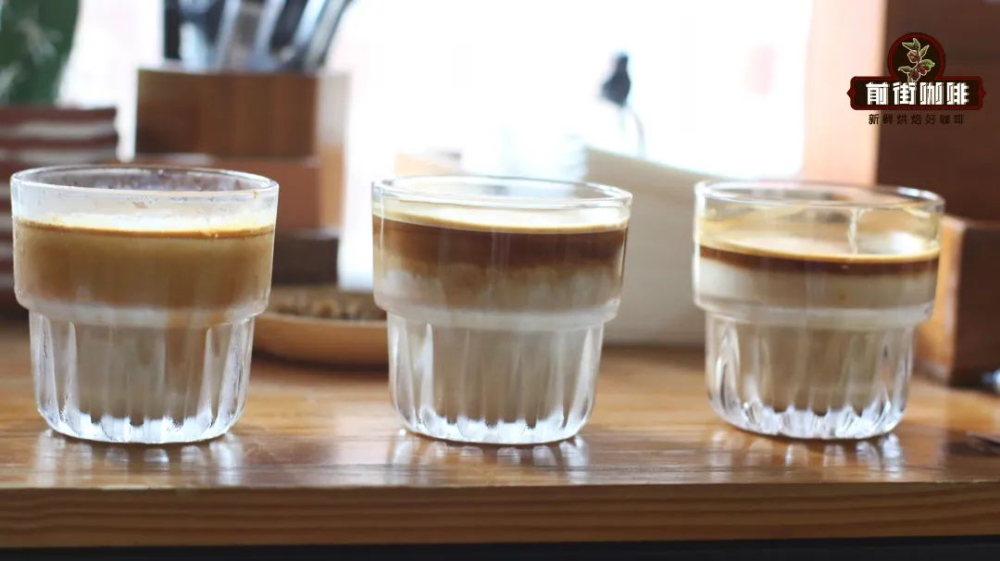
It's easy to see that whether the cup is pre-frozen is not the key to successful layering—as long as the milk itself can sufficiently support the coffee liquid, Dirty can present a beautiful layering. And the lower the cup temperature, the more pronounced the chilled sensation of the milk; combined with the warm, rich coffee liquid, the overall experience naturally rises to another level.
In fact, when Mr. Katsuyuki Tanaka, the founder of Dirty, made this dirty coffee back then, there was no "chilling the cup" step. In 2009, Mr. Tanaka opened Bear Pond Espresso in Kitashimozawa, Tokyo, and Dirty was a signature product from the day it opened, written on the menu as B.P Dirty.
The biggest feature of the B.P Dirty made by Katsuyuki Tanaka is his original espresso—"Angle Stain." He insists on extracting with a bottomless portafilter and judging the espresso state by eye, and the espresso liquid leaves tear-like marks on the cup wall. Under the combined effect of dark roasting, a large dose, ultra-high concentration, and a low extraction yield, the double shot of "Angel Stain" makes the coffee liquid of B.P Dirty sink very slowly, so even without pre-chilling the cup, the layers can still hold for a long time.
Overall, if you want your Dirty to be both photogenic and deliver a distinctly layered tasting experience, Front Street recommends putting the glass cup in the fridge ahead of time, chilling it alongside the milk, and taking it out when you're ready to make it. If you want to fully appreciate the charm of espresso and crema, it's best to keep the photo session within 3 minutes, otherwise you'll miss this cup of Dirty's optimal tasting window.
- END -
The above content is compiled by CoffeeHunters, a coffee news website.


