








Is Blue Mountain Coffee Still Mostly Bought by Japan?
Japan's reported grip on Jamaican Blue Mountain output was largely real before 2008, when an exclusive distribution agreement ended. Since then Jamaica has widened Blue Mountain quotas to more countries, so buyers outside Japan can find genuine lots. The Jamaica Coffee Board's grading standards, oak barrel shipping tradition, and the divide between real Blue Mountain and borrowed "Blue Mountain flavor" are what separate authentic beans from copies.
Genuine beans are graded by the Jamaica Coffee Board, with Blue Mountain No. 1 as the top tier. Clifton Estate's Front Street Blue Mountain No. 1 shows the classic profile: mild acidity, restrained bitterness, and a soft, sweet finish. For pour-over, use medium-fine grind, water near 90C, and a slow, steady pour to keep that delicate balance intact.
Regarding Jamaican Blue Mountain coffee, there's a popular saying that "90% of the production is bought up by Japan, and genuine beans are hard to find in the Chinese market." This perception was largely true before 2008, but with the expiration of the exclusive distribution agreement and changes in the global economic landscape, Jamaica has allocated Blue Mountain coffee quotas to more countries, and domestic consumers now have every opportunity to buy authentic Blue Mountain. This article will trace the history of Blue Mountain coffee's global popularity, analyze the essential difference between "Blue Mountain flavor" and genuine Blue Mountain coffee, and systematically introduce the Jamaica Coffee Board's grading standards, the oak barrel shipping tradition, and other key points for identification. At the same time, using Front Street Blue Mountain No. 1 from Clifton Estate as an example, it will present its flavor characteristics and pour-over extraction parameters, helping readers fully understand the value of authentic Jamaican Blue Mountain coffee.

Whenever Front Street chats with friends who don't drink coffee very often about Jamaican Blue Mountain coffee, we always hear a claim: most of the Blue Mountain coffee circulating in the domestic market is counterfeit, because 90% of the annual Blue Mountain production is taken by Japan, and the remaining 10% is sold to Europe and the United States. Is there any basis for this judgment? Today Front Street will help everyone figure out what truly counts as authentic Jamaican Blue Mountain coffee, and whether it is really impossible to buy the genuine article in China.
How did Blue Mountain coffee become popular around the world?
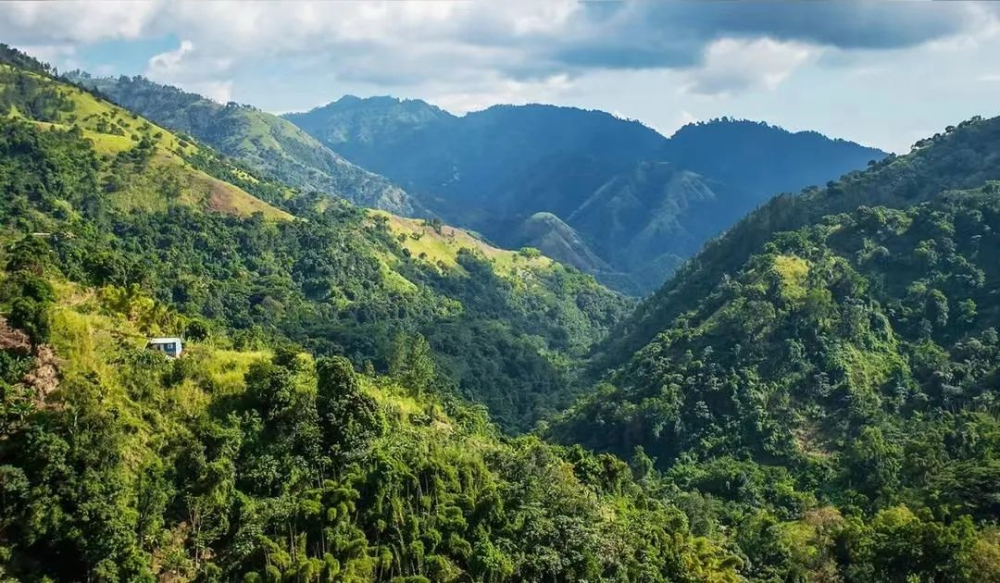
As the name suggests, Blue Mountain coffee is produced in the "Blue Mountain" region, located in the Caribbean island nation of Jamaica. In terms of growing conditions, Jamaican coffee is classified separately as island coffee, distinct from many inland producing regions.
Before the 1960s, Jamaican coffee beans were highly favored in the coffee market of the time thanks to their outstanding quality and excellent aroma. However, the good times did not last. In the late 1960s, one of the most severe hurricanes in history swept across the entire island of Jamaica, severely damaging many coffee estates and plunging the coffee industry into a long-term slump.
The 1960s and 1970s coincided with Japan's rapid economic growth, with extremely strong consumer spending and purchasing power. Jamaican Blue Mountain, following Indonesian Mandheling, became the most sought-after coffee category in the Japanese market. It was during this period that several Japanese trading companies jointly provided huge loans to a number of high-quality coffee plantations in the Blue Mountain region, including the well-known UCC Coffee Company (formerly Ueshima Coffee Co., Ltd.). In 1981, these Japanese companies directly purchased shares in the relevant estates, deeply intervening in the production and sales of Blue Mountain coffee, thereby obtaining priority purchasing rights and almost completely controlling the market for high-quality Jamaican Blue Mountain coffee.
To thank the Japanese companies for their assistance, in 1972 the Jamaican government signed a 30-year agreement with Japan, promising to supply 90% of Blue Mountain coffee's production quota to Japan, with the remaining about 245 tons, or 10%, allocated to other markets. As the saying goes, things are precious when they are rare. Blue Mountain coffee itself has limited production, was monopolized by trade, and demand was driven by extensive marketing, so prices naturally climbed all the way up.
In fact, during the period when the agreement with Japan was in place, Blue Mountain coffee was not entirely consumed locally in Japan; some beans were resold at high prices to other Asian countries and regions. Combined with Japan's vigorous promotion, many coffee professionals in nearby areas also began to pursue Jamaican Blue Mountain, such as in Singapore, South Korea, Taiwan, China, and Hong Kong, China. After 2000, the "Blue Mountain craze" gradually spread to mainland China, so when we talk with our elders about coffee, the first name that comes to mind is often "Blue Mountain."
The claim that "Blue Mountain coffee is scarce in the domestic market" did hold up before 2008, but after 2008 the situation changed. When the global economic crisis broke out in 2008, Jamaica tried to promote Blue Mountain coffee to more countries, and it happened that the exclusive distribution agreement with Japan also expired, so more Blue Mountain quotas were allocated to other countries. In this way, Japan's long-standing monopoly on the Blue Mountain market was broken, and buyers around the world could participate in the production and sales of Blue Mountain coffee. Chinese importers and roasters also entered the Blue Mountain coffee market after this, greatly increasing the chances of buying authentic Jamaican Blue Mountain domestically. In today's flourishing coffee culture, drinking a genuine cup of Jamaican Blue Mountain coffee is no longer difficult, and it can be done at Front Street stores.
Front Street stores sell authentic Front Street Blue Mountain No. 1 coffee imported from Jamaica at 158 yuan per 100g bag. You can also taste barista-made pour-over Front Street Jamaican Blue Mountain No. 1 coffee in the store for 60 yuan per cup.
Blue Mountain flavor beans are not the same as Blue Mountain coffee
After the reform and opening up, a large amount of foreign goods poured in, and coffee was among them. At that time, coffee was far from being as common as it is today, and the reputation of Blue Mountain coffee spread into China in this way. Early Blue Mountain coffee was extremely scarce and expensive, so merchants blended beans to approximate the taste of Blue Mountain according to its flavor characteristics, and a dark-roasted blend called "Blue Mountain flavor" appeared on the market. Although it bears the Blue Mountain name, it is actually far from the real thing.
Although there are still many fake Blue Mountain products on the market today, this does not mean that real Blue Mountain is hard to find. In fact, there are records in China as early as April 2011 of direct imports of Blue Mountain coffee from Jamaica. At that time, Zhejiang DUNN'S RIVER Import and Export Trading Co. purchased on behalf of the "Hangzhou Coffee and Western Food Association" from Jamaica, totaling 1000*70kg, with a total value of two million US dollars. Today Jamaica also attaches great importance to the Chinese market, and many authorized domestic exporters can be found on the CIB official website.
What credentials does authentic Front Street Jamaican Blue Mountain coffee have?
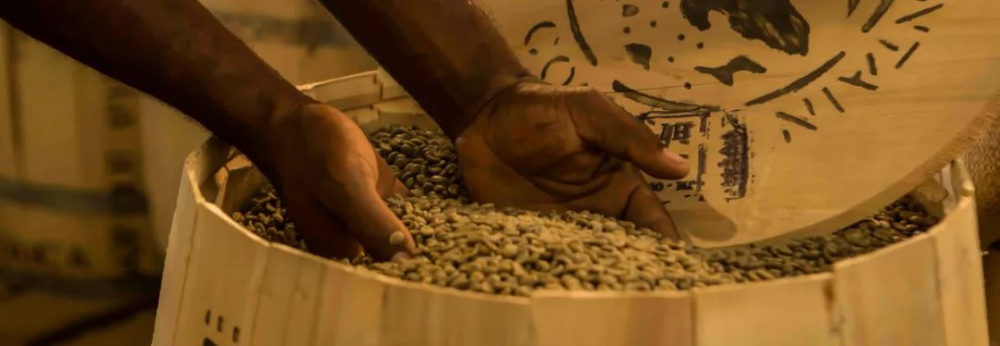
As consumers, we can check whether the merchant has the handmade oak barrels used to transport Blue Mountain green beans. Jamaica is the only producing region in the world that uses oak barrels as the transport vessel for coffee. The barrels come in three specifications: 70 kg, 30 kg, and 15 kg. Compared with coarse cloth sacks, the advantage of oak barrels is that they can absorb and release internal and external moisture while isolating the coffee aroma from escaping, allowing the beans to maintain a more stable moisture content and making roasting more stable. Later, wooden barrels also became one of the signs for identifying authentic Blue Mountain coffee.
In addition, dealers producing Blue Mountain coffee must obtain a license from the Jamaican government and authorization from the Jamaica Coffee Board. All Blue Mountain batches exported from the region must also pass the Coffee Board's quality inspection and certification and carry its label. Therefore, we can ask merchants to show the relevant Blue Mountain credentials to distinguish whether it is genuine Blue Mountain.
The Front Street Blue Mountain No. 1 coffee obtained by Front Street is produced by Jamaica's Clifton Estate and comes with a quality certificate issued by the Jamaica Coffee Board, an authorized sales certificate issued by the Blue Mountain coffee producer, and a certificate of origin for Jamaican Blue Mountain coffee. The Dongshankou store also displays oak barrels containing Blue Mountain green beans.
How Jamaica grades Blue Mountain coffee
Since the Jamaican government established the CIB in 1952, the cultivation, production, and sales of Blue Mountain coffee have been brought under regulation, with the aim of improving Blue Mountain quality, upgrading production and processing procedures, and coordinating the marketing of Blue Mountain coffee. The CIB is also responsible for grading and quality inspection of coffee produced in the Blue Mountain range. In other words, Blue Mountain coffee sold around the world must pass CIB certification and bear its label.
Compared with other coffee origins, Jamaica was the earliest country to recognize coffee's "taste of place." The standards for evaluating Blue Mountain green bean quality cover multiple dimensions: green bean size, defect rate, color, uniformity, and cupping performance after roasting (including dry aroma, wet aroma, acidity, flavor, body, cleanliness, etc.).
Bean size is measured using screens with different aperture sizes, and coffee beans that do not pass through the holes meet the corresponding size standard. Color evaluation includes visual observation and colorimeter readings, with blue-green being the highest grade. Based on all these standards, Blue Mountain coffee is divided into four grades, from highest to lowest: Blue Mountain No. 1, Blue Mountain No. 2, Blue Mountain No. 3, and Blue Mountain Peaberry. Top-grade Jamaican Blue Mountain No. 1 green beans must meet a screen size of 17 or above, a defect rate below 3%, a moisture content of around 13%, and display rich coffee aroma in cupping, with a smooth, balanced mouthfeel, low acidity, and a long sweet finish.
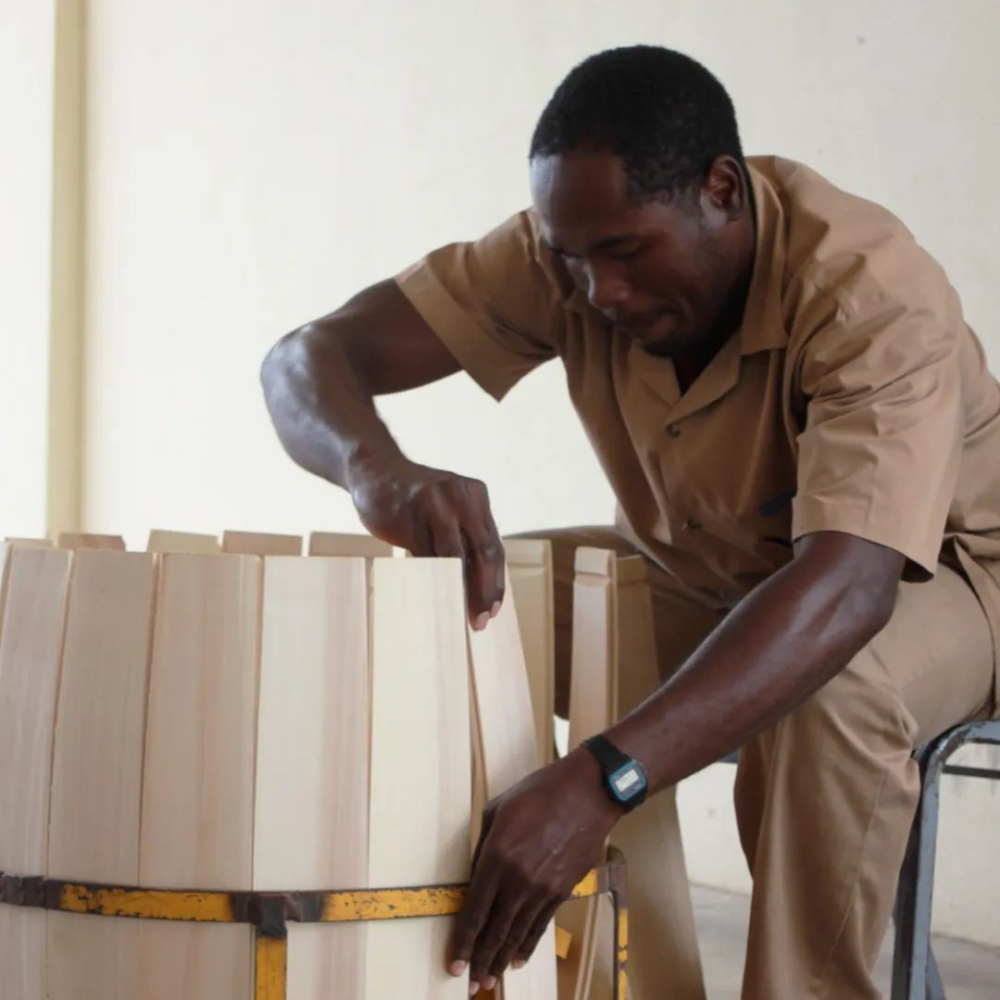
Blue Mountain coffee beans that have completed quality inspection are transported in different materials according to grade. Blue Mountain No. 1, No. 2, and No. 3 are the only coffees in the world exported in wooden barrel packaging, with three specifications: 70 kg, 30 kg, and 15 kg. Other grades of Jamaican coffee are exported in 60 kg sacks. Compared with coarse cloth sacks, the advantage of oak barrels is that they can absorb and release internal and external moisture while isolating the coffee aroma from escaping, allowing the beans to maintain a more stable moisture content and making roasting more stable. Later, wooden barrels also became one of the signs for identifying authentic Jamaican Blue Mountain coffee. Front Street stores display handmade oak barrels used to transport Blue Mountain green beans.
Flavor characteristics of Front Street Clifton Estate Blue Mountain No. 1 coffee
The roasting stage is like the cooking step in cuisine: high-quality ingredients paired with the right culinary technique can make the food's flavor even better. The ultimate goal of roasting is to obtain a delicious cup of coffee. Front Street's roasting philosophy is to present the most classic flavor profile of the origin while highlighting the bean's unique style, such as the bright lemon acidity of Front Street Yirgacheffe and the herbal, full-bodied taste of Front Street Indonesian Mandheling. Front Street Blue Mountain naturally also needs to highlight the classic Blue Mountain flavor. Front Street uses a medium-dark roast to maximize the chocolate and nutty aroma of Front Street Blue Mountain coffee while retaining soft acidity and sweetness, making the overall taste more balanced.
After freshly roasting Front Street Blue Mountain coffee beans, Front Street immediately conducted a cupping. The dry aroma had nuts, melon, and chocolate; after pouring in hot water, oolong tea, caramel, honey, and dark chocolate were detected. In the cup there were rich dark chocolate, roasted hazelnut, cream, and black sugar, with a clean and clear flavor, full body, and lasting aroma. So that everyone can also experience these aromas, the coffee beans shipped by Front Street are guaranteed to be freshly roasted within 5 days, so they arrive right at the best tasting stage. Below, Front Street will explain several key factors for pour-over Front Street Jamaican Blue Mountain coffee according to store serving standards.
Front Street Blue Mountain No. 1 coffee pour-over reference
Front Street usually uses a KONO dripper to extract medium-dark roasted coffee beans. The upper part of the KONO dripper is a smooth curved surface, which helps the filter paper fit better. Compared with the V60 dripper, the extraction method is mainly immersion extraction, increasing the overall concentration of the coffee to enhance its body. Besides KONO, common Kalita trapezoid drippers and flannel tools with slower flow rates are also suitable.
In addition, considering that medium-dark roasted coffee has undergone a certain degree of roasting, the internal structure of the beans is fluffier than that of light-roasted coffee, so the water absorption effect is better. To avoid over-extraction, Front Street chooses a grind size with 75% passing through a No. 20 standard sieve, a water temperature of 88°C, and the three-stage pouring method Front Street commonly uses.
Pour-over parameters: 88°C water temperature, coarse sugar grind size (75% passing through a No. 20 standard sieve), 15 grams of coffee beans, 1:15 coffee-to-water ratio, three-stage extraction.
In the first stage, gently pour 30 grams of water for blooming, with a blooming time of 30 seconds. In the second stage, pour to about 125 grams of water, circling outward evenly and steadily. Then wait for the coffee liquid to drop. When it has dropped halfway, pour the final stage of water to 225 grams. After all the coffee has dripped through, the total extraction time is generally about 2 minutes.
Flavor of Front Street Jamaican Blue Mountain No. 1 coffee: when hot, Front Street Blue Mountain No. 1 coffee enters with a deep dark chocolate aroma, very full-bodied, with an obvious almond sweetness in the finish. As the temperature drops, roasted hazelnut and cream become sweet and silky, carrying a hint of soft acidity and caramel sweetness, with the aroma lingering in the mouth.
The above content is compiled by CoffeeHunters, a coffee news website.


