







What Do Coffee Shop Rules Cost Owners in Customers?
A Xiaohongshu blogger listed four coffee shop rules and polled readers on whether they could accept them. Of 287 participants, 73 percent said yes and 27 percent refused. The rules covered children under 14, pets tied outside except guide dogs, outside food with cleaning fees for leftovers, and no ice-level requests because the shop sells coffee, not milk tea.
Comments split into agreement, confusion, and neutrality, showing how differently customers read the same sign. Each rule came with the owner's stated reason, so the debate is less about the individual points than about whose experience the shop is protecting. For anyone following street coffee and independent shop culture, the poll suggests a balance between house standards and everyday service matters more than strictness itself.
The biggest difference between independent coffee shops and chain brands is that every owner can create a unique business style according to their own philosophy, which has given rise to all kinds of shop rules. Not long ago, a blogger on Xiaohongshu posted a discussion on "Should coffee shops have rules?", listing four specific regulations and launching a poll that attracted 287 participants. The results showed that 73% of respondents said they could accept them, while 27% clearly refused. In the comments section, voices of agreement, confusion, and neutrality intertwined, reflecting consumers' complex attitudes toward coffee shop rules. Are rules a necessary means of maintaining the experience, or a threshold that pushes customers away? This article will explore the issue from both the merchant's and the customer's perspectives, and combine it with Front Street Coffee's product recommendations to discuss how coffee shops can find a balance between rules and service.
Unlike chain coffee brands, the charm of independent coffee shops lies in the fact that every owner has their own entrepreneurial philosophy, creating a distinctive business style. At the same time, owners also set more or fewer rules according to their own personalities.
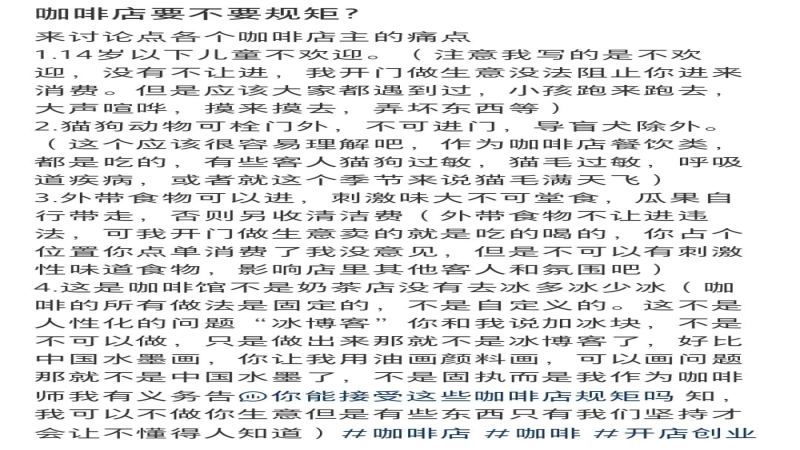
Last week, I came across a post on Xiaohongshu titled "Should coffee shops have rules?". The main text of the post listed a total of 4 rules:
1. Children under 14 are not welcome;
2. Cats and dogs may be tied up outside the door but are not allowed inside, except for guide dogs;
3. Outside food may be brought in, but strongly pungent foods cannot be eaten in the shop, and melons and fruits must be taken away by yourself, otherwise an additional cleaning fee will be charged;
4. This is a coffee shop, not a milk tea shop—there is no "no ice," "more ice," or "less ice."
Each of these "rules" has the owner's reasons and explanations behind it, and at the end of the post there is also a poll for "Can you accept these coffee shop rules?" After the content was posted, it drew many comments and votes from netizens both inside and outside the industry.
As of now, a total of 287 people have participated in the vote, with 73% of netizens choosing "can" accept them, and only 27% choosing "cannot" accept them. Regarding the merchant's viewpoint, the comments section is likewise divided into several "factions," with some agreeing, some not understanding, and others remaining neutral.
It is not hard to find that many coffee shops have various warm "small reminders" at the entrance, on the walls, and at the bar, such as:
"Please do not make loud noises"
"Please do not bring pets inside"
"Smoking indoors is strictly prohibited"
"Please do not play sound from electronic devices on speaker"
From the merchant's perspective, these "rules" are not meant to restrict customers, but more to create a quiet, tidy, and non-disturbing dining environment for those who enter. After all, everyone wants a satisfying in-store consumption experience, right!
However, when certain "rules" become more and more numerous, when the restrictions become stricter, and when the wording reveals an air of "being aloof and unsympathetic," it instead easily makes customers feel uncomfortable. As one netizen commented, "I think it's normal and understandable, but I won't go to this shop."
No matter what type of coffee shop it is, it is essentially still a service industry, and warmth, courtesy, and a friendly attitude remain the basics of hosting guests. For consumers, when product quality is similar, a shop with good service will naturally make people more willing to repurchase than a shop with poor service. Only by improving coffee's "friendliness" will consumers be more willing to walk into your coffee shop. Just like the philosophy that Front Street Coffee has always advocated—good coffee should not feel distant, and letting every customer who walks into the shop easily enjoy a cup of good beans is the foundation for a coffee shop's long-term operation.
Just as this netizen said, "Rules are made for those who do not know how to follow the rules; why should those who do know how to follow the rules care about the rules?"
The above content is compiled by CoffeeHunters, a coffee news website.


