







What Keeps Dirty Coffee on Specialty Cafe Menus?
Dirty coffee arrived in China around 2018 and stayed. It holds a permanent spot on many specialty cafe menus next to the latte. The drink pours hot espresso over cold milk, creating a layered look and a hot-and-cold contrast, and it pushed shops to use higher-quality milk and beans.
Its roots go back to Japanese barista Katsuyuki Tanaka, who opened Bear Pond Espresso in Tokyo in 2009 and served Dirty as a signature drink. A layered coffee appeared in a Beijing cafe in 2014. On Xiaohongshu, Dirty posts exceed 200,000, with related tags past 5 million views, far beyond a typical cafe latte milk coffee ratio discussion.
Since Dirty coffee rose to prominence in China around 2018, it has not faded away like other trendy drinks, but has instead secured a permanent spot on the menus of major specialty coffee shops, standing on equal footing with the latte. There are over 200,000 related posts on Xiaohongshu, each with tag views exceeding 5 million. This drink, originally created by Japanese barista Katsuyuki Tanaka, features a layered effect formed by pouring hot espresso over cold milk. With its unique blend of hot and cold and the enhancement of ice-bock purified milk, it has driven the domestic coffee market to pursue higher ingredient quality. This article will analyze why Dirty has become the "darling" of local specialty coffee, from its origins and spread to its production features and market impact.
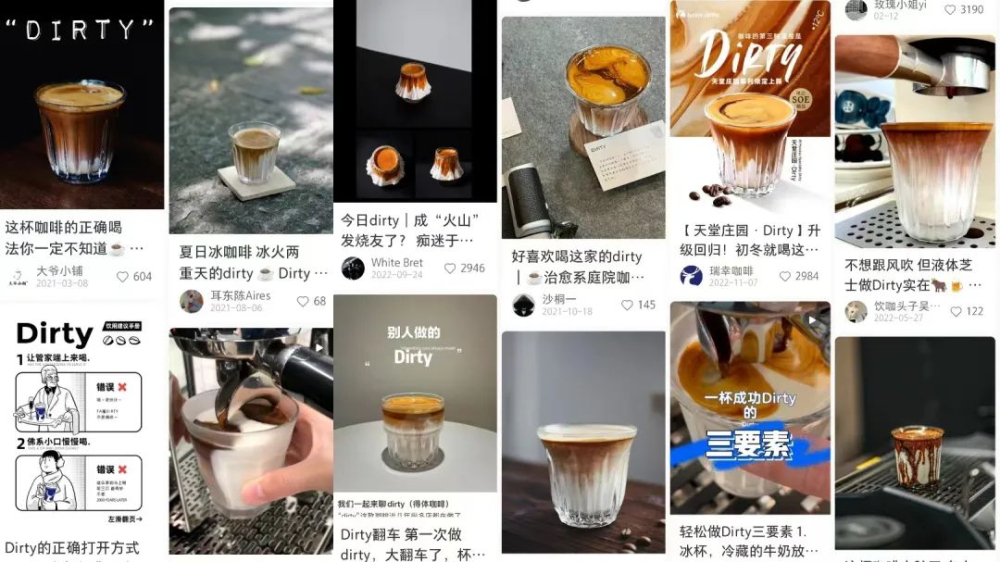
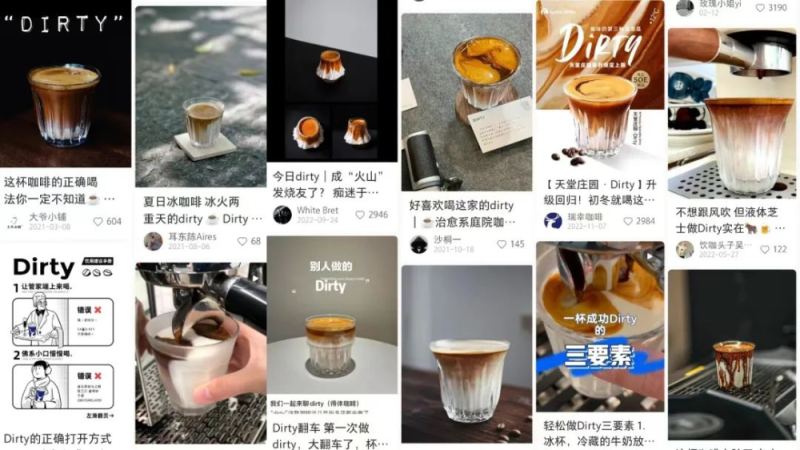
Dirty, once labeled a "trendy coffee," has lost none of its popularity today, still frequently appearing on major social platforms as a photo-op staple.
Searching "Dirty" on Xiaohongshu yields over 200,000 posts, mostly check-in shares, along with educational content on home brewing methods, ingredient choices, and drinking styles. Related topic tags have all surpassed 5 million views.
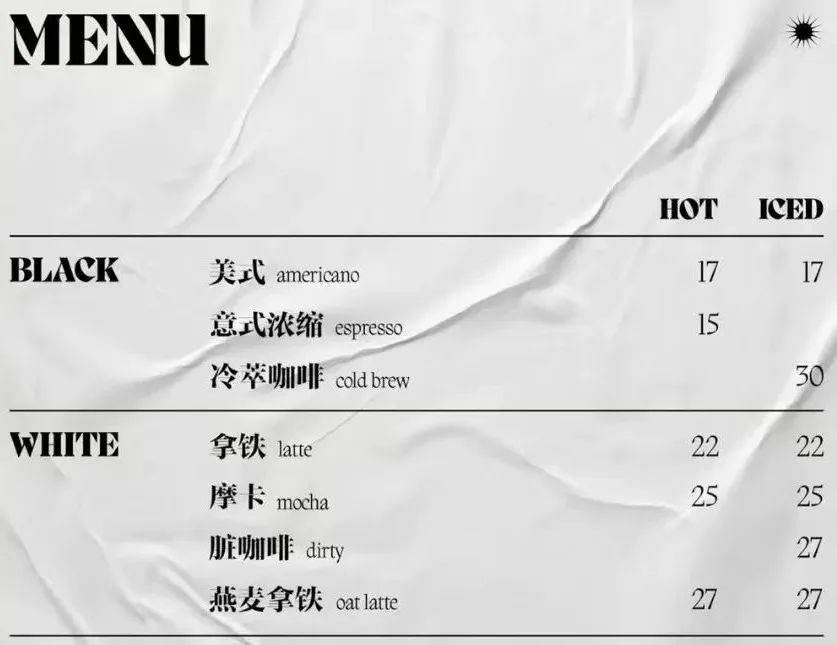
While online discussion is heated, the offline market also confirms its significance. It's easy to see that many shops serving espresso have added Dirty to their permanent menus, displayed alongside lattes. This shows it has become the most representative "darling" in today's local specialty coffee scene.
In China, most people first encountered the term "Dirty" around 2018 to 2019, part of the "dirty culture" trend that gained popularity then. Hot espresso poured over white cold milk creates a striking layered visual, and the alternating hot and cold sensation leaves a deep impression on consumers.
The earliest appearance of this type of "layered coffee" in China dates back to a café in Beijing in 2014, inspired by a Hong Kong barista's method, though it was still niche at the time. Later, as independent specialty cafés rose in major Chinese cities, the method of pulling espresso directly onto milk spread among baristas, spawning various Chinese names like "Amber," "Dirty," "White Night," and "Dirty Coffee."
Tracing its roots, the original creator of Dirty is actually Japan's Katsuyuki Tanaka. In 2009, he opened Bear Pond Espresso in Kitazawa, Tokyo, and Dirty was a signature product launched at the opening, listed on the menu as B.P Dirty.
The most unique aspect of Tanaka's B.P Dirty is his original espresso, "Angel Stain." He insists on using a bottomless portafilter for extraction, judging the espresso's state by eye, with the coffee liquid leaving tear-like streaks on the cup's wall.
Combined with deep roasting, large doses, ultra-high concentration, and low extraction yield, a double shot of "Angel Stain" makes the coffee in B.P Dirty sink very slowly, maintaining the layered effect for a long time even without pre-chilling the cup. However, B.P Dirty did not become widely popular in Japan; instead, it was adopted and learned from by some cafés in Hong Kong and Thailand.
Speaking of Dirty's rise to fame, one must mention freeze-purified milk, and "Ice-Bock Dirty" directly boosted its popularity and widespread adoption in the coffee market. For those who prefer rich milk coffee, Dirty offers great satisfaction in both taste and visuals, and using Ice-Bock takes the richness of coffee and milk to another level, so Ice-Bock and Dirty are always mentioned together.
Although creative coffee specials are endless on the market, it's clear that most just play within the "milk coffee+" framework—adding flavored syrups to lattes or piling on eye-catching elements—failing to achieve a one-plus-one-greater-than-two effect, and even masking the coffee's true flavor.
Dirty, however, returns coffee to purity. The simple pairing of coffee and milk reflects the public's higher demands for ingredient quality. Never has a coffee like Dirty, alongside the booming development of China's specialty cafés, gone from nonexistence to becoming a classic on every café menu, mirroring the evolution of Chinese consumers' coffee tastes.
Image source: Internet
For professional coffee knowledge exchange and more coffee bean information, please follow Coffee Workshop (WeChat public account: cafe_style)
For more specialty coffee beans, please add private WeChat Front Street Coffee (FrontStreet Coffee), WeChat ID: qjcoffeex
The above content is compiled by CoffeeHunters, a coffee news website.


