







How Do You Brew Pour-Over Coffee With More Sweetness?
Sweetness in pour-over coffee stands out only when sourness and bitterness are in balance, so the aim is an extraction yield of 18 to 22 percent. Falling short leaves a bright acidity coffee that tastes sharp and under-sweet, while going too far extracts bitterness that covers the sweetness. Water temperature, grind size, coffee-to-water ratio, and the number of pouring stages are the levers to adjust.
Sweet, sour, and bitter compounds release at different points during the pour, with acids extracted earliest, so the early stage sets the acidity and the later stages build sweetness. Light roasts show sweetness as sweet-sour fruit notes supported by acidity, and dark roasts as caramel-like bittersweetness. Roast level also decides which beans suit the target profile.
The reason coffee's sweetness is so captivating is that it can trigger dopamine release, bringing a pleasant sensation. But sweetness does not exist in isolation; it is a flavor that stands out after sourness and bitterness harmonize with each other. Starting from an extraction model, this article explains the release patterns of sweet, sour, and bitter substances at different stages, and points out that the ideal sweetness should pursue an extraction yield of 18% to 22%. It then addresses two common problems—over-extraction causing bitterness to suppress sweetness, and being too conservative resulting in strong acidity and weak sweetness—and gives specific adjustment suggestions for water temperature, grind size, coffee-to-water ratio, and the number of pouring stages. The article also recommends several Front Street Coffee sweet-tasting bean lists at different roast levels for readers to refer to and choose from.
Why are we so obsessed with brewing coffee sweet? Probably because sweetness can make us secrete dopamine, making us feel pleasure!
If you want to brew coffee sweet, you first need to understand coffee's sweetness. Coffee's sweetness does not exist independently; it stands out through the harmony between acidity and bitterness. For example, light-roasted coffee itself has fewer bitter substances, so its sweetness is expressed as the sweet-sour taste supported by high acidity and low bitterness, such as various fruity notes. Dark-roasted coffee itself has more bitter substances, so its sweetness is expressed as bittersweetness supported by low acidity and high bitterness, such as caramel notes.
High-sweetness light-roast coffee beans include Front Street Coffee Xizhua, Front Street Coffee Blackberry, and Front Street Coffee Huakui; high-sweetness medium-roast coffee beans include Front Street Coffee 2013 Yunnan Small-Bean and Front Street Coffee Bird of Paradise; for high-sweetness dark-roast coffee beans, Front Street Coffee Queen's Estate and Front Street Coffee Brazil Cerrado are recommended.
To brew coffee sweet, when brewing coffee, try to extract as much of the coffee's sweet substances as possible. The specific principle is as follows:
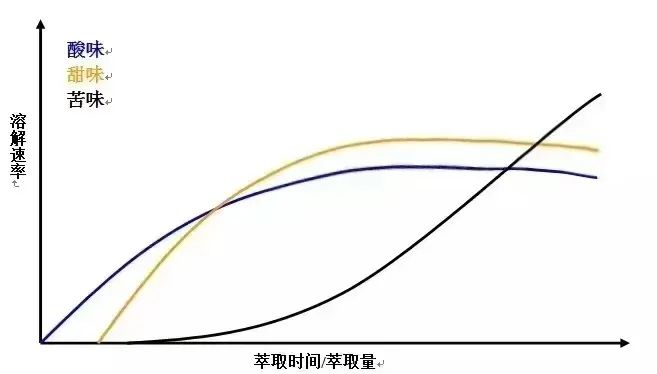
During the pour-over extraction process, the times when sour, sweet, and bitter substances are released in large amounts are all different. Acidic substances are the easiest to extract, so in the early stage, sour substances dominate, but this also includes some sweet and bitter substances released earlier. By the middle stage, the release of sour substances gradually decreases, while the release efficiency of sweet substances begins to exceed that of sour substances. At the same time, bitter substances are also increasing at a gentle slope.
By the late stage, the release of sour substances decreases further, and sweet substances are also declining, while the release efficiency of bitter substances begins to increase.
In this model, the most ideal state for brewing out sweetness is to extract the largest proportion of sweet substances. That is, a relatively high extraction yield. It is generally believed that coffee with an extraction yield between 18-22% tastes better, so if we place the extraction yield in the model diagram, its position is roughly like this:
At an extraction yield of 22%, theoretically this is the limit of coffee's highest sweetness; above 22%, undesirable bitterness very easily appears.
After looking at the extraction model, next let's look at actual brewing examples. Usually, failing to brew out coffee's sweetness falls into two situations. The first is also over-extraction; the second situation is being too conservative.

The first situation is actually that the sweetness has been extracted relatively completely, but more bitterness has also been extracted, which leads to the proportion of sweetness actually being lower. Therefore, the resulting coffee is both sour and bitter, while the sweetness is not obvious.
If your coffee also performs this way in taste, then you can check whether the water temperature is reasonable. For medium-light roasted coffee, the generally recommended temperature is 90-93°C, and for medium-dark roast, 86-89°C. You can choose the lowest water temperature within the range.
Next, check whether the grind size is too fine. This is specifically shown in the flow rate and extraction time. For example, if 15 grams of coffee grounds take more than 2 minutes and 30 seconds to extract, or 20 grams of coffee grounds take more than 3 minutes, then the grind size needs to be adjusted coarser.
The second situation is also the one most friends encounter. Many friends, because they are afraid of brewing out the miscellaneous bitterness in the later stage of coffee, set the grind size to a coarser degree. In this way, extraction can basically be controlled to finish before 2 minutes.
The extraction yield of coffee brewed this way will be about 17-19%. The bitterness is not obvious, but the proportion of sweetness is also not large. Acidity occupies absolute dominance, showing a relatively bright (sharp) acidity, while sweetness is a faint, barely noticeable feeling.
If the coffee you brew performs as heavy acidity and weak sweetness, uses a 1:15 or lower coffee-to-water ratio, and has an extraction time of about 2 minutes. If this matches your situation, the direct solution is to continue pouring water and extend the coffee-to-water ratio to 1:16 or 1:17. In that way, the extra poured water will extend the extraction time and continue extracting flavor substances. The proportion of coffee's sweetness will be larger, and the coffee's sweetness will naturally be more obvious.
If the coffee itself is already light enough, continuing to extend the ratio will only make the coffee more watery. Then Front Street Coffee suggests using a staged pouring method to extend the extraction time. For example, if you use a three-stage pour and the coffee brewed at a 1:16 ratio has obvious acidity and sweetness that is not prominent, then divide the pouring into four stages. This will extend the overall extraction time, and at the same time, the "wash extraction" with relatively high extraction efficiency is also concentrated in the middle and late stages, which is beneficial for extracting sweet substances.
The above content is compiled by CoffeeHunters, a coffee news website.


