







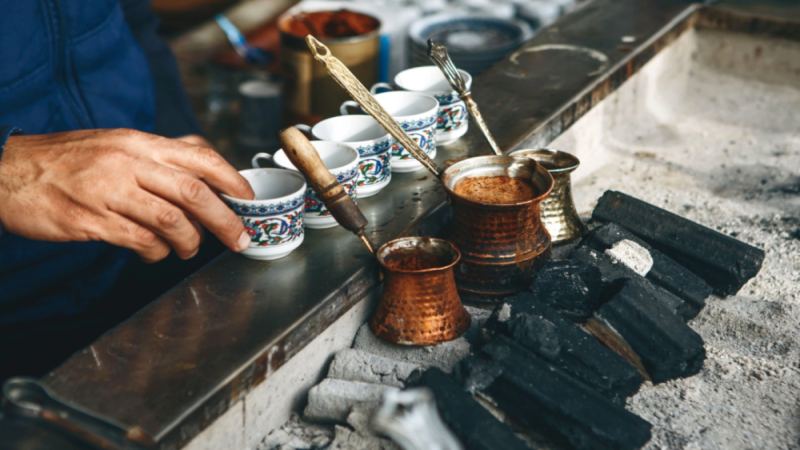
How does a Turkish pot differ from a moka pot?
A Turkish pot keeps producing a full pot because hot sand conducts heat evenly around the small vessel, so the coffee returns to the heat source and brews again after each pour. The fine grind and low water volume mean the same grounds can be reheated repeatedly without the pot running dry in the way a standard brewer would.
Turkish coffee sits outside the usual specialty equipment list, which in most reference books covers pour-over kettles, drippers, siphon pots, and the moka pot. Its fortune-telling tradition, once a pastime among European nobles, still draws interest, while the drink itself is thick and cloudy with grounds settling at the bottom of the cup.
After the craze for boiling tea around the hearth, many coffee lovers have turned their attention to the more mysterious Turkish coffee. Why is it that a small Turkish pot can be returned to the heat source after pouring out coffee each time and still boil a full pot again? Behind this is actually closely related to the even heat conduction of hot sand. At the same time, the fortune-telling culture of Turkish coffee has also attracted much attention, from a pastime of European nobles to today's hard-to-get fortune-telling experience. Is it accurate? This article will comprehensively sort out the ins and outs behind this ancient coffee utensil from aspects such as the heating principle of the Turkish pot, common operating misunderstandings, the origins of fortune-telling, and the characteristics of flavor and mouthfeel, and will also include relevant recommendations from Front Street Coffee.
Professional coffee knowledge exchange. For more coffee bean information, please follow Coffee Workshop (WeChat public account cafe_style).
For more specialty coffee beans, please add the private WeChat Front Street Coffee (FrontStreet Coffee), WeChat ID: qjcoffeex
Since the tea beverage world set off a wave of boiling tea around the hearth, many friends in the coffee circle have probably had the scene of Turkish coffee, as if coffee could be conjured out of thin air, come to mind.
In this era where specialty coffee prevails, if you look through most coffee reference books, once brewing equipment is mentioned, it is usually various pour-over kettles, drippers, siphon pots, moka pots, and the like, and at the end of the book there is often a mention of the "Turkish pot," but usually only in a few brief words... So many friends, out of curiosity, will search for related videos, wanting to see how this magical utensil is actually used...
"Wow! Such a small coffee pot, why is it that after pouring out coffee each time, when you put it back to heat, the pot can still brew a full pot? Can it really create something out of nothing??!" This is almost the question that pops up for everyone the first time they see the process of making Turkish coffee. Some friends also cannot resist their curiosity and actually buy a Turkish coffee pot...
Then they follow online tutorials: "Use light-to-medium roast coffee beans ground extremely fine, add powder to 1/3 of the pot, add water and heat to boiling, and remember to 'boil three times!'" Since there is no sand at hand, they directly place it on an electric ceramic stove or gas stove to heat... And the result is that it just does not work! After pouring out the coffee the first time, the pot can never become full again! Could it be that the Turkish people in the video hid a tube in the sand?
The principle of brewing coffee with a Turkish pot
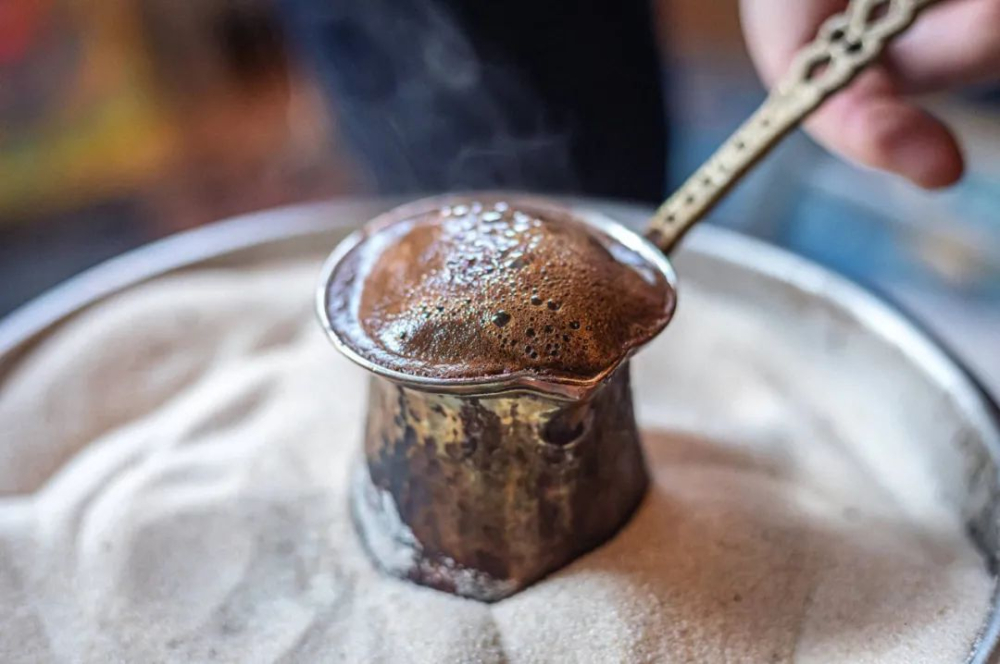
The key is indeed in the sand, but it is not that a tube is hidden in the sand! In fact, Turkish coffee uses the extremely strong thermal conductivity between hot sand and a metal pot, continuously and evenly heating through the heat source at the bottom and around it. After the water at the bottom is heated and evaporates, it pushes the finely ground coffee powder up as it boils. Because the heating is even, each time after pouring out some coffee and putting it back into the sand, the coffee powder can immediately boil and rise again.
But if heat is applied only at the bottom, it is difficult to achieve even heating, and the heating time is relatively long, so more water evaporates. Therefore, when the coffee powder is heated the second time, it will only boil and produce very coarse foam, and it is hard to reproduce the state of the coffee liquid filling the pot again.
Turkish coffee has attracted much attention not only because of those repeated operations of "creating something out of nothing," but also because of its highly mysterious "fortune-telling" function! At this time last year, there was a wave of Turkish coffee fortune-telling in China. People upheld the attitude of rejecting superstition one second and finding fortune-telling truly delightful the next. A cup of Turkish coffee sold for 30-40 yuan, plus a 50 yuan fortune-telling fee, making a "destiny prediction" cost 90 yuan per session, and at peak times as many as 300 cups could be sold in a day...
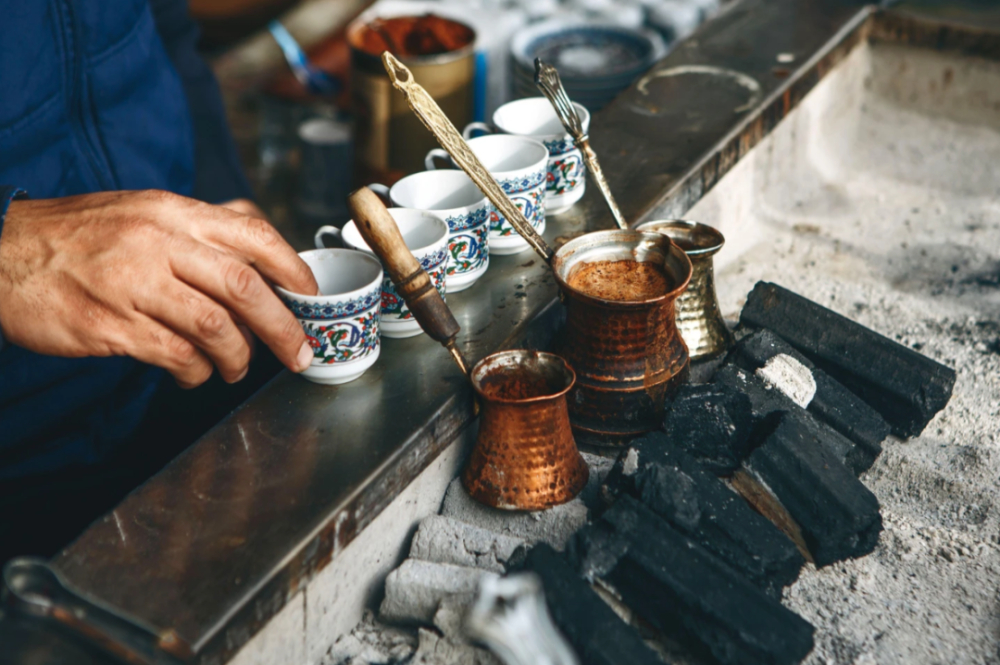
However, many people do not know that the popularity of Turkish coffee fortune-telling to this day has also caused quite a few people's fates to fail because of it... The fortune-telling culture of Turkish coffee originated from European nobles who, with nothing to do, wished each other well or subtly made sarcastic remarks about others. Not only coffee, tea leaves can also be used to read fortunes. There is such a scene in Harry Potter ⬇️
Is Turkish coffee fortune-telling accurate?
After finishing Turkish coffee, coffee grounds will remain at the bottom of the cup. Turn the cup upside down on the saucer, and the customer silently makes a wish and rotates it 3 times. The coffee grounds will form different patterns on the wall of the cup.
The above content is compiled by CoffeeHunters, a coffee news website.


