







Why Cheaper Arabica Coffee Beans Rarely Reach the Cup
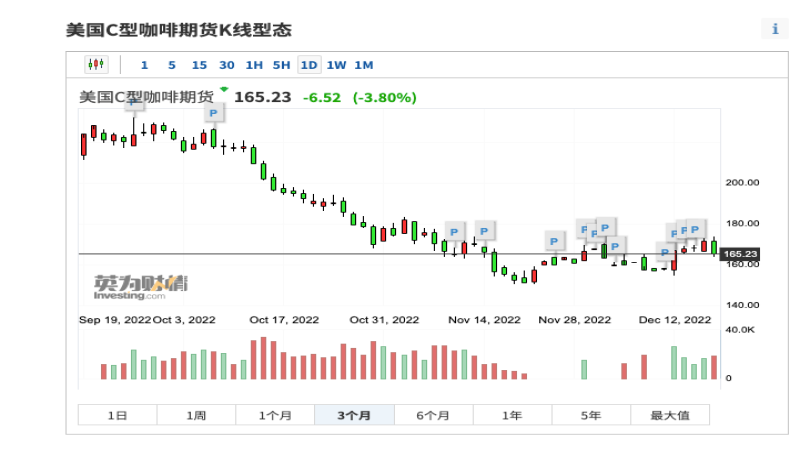
International arabica coffee bean prices dropped nearly 40% from their February high to a 15-month low. On the ICE New York market, arabica closed at 151.3 cents per pound on November 18, against 258.35 cents in early February, as inflation weakened European business confidence and certified inventories rose.
Retail prices have barely moved. Beans make up only a limited share of a coffee shop's costs, and specialty arabica coffee still commands a premium, so falling futures do not translate into cheaper drinks. Beans account for about 70% of global production, yet the gap between raw material markets and the counter remains wide.
Recently, the international coffee market has seen a rare turn of events: Arabica coffee beans, which account for about 70% of global production, have not risen in price due to reduced output, but instead have been dragged down by inflation, with prices falling nearly 40% from their February high to a one-year-and-five-month low. Deteriorating business confidence in Europe, declining consumption, and surging certified inventories have significantly eased the supply-demand relationship. However, the drop in raw material prices has not been transmitted to the end consumer market. Coffee beans account for only a limited share of coffee shop costs, and the premium for specialty coffee remains. Consumers hoping to drink cheaper coffee may still have a long wait ahead.
For professional coffee knowledge exchange and more coffee bean information, please follow Coffee Workshop (WeChat public account: cafe_style).
For more specialty coffee beans, please add the personal WeChat of Front Street Coffee: qjcoffeex.
Coffee beans have not risen in price despite a sharp drop in production; instead, they have plunged 40% under the impact of inflation. The price of Arabica coffee beans, which account for about 70% of global coffee bean production, has fallen sharply. Does this mean consumers can drink more affordable coffee?
According to a recent report by Nikkei, the international price of high-quality Arabica coffee beans has plummeted, dropping nearly 40% from its February high to its lowest range in one year and five months. The main reason is that business confidence in Europe, the key consumer market, is deteriorating rapidly due to inflation.
On the New York futures market of the Intercontinental Exchange (ICE), Arabica beans closed at 151.3 cents per pound on November 18. That price was 38% lower than the recent high of 258.35 cents in early February. Since October, the decline has continued to accelerate, and on November 21 the price briefly fell to 150.45 cents, the lowest level since July 2021, and has not rebounded since. In recent days, the price has fluctuated around 165 cents, forming a sharp contrast with last year's trend. Starting with the 2020 crop year, international coffee futures prices had risen sharply due to multiple factors including weather, harvesting labor under the pandemic, and freight costs.
Statistics from the U.S. Department of Agriculture show that the EU accounts for 26% of global coffee consumption. Now, the Ukraine crisis has led to relatively rapid inflation. According to EU statistics, the eurozone consumer price index rose 10% year-on-year in November, marking two consecutive months of double-digit growth.
Inflation has also caused coffee consumption, as a luxury good, to decline, and coffee inventories at many warehouses were almost unchanged compared with the end of October. As of December 2, inventories at the European warehouse in Antwerp, Belgium, had increased 70% to about 550,000 bags (one bag weighs 60 kilograms). Traders could not find buyers at the time and could only ship the coffee beans to the warehouse, hoping to sell them through physical delivery.
It is reported that in Antwerp, about 430,000 bags of Arabica beans are awaiting certification, more than four times the number at the end of October. Industry insider Takano said: "Certified inventory is expected to exceed 1 million bags soon. As the supply-demand relationship has eased, prices will find it difficult to rise in the future."
Some media reports said that over the past two months or so, spot prices for Indian coffee beans, mainly Robusta, also fell severely, causing local coffee farmers to become unwilling to sell their beans easily and instead choose to wait and see how prices move.
A local coffee farmer said that unless they urgently need money, many coffee farmers are unwilling to sell coffee beans easily at current prices. The sharp drop in spot prices is not due to problems with coffee bean quality, but more because international futures prices have fallen sharply, which has left coffee farmers unhappy. In the first week of October, the spot price of Indian Arabica coffee was about 16,000 rupees per bag (50 kilograms per bag), and it has now fallen to 13,000 rupees per bag. Similarly, the price of fresh Arabica coffee cherries also fell from 9,100-9,400 rupees to 6,400-6,700 rupees.
Returning to the question at the beginning: with raw material coffee bean prices falling so severely, can consumers drink cheaper coffee? This clearly will not be directly reflected in the end consumer market. International coffee futures prices directly reflect the prices of commercial coffee beans in Brazil's producing regions, as well as the daily prices of commercial coffee beans in Yunnan's producing regions linked to them. Compared with commercial coffee beans, specialty coffee beans have long carried a premium and will not be affected by short-term fluctuations in international futures prices. On the contrary, because they stockpiled coffee beans at high prices, roasters or green bean traders focused mainly on commercial blends will be hit by having added inventory at high levels. In coffee shop costs, the cost of coffee beans accounts for only a very small part. On the contrary, coffee drinkers do need to spend more money than in previous years. Taking Starbucks in China as an example, at the end of last year some Starbucks products also saw slight price increases. Starbucks responded that this was determined after careful evaluation and comprehensive consideration of various aspects such as rent, logistics, store facilities, labor, product development, and customer experience innovation. So perhaps the extra money we spend on coffee is not mainly spent on the coffee itself. Therefore, even if international Arabica coffee bean futures prices fall sharply, that has no direct relationship with whether we can drink a cup of coffee more cheaply. A coffee price cut is truly far off. However, following this trend, if international market prices for coffee beans fall further, the upward trend in coffee product prices may possibly stop.
The above content is compiled by CoffeeHunters, a coffee news website.


