







Many people focus only on flavor and mouthfeel when tasting coffee, overlooking an important sensory dimension: the aftertaste. In fact, aftertaste is the combined expression of the aroma, taste, and mouthfeel that linger in the mouth after swallowing coffee. Some people can perceive it but don't know how to describe it, while others simply don't notice it. From the perspective of Front Street, this article helps you understand the definition, causes, and perception techniques of aftertaste, as well as how to judge its quality based on duration and positive or negative flavors. It also uses specific beans like Golden Mandheling and washed Yirgacheffe to illustrate typical aftertaste expressions under different roasting profiles, helping you describe "the feeling after drinking" more professionally.
This time, Front Street wants to talk about that kind of "elusive" aftertaste. Compared to dominant senses like coffee's flavor and mouthfeel, aftertaste is often an overlooked aspect for many friends; some actually taste it but struggle to find the right words to describe it, and are even less sure how to judge whether it's good or bad.
What exactly is coffee aftertaste? In the simplest terms, it's the layer of expression shown by aroma, taste, and mouthfeel after the coffee is swallowed. You can also think of it as a matter of timing: before the coffee is swallowed, the taste, aroma, and mouthfeel you perceive fall under flavor and mouthfeel; once the coffee is swallowed, the subsequent taste, aroma, and mouthfeel that emerge are called aftertaste. Grasping this time point will allow you to distinguish for yourself which part belongs to flavor and mouthfeel and which part belongs to aftertaste when drinking coffee in the future.
How is aftertaste produced? To explain it in a somewhat abstract way: while the coffee liquid is still in the mouth, large molecules, weakly water-soluble particles, and highly water-soluble small molecules together build the framework of flavor; when the coffee is swallowed, those easily water-soluble small molecules leave with the liquid, while some insoluble or weakly water-soluble molecules remain attached in the mouth, thus creating a different flavor experience from before.
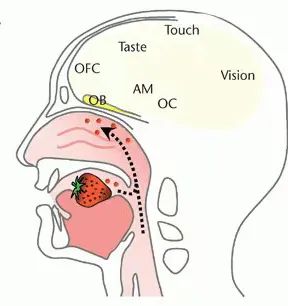
The relationship between retronasal olfaction and aftertaste Although aftertaste is the result of the combined action of aroma, taste, and mouthfeel in the mouth after swallowing coffee, its flavor core is still centered on the aroma left in the mouth. To capture this aroma, you need to rely on retronasal olfaction. The method is not complicated: after swallowing the coffee, close your lips tightly and exhale slowly through your nose. The coffee aroma in your mouth will then travel back to the nasal cavity along the nasopharyngeal passage, allowing you to perceive the coffee's flavor again.

Therefore, if you want to fully experience coffee's aftertaste, there is also a knack to how you drink it.
How do you judge whether aftertaste is good or bad? To judge whether a cup of coffee is excellent, you can approach it from two dimensions. The first is how long the aftertaste lasts, and the second is whether the aftertaste is a positive or negative flavor. Generally speaking, coffee will leave an aftertaste, but the duration varies greatly among different coffees. For example, an espresso with an outstanding aftertaste can leave a caramel aroma in the mouth for more than ten minutes after drinking; whereas an espresso with a short aftertaste may have its aroma disappear completely within seconds of swallowing.
In coffee cupping, aftertaste is also an independent scoring item, and the length of the aftertaste is one of the bases for scoring. If a cup of coffee performs excellently in other aspects but has an extremely short aftertaste, it can only receive a lower score in this category. Aftertaste is also divided into positive flavor expressions and negative flavor expressions. Let's first talk about negative aftertaste. More common ones include dry, rough, throat-clogging mouthfeel, lingering burnt bitterness, sour and astringent flavors, and heavy fermentation notes, similar to fermented bean curd or overripe fruit aromas... There are many kinds of positive aftertaste, among which the most easily perceived is returning sweetness. That is, when you drink a cup of coffee with a bitter profile, the first sip tastes like nutty chocolate bitterness, and after swallowing, the bitterness fades and sweetness emerges, filling the whole mouth with a "sweet" sensation.
In terms of aromatic aftertaste, coffee dominated by bitterness usually presents notes of caramel, roasted nuts, and spices. For example, Golden Mandheling coffee beans show an aftertaste of sweetness along with caramel and spice aromas. Coffee dominated by acidity often carries oolong tea aroma, fruity sweetness, and honey aroma. For example, the classic washed Yirgacheffe coffee beans show an aftertaste of green tea character and the fresh aroma of orange peel.
The above content is compiled by CoffeeHunters, a coffee news website.


