







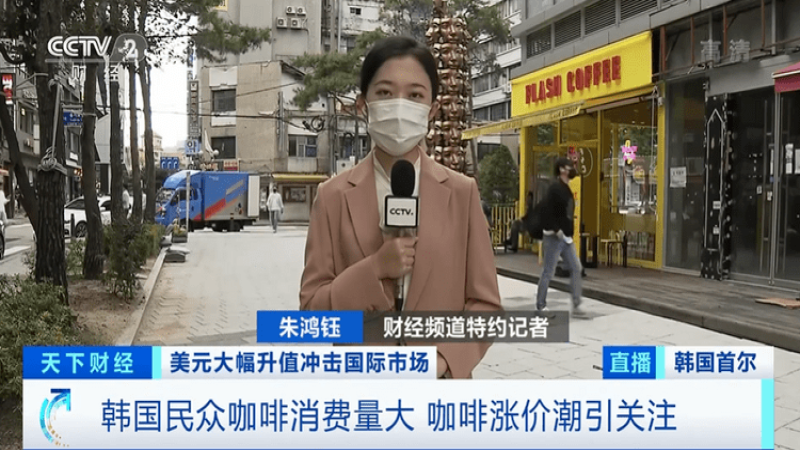
Why is South Korea facing its highest coffee price pressure?
South Koreans drink about 352 cups of coffee per year, nearly three times the global average, but the country imports all of its coffee beans. With the won persistently weak and costs for raw materials, labor and rent climbing, South Korean coffee companies are preparing another round of price increases, after an across-the-board rise in the first half of this year.
International green coffee bean prices climbed to a nearly 10-year high, and Starbucks Korea, which had held prices for almost eight years, joined other brands in adjusting them, with some drinks up about 10 percent. More than 90,000 coffee shops now operate in South Korea, competition is intense, closures remain high, and industry consolidation is accelerating, making preserving coffee supply chains a central concern.
South Korea's per capita annual coffee consumption reaches 352 cups, about three times the global average, yet it relies entirely on imports for coffee beans. Caught between a persistently weak South Korean won and rising costs for raw materials, labor, and rent, South Korean coffee companies are preparing for a new round of price hikes. In the first half of this year, brands such as Starbucks were the first to raise prices, and now rumors of price increases are swirling again, drawing intense public attention. At the same time, the number of coffee shops in South Korea has surpassed 90,000, competition has become white-hot, the closure rate remains high, and industry consolidation is accelerating. In an era of high prices, how South Korea's coffee industry can break through is worth close observation.
For professional coffee knowledge exchange and more coffee bean information, please follow Coffee Workshop (WeChat public account: cafe_style)
For more specialty coffee beans, please add the private WeChat of Front Street Coffee (FrontStreet Coffee), WeChat ID: qjcoffeex
On October 5, according to media reports, South Koreans consume an average of 352 cups of coffee per year, nearly three times the global per capita consumption level. However, South Korea relies entirely on imports for its coffee beans. As prices climb and the South Korean won remains weak, South Korean coffee companies are struggling to withstand the pressure and are preparing for a new round of price increases.
According to reports, as the South Korean won continues to depreciate and costs rise, some coffee chains in South Korea have already raised the prices of certain coffee drinks by about 10 percent. In fact, coffee prices in South Korea already rose across the board once in the first half of this year, so this round of price increases has drawn intense public attention.
In the first half of this year, the wave of price increases had already reached South Korea. As the market with the highest per capita coffee consumption in Asia, South Koreans faced their most expensive coffee moment. International green coffee bean prices climbed to a nearly 10-year high, and Starbucks Korea, which had not raised prices in nearly eight years, could no longer sit still at that time. Led by Starbucks, multiple coffee brands adjusted prices in the South Korean market. The price of individual items at some South Korean Starbucks stores was set to rise by about 2 yuan. Now that another wave of price increases has been set off, how should South Korea respond?
The price increases brought about by reduced raw material production: the decline in Brazilian coffee bean production directly led to higher coffee prices, and natural disasters such as drought and frost caused serious problems in coffee production, causing the reduction in coffee bean output to spread globally. Then there was the rise in global supply chain prices, affected by inflation covering the entire United States. There was also the impact of rising labor costs and rent costs. More and more coffee companies began to face greater market pressure, and ultimately a trend of price increases began to emerge.
The combined effect of these three pressures ultimately caused upward pricing pressure across the entire coffee market to grow. At the beginning of this year, coffee companies such as Starbucks and Tims could no longer withstand the original market pressure, so they began to raise market prices one after another.
International coffee bean prices continue to rise, while at the same time the South Korean won's exchange rate against the US dollar remains weak, intensifying the cost pressure on South Korean coffee companies. Today in the Seoul foreign exchange market, the South Korean won traded at around 1,430 won per US dollar, fluctuating at a persistently low level. South Korea's coffee industry says that if the won's exchange rate reaches 1,500 won per US dollar, then cost expenditures will increase by about 10 percent.
Since the outbreak of the pandemic, as people's need to relieve mental stress and demand for delivery surged, the number of coffee shops in South Korea grew rapidly. As of June this year, South Korea had more than 90,000 coffee beverage shops, a year-on-year increase of 16 percent. The total number of shops is nearly twice the total number of convenience stores nationwide, and Seoul alone has more than 25,000 coffee beverage shops.
In South Korea's food and beverage industry, coffee beverage shops have a relatively low barrier to entry, so market competition is extremely fierce and the closure rate is very high. A Seoul survey shows that in the second quarter of this year, the closure rate of coffee beverage shops was higher than that of the entire food and beverage industry, and fewer than 40 percent of shops were able to operate for more than five years. At present, prices in South Korea are high, and the highly cost-effective coffee sold in convenience stores for about 5 yuan renminbi is deeply welcomed by people. Coffee shops already under cost pressure from coffee raw material fees, labor fees, and other expenses have seen their room for survival squeezed once again, prompting faster industry consolidation.
Against this backdrop, raising prices in the coffee market seems to be a helpless choice, but will consumers be willing to keep paying? How to forge a distinctive path in an era of high prices has become a question for South Korea's entire coffee industry to consider.
Image source: Internet
The above content is compiled by CoffeeHunters, a coffee news website.


