








What Is the Origin of Latte and Other Cafe Names?
Many cafe menu names confuse first-time visitors: matcha latte contains no coffee, and americano has nothing to do with America. The origin of latte, cappuccino, mocha, flat white, and cold brew lies in the ingredients and preparation method, not in the words themselves, which is why a simple guide helps.
Espresso, americano, latte, cappuccino, flat white, dirty coffee, mocha, hand drip, and cold brew each follow a defined recipe. Knowing who invented mocha coffee or how milk and espresso are layered lets a newcomer match a drink to whether they want a rich milk coffee or a clean black cup.
Have you ever walked into a coffee shop for the first time and felt lost facing the dazzling array of names on the menu? Matcha latte contains no coffee, and americano has neither beauty nor scenery—what stories are hidden behind these names? This article, from the perspective of coffee culture, breaks down one by one the definitions, origins, and flavor characteristics of common categories found in coffee shops worldwide, including espresso, americano, latte, cappuccino, flat white, dirty coffee, mocha, hand drip, and cold brew/ice drip. Whether you love rich milk coffee or prefer a refreshing black coffee, you can find the right cup for you here. At the end, there are also tips for choosing hand-drip beans and recommendations from Front Street Coffee to help you order easily without stepping on landmines.
For professional coffee knowledge exchange and more coffee bean information, please follow Coffee Workshop (WeChat public account cafe_style)
For more specialty coffee beans, please add the private WeChat account Front Street Coffee (FrontStreet Coffee), WeChat ID: qjcoffeex
Do you still remember the feeling of pushing open the door of a coffee shop for the first time and staring at those unfamiliar terms on the menu with a face full of question marks? Or maybe you excitedly ordered a cup, only to find when it arrived that it was completely different from what you had imagined? For example: matcha latte contains no coffee at all, and americano has neither a beauty nor scenery... (Stop, stop, we're getting off track!)
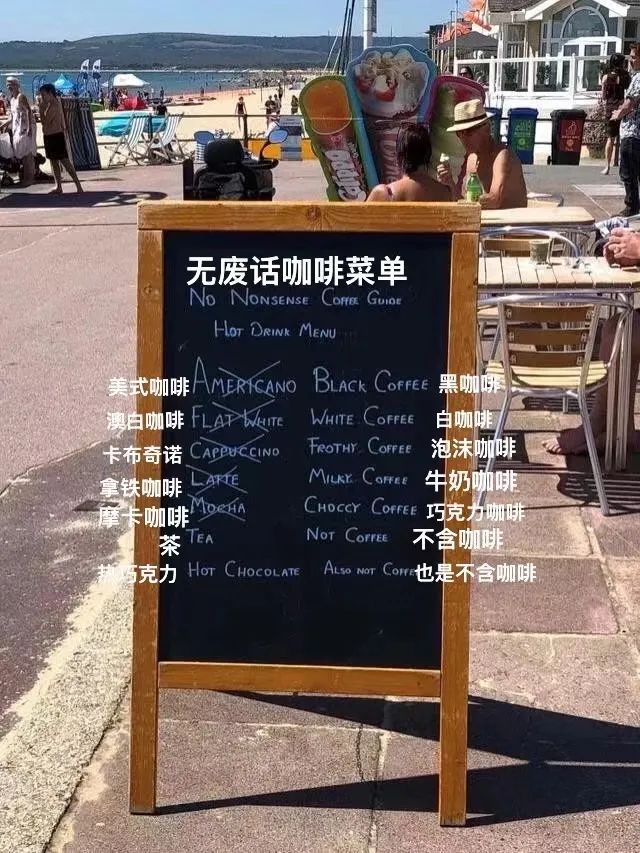
Earlier, a British coffee organization created a "no-nonsense coffee guide," which quickly sparked widespread discussion after being posted online. This guide used a big ✘ to cross out the names of common drinks on coffee shop menus, then immediately gave concise and straightforward explanations of the terms:
All of the above are classic items on coffee shop menus around the world, and almost every shop will have them all. As soon as the guide came out, it immediately received a large number of likes from netizens!
Many netizens sighed that if only they had come across such a simple and clear menu when ordering at a coffee shop for the first time, they would not have made fools of themselves...
Speaking of which, the ingredients of each type of coffee are clearly not complicated, and the methods are not particularly cumbersome either, so why are there so many different names? Below we will explore the origins and stories behind the names of popular coffee drinks from both a simple perspective and the perspective of coffee culture, and see exactly what kind of cup of coffee each one is~
Espresso / Italian Espresso Espresso
Simple understanding: super concentrated coffee liquid in an extremely small serving
Espresso comes from the past participle of the Italian word esprimere, traceable to the Latin exprimō, meaning "to press out." However, some linguists believe its meaning is closer to the English express, carrying the sense of "fast, exclusively personal." Although the two etymological interpretations differ, they happen to correspond to the two core characteristics of espresso.
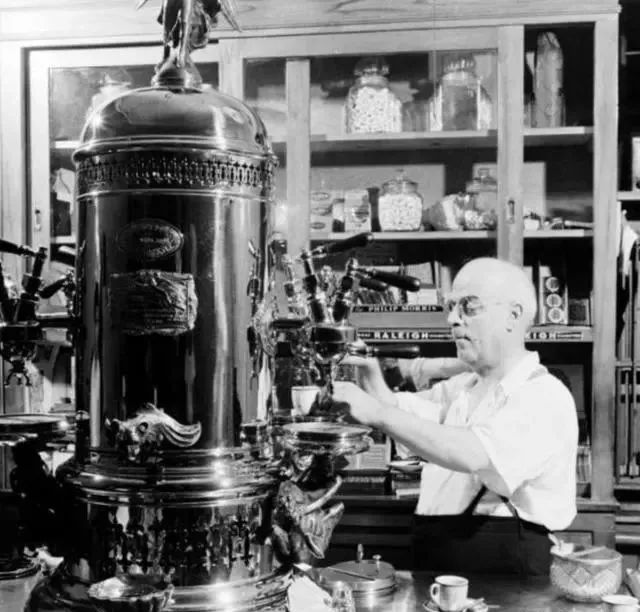
During the rapid development of the industrial age in the 18th and 19th centuries, everyone pursued efficiency. In order to quickly extract refreshing, mind-awakening coffee, Italians used the pressure generated by steam engines to make hot water rapidly pass through coffee grounds, thereby obtaining a rich coffee liquid. In 1884, a machine that used steam power to pressurize and extract coffee was successfully developed and patented, and this was the prototype of today's espresso machine.
Most espresso on the market is made from blended coffee beans, mainly considering controllable cost and stable flavor quality. As coffee lovers' demands for flavor continue to rise, some coffee shops now begin using single-origin coffee beans to make espresso, which is commonly known as SOE (Single Origin Espresso).
Core characteristics of espresso: it requires pressurized extraction, has an extremely small serving (usually only 15-40ml), is drunk without any dilution, is extremely concentrated, is covered on the surface with a rich golden crema, and has a strong taste and intense mouthfeel.
Americano Americano
Simple understanding: espresso diluted with water
It is said that during World War II, American soldiers in Italy were not used to drinking the local harsh and strong espresso, so they diluted the pressure-extracted coffee liquid with hot water before drinking it.
The English name of americano is Americano. The Cambridge Dictionary defines it as: a type of coffee drink made by adding hot water to espresso coffee, that is, adding hot water to espresso—simply put, espresso diluted with water is americano.
Characteristics of americano: based on espresso, diluted with water, with prominent coffee aroma, moderate concentration, and adjustable strength according to personal taste.
Caffe Latte / Coffee Latte
Simple understanding: milk coffee
Regarding the origin of latte, the most widely circulated saying is that in the early 20th century Italy invented the semi-automatic steam pressure coffee machine, adding steam-frothed milk to extracted espresso. Latte in Italian means "milk" (so not all lattes contain coffee), and therefore "Caffe Latte" originally expressed the combination of coffee (caffe) and milk (latte).
But some also argue that this kind of milk coffee was not first created by Italians. After the war between the Ottoman Empire and Vienna ended, Viennese people were not used to the way Turks brewed coffee, so they added milk and honey to it. Another saying holds that it came from the drinking habits of the Dutch when they were stationed in Indonesia in 1660, and still another says it was invented by the French when the Dutch brought coffee beans from Indonesia to France...
Regardless of its origin, the latte we drink today is made by combining espresso with steam-frothed milk. Therefore, the characteristics of latte: based on espresso, contains milk in the finished product, (when hot) has delicate and dense milk foam, balanced milk aroma and coffee aroma, and a mellow, smooth mouthfeel.
Cappuccino Cappuccino
Simple understanding: milk coffee with milk foam as dense as marshmallow
Cappuccino is the transliteration of "Cappuccino." This word comes from the Italian "Cappuccio"—hood. Sharp-eyed friends may have already noticed that the two words differ by only one letter, n, and this n is precisely the inspiration for cappuccino's appearance—the Capuchin Catholic Franciscan order.
When this order went to Italy to preach, they wore dark brown robes and small pointed hats made from folded hoods. Italians had a flash of inspiration: after frothing milk into dense, stable foam, they poured it into espresso, producing a ring in the cup close to the color of the robe, and then used a spoon to shape the surface milk foam into the form of a pointed hat.
Because Capuchin and Cappucci sound similar, Italians, without changing the rhythm of pronunciation, incorporated n into Cappuccio, and ultimately named this milk coffee with the word Cappuccino~
Characteristics of cappuccino: based on espresso, rich in milk in the finished product, (when hot) has thick and dense milk foam, balanced milk aroma and coffee aroma, and a mellow, dense mouthfeel.
Flat white / Small white / Flat white coffee Flat white
Simple understanding: milk coffee with a more prominent coffee flavor
From the Southern Hemisphere to global popularity, the origin of Flat white is still an old topic that Australia and New Zealand have debated for decades. Australian Alan Preston claims that he invented this coffee in 1985 when he opened Moors Espresso Bar in Sydney; New Zealand barista Fraser McInnes says that in 1989, while working at a cafe in Wellington, he accidentally made a cappuccino with insufficiently thick milk foam, and simply gave it a new name rather than correcting the mistake.
As for where the true birthplace is, it can no longer be verified. The Australian method uses a smaller (about 3oz) glass, combining a single shot of espresso with a small amount of steamed hot milk, with a milk foam thickness about half that of a latte. The New Zealand method uses a regular-sized glass, combining a double ristretto with steamed hot milk, with the milk foam also on the thin side.
Whichever school it belongs to, the characteristic of Flat white is: although it is also a mixture of milk and coffee, compared with latte and cappuccino, Flat white uses less milk, and the coffee flavor is more prominent! Therefore, friends who want to drink milk coffee but do not want to consume too much milk can choose Flat white—rich coffee taste, mellow and smooth mouthfeel~
Dirty coffee Dirty
Simple understanding: milk coffee served only iced, not stirred, with distinct layers and a rich coffee flavor
This is a coffee that only began to become popular around 2018. As the name suggests, visually the entire surface of the coffee is covered by the thick crema of espresso, creating the effect that the coffee liquid has dirtied the white milk.
Dirty emphasizes using refrigerated milk with a higher milk fat content, a chilled cup, and espresso that needs to float on the surface of the milk. Therefore, you should directly use an ice-cold cup filled with cold milk, then catch the extracted espresso at close range. Espresso is hot and carries a layer of crema, so it will float on the surface of the milk and gradually show a gradient effect.
The mouthfeel of Dirty changes dynamically, from strong to light, from deep to pale. The first sip is a strong coffee flavor, and the last sip is sweet. Therefore, after receiving a Dirty, do not leave it for too long, and do not stir it before drinking. If possible, try to finish a cup of Dirty in three sips and experience the charm of its gradual changes~
Mocha coffee (Coffee Mocha)
Simple understanding: milk coffee with chocolate/dark cocoa added
The word mocha comes from the Yemeni port of Mocha. Yemen was the first country in the world to cultivate and produce coffee beans on a large scale, and in the early 17th century it began exporting its first batches of coffee beans to Europe. At that time, Yemen had only one port leading to Europe—Mocha Port. Goods exported from here were all marked with "MOCHA" to prove they had been shipped from Mocha Port, so Europeans called the delicious coffee shipped from Mocha Port "mocha coffee."
Although mocha coffee beans are small in size, they have a very rich and fragrant flavor. The acidity is distinct, the body is strong with a fermented feel, the sweetness in the finish is moderate, and the aftertaste carries a rich dark cocoa aroma.
By the 18th century, Mocha Port was controlled by the Ottoman Empire (a multi-ethnic empire established by the Turks). The Turks especially loved Yemeni coffee, so fewer and fewer Yemeni coffee beans were exported to Europe. At that time, Italians deeply missed the rich cocoa aroma of mocha coffee beans, so they tried adding dark cocoa to espresso, thus setting off a new wave of mocha enthusiasm—espresso mocha coffee.
Characteristics of mocha coffee: based on espresso, with dark cocoa/chocolate added, most mocha coffee on the market is on the sweet side, and it has a rich, smooth, and sweet mouthfeel.
Hand Drip Hand Drip
Simple understanding: filtered coffee with overall balance, a clean mouthfeel, and distinct layers of aroma and flavor
Hand drip was first invented by German woman Melitta in the early 20th century. At the time, she was making coffee at home and had a sudden inspiration to use her son's blotting paper as filter paper to brew coffee grounds, unexpectedly extracting a cup of coffee with a flavor different from before.
After many improvements, in 1908 the Melitta filter paper and ceramic dripper obtained a German patent and became very popular in Europe, and people finally got to drink clean, sediment-free filtered coffee. Compared with espresso, drip coffee has a higher overall cleanliness, and you can also choose single-origin coffee beans suited to your personal taste preferences for brewing.
Nowadays, the choice of single-origin coffee beans is becoming more and more abundant, and many friends feel quite torn when choosing. Here is a little tip for choosing hand-drip coffee beans: if you like acidic, refreshing coffee, you can choose light-roast beans from Africa; if you like mild acidity and a mellow mouthfeel, choose beans from Central America; if you like no acidity at all, high body, and a solid mouthfeel, you can choose beans from Asia or island regions.
Remember, the more expensive the coffee beans, the better they taste is not necessarily true! What matters most is choosing what you like!! In flavor descriptions, those mainly featuring floral and fruity notes mostly have acidity; the more fruit descriptions, the higher the sweet-and-sour taste. Those mainly featuring nutty descriptions are mostly mildly acidic, and those without floral or fruity descriptions are mostly not acidic.
Cold Brew / Ice Drip Coffee Cold Blew/Ice Drip coffee
Simple understanding: iced coffee extracted at low temperature with a clean, full, and smooth mouthfeel
It is said that in 1660 Dutch sailors transported coffee back to Europe from the colony of Indonesia. On the way, because there was no hot water on board, they could not drink hot coffee, so they came up with the method of extracting coffee with cold water. The taste was mild and easy to drink, with an inviting aroma, and not only the sailors loved it, but ordinary people did too. Later, Japanese merchants adapted the background of this story into the origin of ice drip coffee.
Whether it is ice drip coffee or cold brew coffee, both use low-temperature extraction. Compared with other coffees extracted with hot water, cold water lacks heat to promote the movement of water molecules, and the bitter substances in coffee are difficult to release at low temperatures. Therefore, cold brew/ice drip coffee has a cleaner and more refreshing taste, and the long extraction time also allows the high-quality flavor substances in the coffee to be fully released, so it tastes very full.
Due to the long extraction time, the caffeine content of ice drip coffee/cold brew coffee is higher than that of drip coffee and espresso-style coffee, so friends in urgent need of a pick-me-up can choose them~
Image source: Internet
The above content is compiled by CoffeeHunters, a coffee news website.


