







What does blue mountain coffee mean on a vintage coffee menu?
A vintage-looking coffee menu circulating online lists a 68-yuan iced Americano next to a 58-yuan Blue Mountain coffee, which suggests the cheaper cup is not authentic Blue Mountain at all. True Blue Mountain coffee follows strict certification standards, while "Blue Mountain flavor" coffee is a different product made from other beans with similar tasting notes.
The same menu also touches on Yunnan arabica, Costa Rican regions like Tarrazú and Tres Ríos, and Hawaiian Kona coffee, which faces its own export issues. Price alone does not prove origin, so buyers should look for certification and traceable sourcing rather than relying on a menu label.
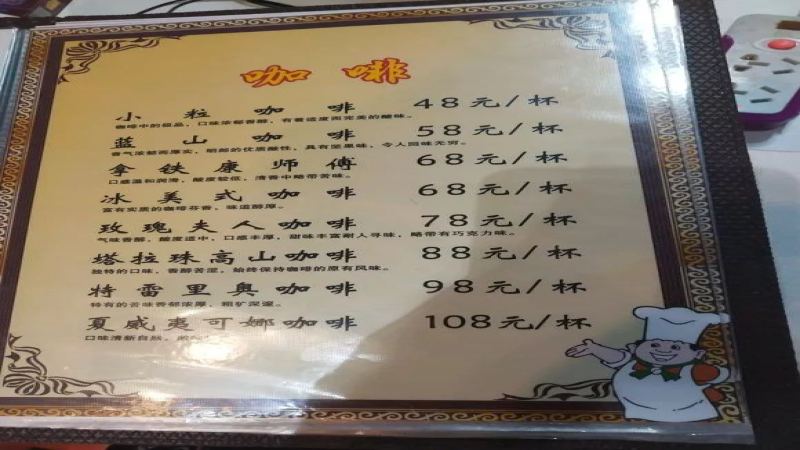
Recently, a coffee shop menu circulating online has sparked heated discussion, its retro layout and astonishing prices making people feel as if they've traveled through time. A 68-yuan iced Americano stands in stark contrast to a 58-yuan Blue Mountain coffee—is the shop being generous, or is there something else going on? This article will analyze the coffee knowledge behind this menu from a professional perspective: the true standards and certification system of Blue Mountain coffee, the essential difference between Blue Mountain flavor and authentic Blue Mountain, the characteristics of Yunnan arabica coffee, and the flavor profiles of Costa Rican regions such as Tarrazú and Tres Ríos. It will also address the current situation and export issues of Hawaiian Kona coffee, and provide coffee enthusiasts with Front Street Coffee's specialty bean recommendation channels.
Professional coffee knowledge exchange. For more coffee bean information, please follow the Coffee Workshop (WeChat public account: cafe_style).
For more specialty coffee beans, please add the private WeChat of Front Street Coffee: qjcoffeex
Recently, a coffee menu circulating online gave the author an instant illusion of being transported back fifteen years... Yet when my eyes swept over the price column, it felt as if I'd been yanked into the future...
In an era when coffee has long become part of everyday consumption, there's actually still a coffee shop using such a "vintage-feeling" menu design, and the prices on it left everyone who saw it speechless for a long time...
After looking through the prices, the author couldn't help but exclaim:
The shop owner is perfectly capable of just robbing you outright, yet chooses to give you a cup of iced Americano instead?!
Judging from the menu content, this shop mainly sells drip/brewed coffees and espresso-based drinks, but the pricing and flavor descriptions of every single beverage are somewhat jarring! This prompted the author to conduct a careful analysis of this menu.
A latte or iced Americano is priced as high as 68 yuan!!! Yet Blue Mountain coffee is only 58 yuan?! For a moment it's truly hard to tell whether the owner is being generous, or whether this "Blue Mountain coffee" is actually just Blue Mountain flavor coffee. In fact, these two categories of coffee cannot be equated at all. Blue Mountain flavor coffee ≠ Blue Mountain coffee!
According to the standards set by the Jamaica Coffee Industry Board (CIB), only coffee grown in the Blue Mountain range at altitudes above 2,200 feet (about 670 meters) qualifies to be called "Jamaica Blue Mountain Coffee." It is further graded based on bean size and defect ratio, in order: Blue Mountain No. 1, Blue Mountain No. 2, and Blue Mountain No. 3.
The export of Blue Mountain coffee beans must be handled through companies designated by the Jamaica Coffee Board, and the green beans must be shipped in wooden barrels. Relevant certification documents must also accompany the export (including the quality certificate issued by the Jamaica Coffee Board, the authorized sales certificate issued by the Blue Mountain coffee producer, and the Jamaica Blue Mountain Coffee certificate of origin).
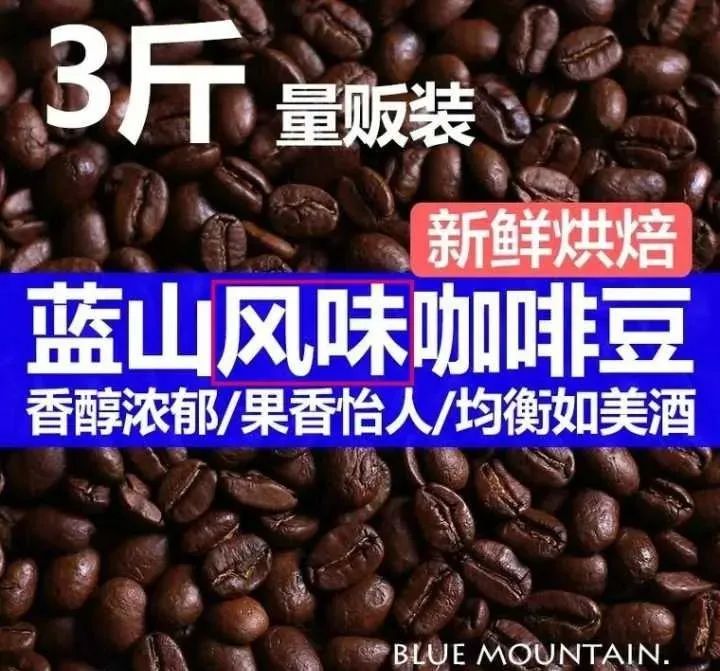
Due to limited annual production, authentic Blue Mountain coffee is naturally expensive... However, because of its extremely high profile, a large number of coffee products labeled "Blue Mountain flavor," "Blue Mountain coffee flavor," etc. have appeared on the market, or low-priced coffee beans... None of these can possibly be truly Blue Mountain coffee!
If a merchant lists Blue Mountain coffee on the menu and consumers cannot determine its authenticity, they can ask the merchant to produce the relevant certification documents for the coffee beans~ If it is indeed authentic Blue Mountain, then 58 yuan a cup can be considered quite a bargain! If not, the merchant would need to bear corresponding legal liability, such as selling counterfeit goods.
"Small bean coffee" originally refers to arabica coffee beans. Judging from the flavor description provided by the shop, this coffee bean has a rich, mellow taste with moderate and perfect acidity. Combined with its pricing, it should be a Yunnan-grown arabica coffee bean...
Regarding Rose Madame coffee, it's uncertain whether it refers to a relatively traditional French flavored coffee, "Rose Coffee"~ It uses espresso as a base, incorporates steamed milk, then tops it with whipped cream, and finally drizzles rose jam and garnishes with rose petals.
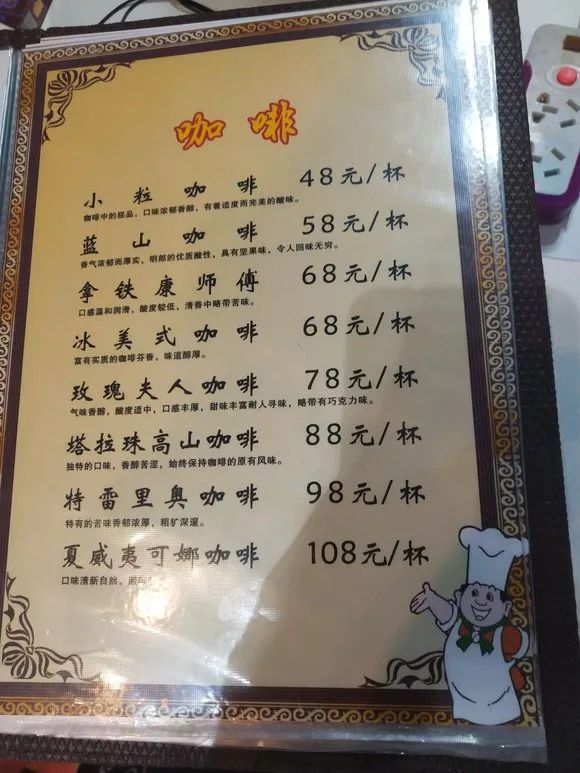
Regarding Tarrazú highland coffee, coffee beans from Costa Rica's Tarrazú region typically exhibit soft acidity along with nutty and caramel flavors. As for the use of the word "bitter," one can only say this shop owner has great confidence in their own product~
Regarding Terreo coffee, it is likewise a coffee from Costa Rica. "Terreo" refers to Costa Rica's Tres Ríos region... This shop adopted a transliteration of the region name, which nearly stumped the author.
Coffee from this region likewise has soft acidity along with nutty and caramel flavors, yet the menu describes it as rugged and profound—once again, one must admire this owner's courage! Truly.
The most normally priced item on the entire menu is none other than the last one, Kona coffee! (Provided it really comes from Hawaii's Kona.) But in recent years the situation in Hawaii has been unstable, and no Kona coffee has been exported through proper channels, so whether this coffee is authentic remains to be further verified.
After reading this menu, you can't call it outrageous—you can only say it gives one the feeling of shuttling back and forth between the 1980s-90s and the future~ As for the latte Master Kong, many netizens have said: Baishuishan and Nongfu Mountain refuse to accept this!!
From the menu, one can also see that the owner is someone who adheres to traditional coffee philosophy, but today's coffee consumers' level of understanding has greatly improved, and such a menu clearly can no longer adapt to the current market environment.
Image source: Internet
The above content is compiled by CoffeeHunters, a coffee news website.


