







Does blending coffee with dried osmanthus actually work in espresso?
Adding dried osmanthus to espresso works, but only in small amounts and only if the flowers sit in the right place in the puck. Tests with 20g of coffee grounds showed that 0.3-0.5g of dried osmanthus is the useful range. More than that disturbs the puck structure, and the extraction becomes uneven instead of floral.
Three setups were compared: osmanthus on the puck surface, at the bottom, and mixed through the grounds. The surface method gave the most stable extraction, the bottom method pushed the osmanthus aroma forward most clearly, and the mixing method tended to cause channeling. Dried edible osmanthus is cheap and easy to buy; fresh flowers must be dried before use.
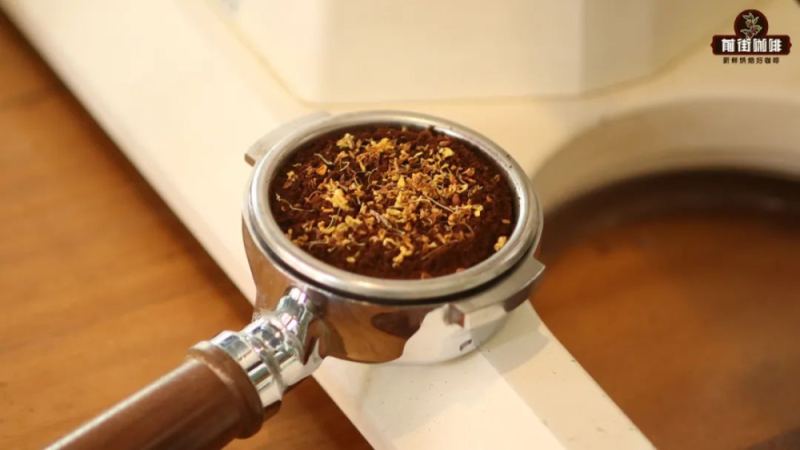
Osmanthus has a rich, intense aroma. If it is added to coffee grounds and extracted together, can this floral fragrance be infused into espresso? Front Street conducted three comparison experiments, placing dried osmanthus on the surface of the puck, at the bottom, and mixed with the coffee grounds, to observe extraction stability and flavor performance. The experiments found that the density of osmanthus differs greatly from that of coffee grounds, and both the amount used and its position affect the extraction result. For 20g of coffee grounds, it is recommended to add 0.3-0.5g of dried osmanthus; too much will instead disrupt the puck structure. The three methods each have their own characteristics: the surface method gives stable extraction, the bottom method gives a pronounced osmanthus aroma, and the mixing method easily causes channeling. Which method is ultimately most suitable for making an osmanthus latte? Let's look at the experimental results together.
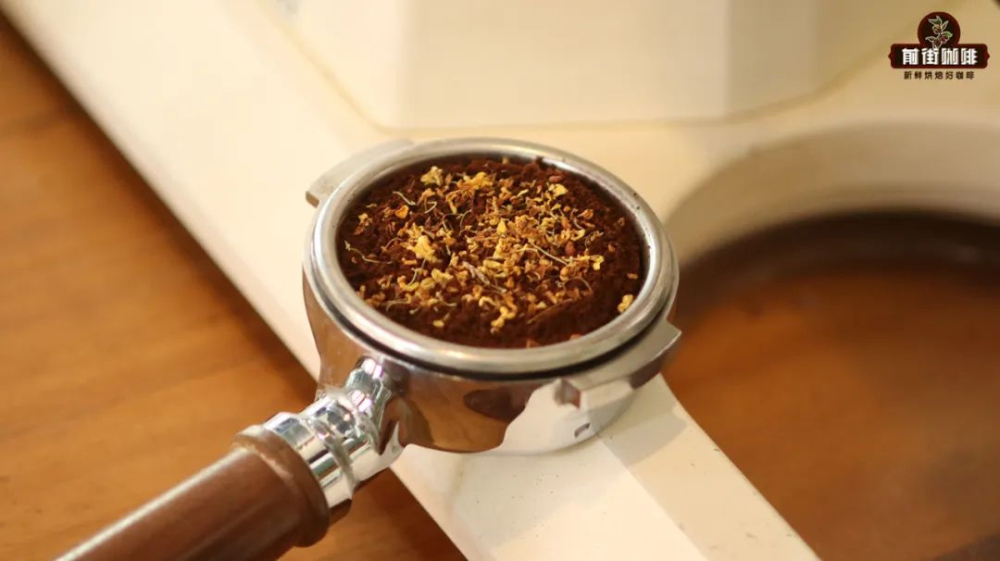
Why choose osmanthus? Osmanthus is a flower with an extremely rich fragrance, and the public generally accepts this scent very well. At the same time, osmanthus already has mature applications in the food field, such as osmanthus cake and osmanthus tea, which use it as an ingredient. In coffee bean flavor descriptions, osmanthus is also a common note. Many osmanthus-flavored coffee drinks on the market are actually made by blending coffee liquid with osmanthus-type flavorings. Since osmanthus itself has a prominent aroma, then trying to extract it together with coffee grounds may also give the coffee liquid an osmanthus flavor.
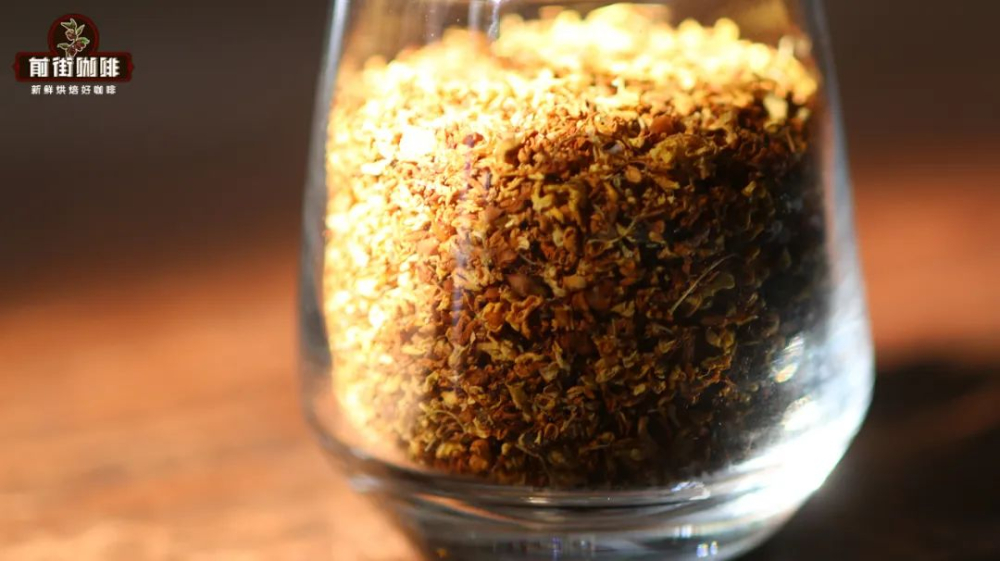
How much osmanthus is suitable to add? Front Street will first talk about choosing osmanthus. If you have an osmanthus tree at home, be sure not to pick fresh flowers and use them directly, because fresh osmanthus cannot be eaten directly and must be dried first; you can look up the specific method yourself. Of course, edible dried osmanthus is very easy to buy on e-commerce platforms, and a large bag can be purchased for just over ten yuan.
Adding osmanthus to coffee grounds is not aimed at getting the taste of osmanthus, but at letting the coffee you finally drink reveal the aroma of osmanthus. In fact, osmanthus steeped in water is very mild in taste and mainly presents a floral fragrance. Therefore, the amount only needs to ensure that the coffee has a faint, elusive osmanthus scent. Floral aromas like this are pleasant when delicate, but when too strong they feel pungent. In addition, osmanthus changes the density structure of the coffee puck, so more is not better. After repeated testing, Front Street found that adding 0.3-0.5g of dried osmanthus to 20g of coffee grounds is more suitable.
How to extract? The density and volume of osmanthus differ noticeably from those of coffee grounds, and there is a risk of channeling during extraction. Therefore, Front Street decided to verify which extraction method is better.
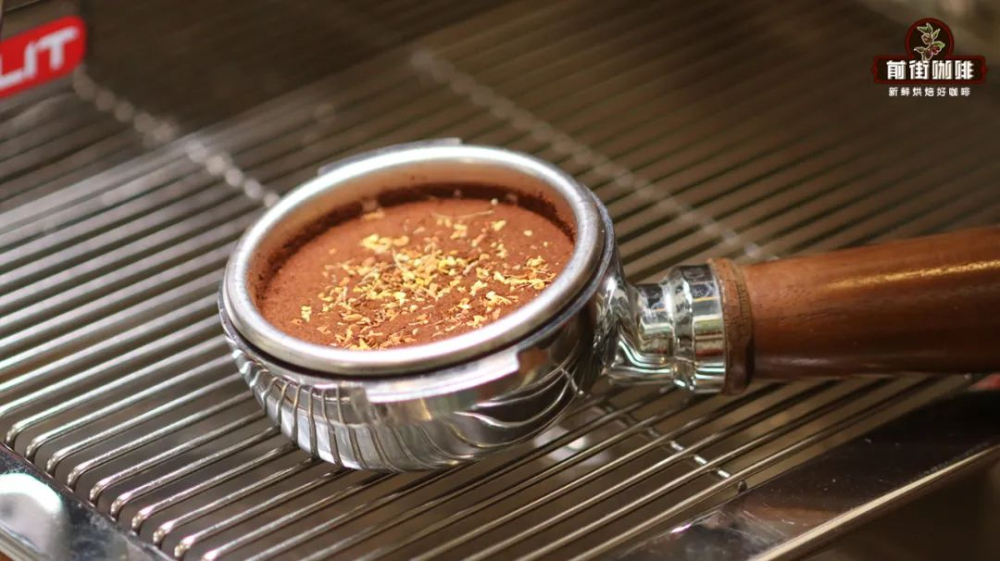
First method: place osmanthus on the surface The procedure is to first pour the coffee grounds into the portafilter basket, gently level them, then sprinkle dried osmanthus on the surface of the coffee bed, and tamp with the tamper.
The extraction process was very stable, with no channeling. The resulting espresso had a detectable osmanthus aroma. Looking at the puck after extraction, the surface structure was intact and gave off a rich osmanthus fragrance.
When this espresso was made into a hot americano according to ratio, a delicate osmanthus aroma could be tasted, very pleasant. But when made into a hot latte according to ratio, the osmanthus aroma was masked by the milk.
Second method: place osmanthus at the bottom This method is to first spread dried osmanthus at the bottom of the portafilter basket, then add the coffee grounds, and begin extraction after distributing and tamping.
The extraction process was generally stable, but some slight spitting occurred (channeling). The extraction time was basically the same as the first method. The resulting espresso had an obvious osmanthus aroma. Observing the puck after extraction, the osmanthus at the bottom had not separated and was integrated with the puck.
Both the americano and latte made from it had a perceptible osmanthus aroma.
Third method: mix osmanthus with coffee grounds Mix the coffee grounds with dried osmanthus, then pour into the portafilter basket, and extract after completing the distribution and tamping steps.
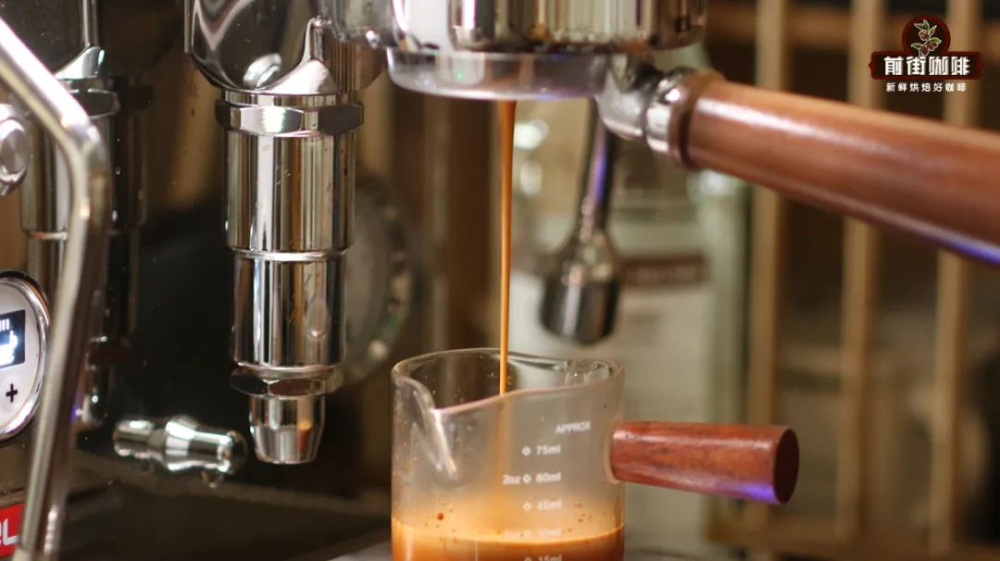
During extraction, the flow rate of the coffee liquid became unstable in the middle stage, accompanied by slight spitting (channeling). The extraction time was slightly faster by 1-2 seconds. Observing the coffee bed, cracks could be seen in the puck. Although not serious, this shows that mixing osmanthus into the coffee grounds does indeed affect the density structure and makes channeling more likely.
When made into americano, the taste was rather sour, which was caused by channeling and the slightly shorter extraction time. When made into latte, the coffee flavor was somewhat weaker. However, both had a perceptible osmanthus aroma.
From the experimental results, the extraction method with osmanthus placed at the bottom had the better effect, while the method with it placed on the surface was more stable. You might as well give it a try; the result is really amazing!
The above content is compiled by CoffeeHunters, a coffee news website.


